Diagnosis
Schistosomiasis
A parasitic disease caused by blood flukes (trematodes) of the genus Schistosoma.
Also known as: Bilharzia, Katayama fever, Katayama syndrome
Etiology
Cause [jv7][emo]
S haematobium, S mansoni, and S japonicum
Less prevalent species: S mekongi and S intercalatum
A trematode (parasitic flatworm commonly known as a blood fluke)
Pathophysiology [jv7][emo]
Freshwater snails release larva stage of schistosomes (cercariae)
The larva penetrate the human skin during contact with infested water
The larvae develop into adult schistosomes in vivo and digest erythrocytes
The minimally immunogenic adult worms live in the blood vessels and release eggs
Lifespan of 3 to 7 years (ranging from 20 to 290 eggs per day in S. haematobium)
Schistosomiasis is the pathologic immune reaction to Schistosoma eggs in the tissues
Antigens released from the egg stimulate a granulomatous reaction involving T cells, macrophages, and eosinophils
Results in fibrosis, organ damage and clinical disease
Symptoms and signs depend on the number and location of eggs trapped:
Intestinal: Worms in the mesenteric venules releases eggs into the intestines
Urogenital: Worms in the urogenital venules releases eggs into the urinary tract
Other: Skin, brain (embolization of eggs), muscle, adrenal glands, and eyes
Complications [jv7][emo]
Gastrointestinal bleeding
Gastrointestinal obstruction
Renal failure
Pyelonephritis
Bladder Cancer (2nd leading cause of bladder cancer worldwide) [emo]
Liver Cancer
Gallbladder Cancer
Sepsis
Pulmonary hypertension
Portal hypertension
Cor pulmonale
Neuroschistosomiasis
Infertility
Anemia
Spontaneous abortion
Ectopic pregnancy
Epidemiology
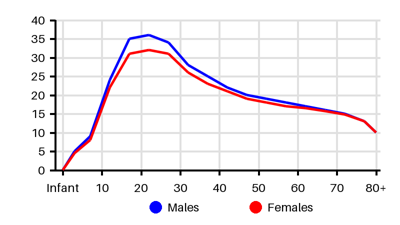
Incidence per 100.000 [uzb][rbg]
Symptoms & findings
Symptoms
Anorexia, Caput medusa, Cough, Diarrhea, Dizziness, Dyspepsia, Dyspnea, Dysuria, Edema, Fatigue, Fever, Headache, Hematemesis, Hematochezia, Hematospermia, Hematuria, Hepatomegaly, Lethargy, Lymphadenopathy, Malaise, Metrorrhagia, Muscle weakness, Myalgia, Nausea, Paresthesia, Seizure, Splenomegaly, Vaginal discharge, Weakness
Clinical findings
Anemia, Ascites, Elevated Intracranial Pressure, Eosinophilia, Esophageal varices, Granuloma, Portal hypertension, Pulmonary hypertension, Pyelonephritis, Urinary retention
Anamneses
None listed.
Localized findings
Approach
Blood test: Complete blood count, eosinophilia, GGT, transaminase, renal function
Blood culture
Urine culture
Stool culture
Urine PCR
Urine microscopy
Serelogy
Antigen test
Ultrasound abdomen
CT abdomen
CT thorax
CT/MRI caput
Echocardiography
Biopsy
Cystoscopy
Coloscopy
Gastroscopy
Bronchoscopy
Lumbar puncture
Treatment
Stabilize the patient [jv7][emo]
Treat acute complications: intestinal bleeding, renal failure, cardiac failure, bacteremia, and CNS complications
Antischistosomal drug:
Praziquantel 40 mg/kg (one dose) or 20 mg/kg every 4-6 hours for three doses
Corticosteroids: Reduce inflammation
Surgery: Removal of tumor masses, ligation of esophageal varices, porta-caval shunt surgeries, extirpation of granulomas in urinary bladder or lungs
Differential diagnoses
Acute pancreatitis, Appendicitis, Bladder cancer, Chlamydia, Cirrhosis, Clonorchiasis, Crohn disease, Drug side effects, Epididymitis, Epilepsy, Gastroenteritis, Glomerulonephritis, Gonorrhea, Heart failure, Herpes simplex, HIV, Leishmaniasis, Leukemia, Malaria, Pulmonary edema, Pulmonary hypertension, Pyelonephritis, Renal cell carcinoma, Salmonellosis, Serum sickness, Spinal cord infection, Trichinosis, Tuberculosis, Typhoid fever, Ulcerative colitis, Ulcer disease, Urinary retention, Urinary tract infection, Viral hepatitis
References
[1] http://emedicine.medscape.com/article/228392; [Medscape]
[2] Lackey EK, Horrall S. Schistosomiasis. [Updated 2023 Aug 7]. In: StatPearls [Internet]. Treasure Island (FL): StatPearls Publishing; 2025 Jan-. Available from: https://www.ncbi.nlm.nih.gov/books/NBK554434/
[3] Li Q, Li YL, Guo SY, Li SZ, Wang Q, Lin WN, Zhang LJ, Li SZ, Zhou XN, Xu J. Global trends of schistosomiasis burden from 1990 to 2021 across 204 countries and territories: Findings from GBD 2021 study. Acta Trop. 2025 Jan;261:107504.
[4] Dong, B., Hou, Z. & Lu, K. Schistosomiasis trends and control efforts: a global perspective from 1990 to 2050. Eur J Clin Microbiol Infect Dis (2025).