Diagnosis
Bladder cancer
Bladder carcinoma originating from the urothel (the lining of the urinary system from the renal pelvis to the urethra).
Also known as: Bladder carcinoma, Bladder tumor, Urothelial carcinoma
Etiology
Cause
Urothelial carcinoma (transitional cell carcinoma): 90% of the cases [3dh]
Rarely squamous cell carcinoma and adenocarcinoma
Very rare: Sarcoma of the bladder muscle, small cell carcinoma from the neuroendocrine cells
Pathophysiology [3dh]
Chronic inflammation (infection, toxic chemicals, carcinogenic molecules)
Increased cell turnover in the mucosa
Risk of DNA mutation in the critical areas
Genetic damage accumulates
Risk of malignant transformation
Tumor grade:
Cellular characteristics: low grade and high grade
Tumor invasiveness: Non-muscle-invasive and Muscle-invasive bladder cancer
Risk factors [3dh]
Age
Male
Cigarette smoking: >10 pack-years
Dye
Toxic chemical exposures: Aromatic amine, ydrocarbon, arsenic, benzene products, formaldehyde, nitrosamine, petrochemicals, rubber
Chronic inflammation
Chronic indwelling catheter
Recurrent urinary tract infection
Schistosomiasis
History of pelvic radiation
Chemotherapy: cyclophosphamide, ifosfamide
Metastasis (rare)
Genetics: family history of bladder cancer, Lynch syndrome, Peutz-Jeghers syndrome, or Cowden syndrome
Epidemiology
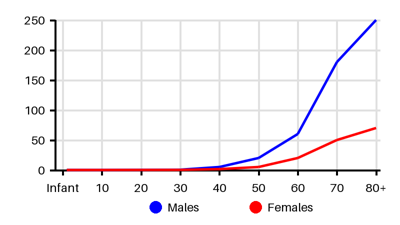
Incidence per 100.000 [nea]
Symptoms & findings
Symptoms
Dysuria, Hematuria, Polyuria, Urinary urgency
Clinical findings
Anemia, Bladder wall thickening, Hydronephrosis, Hydroureter, Ureteral obstruction, Urinary retention
Anamneses
None listed.
Localized findings
Approach
Urine stix
Urine cytology
Intravenous pyelography
Cystoscopy with tumor biopsy (photodynamic cystoscopy)
CT urography
MRI
PET-CT
Genetic test: FISH
Treatment
Low-grade, low-stage bladder cancer: [w4p]
A single instillation of intravesical chemotherapy such as Bacillus Calmette-Guérin
Cystoscopy controls
Muscle-invasive bladder cancer:
Radical cystectomy and pelvic lymphadenectomy
In comorbid patients: transurethral resection of bladder tumor (TUR-B)
Followed by concurrent radiation therapy
Then systemic chemotherapy
Metastatic Bladder Cancer: Systemic chemotherapy
Future treatment strategies:
Gene therapy
Immunotherapy
Differential diagnoses
Acute liver failure, Amyloidosis, Benign prostatic hyperplasia, Bladder cancer, Bladder exstrophy, Colovesical fistula, Diverticulitis, Hemangioma, Interstitial cystitis, Myoma uteri, Overactive bladder, Prostate cancer, Prostatitis, Renal cell carcinoma, Urinary tract infection, Urolithiasis
References
[1] Leslie SW, Soon-Sutton TL, Aeddula NR. Bladder Cancer. [Updated 2024 Aug 15]. In: StatPearls [Internet]. Treasure Island (FL): StatPearls Publishing; 2025 Jan-. Available from: https://www.ncbi.nlm.nih.gov/books/NBK536923/
[2] Saginala et al. Epidemiology of Bladder Cancer. Med Sci (Basel). 2020 Mar 13;8(1):15.
[3] http://emedicine.medscape.com/article/438262 (2014-01-02); [Medscape]
[4] Lakkis et al. Bladder Cancer in Lebanon: Incidence and Comparison to Regional and Western Countries. Cancer Control. 2018 Jan-Dec;25(1):1073274818789359.
[5] Song W, Jeon HG. Incidence of kidney, bladder, and prostate cancers in Korea: An update. Korean J Urol. 2015 Jun;56(6):422-8.