Diagnosis
Febrile seizure
Generalized seizures (typically in children between 6 months and 5 years) that occur with a fever greater than 38 °C. Not associated with:
Central nervous system infection
Seizure trigger (electrolyte imbalance, hypoglycemia, or substance abuse)
History of an afebrile seizure
Also known as: Febrile convulsion, Fever convulsion, Fever fit
Etiology
Cause [2es]
Genetic predisposition
Immaturity
Vulnerability of the central nervous system
Environmental factors:
Fever
Viral infection such as Roseolovirus, HHV-7, coronavirus, adenovirus, RSV, cytomegalovirus, shigella, herpes simplex virus
Bacterial infections
Vaccine
Pathophysiology
Seizure threshold is low at the time of brain development [children)
Frequent childhood infections: upper respiratory infection, otitis media, viral syndrome
Children respond with comparably higher temperatures
Classification [t5u]
Simple febrile seizures: generalized, last < 15 min and do not recur within 24 h
Complex febrile seizures: focal, prolonged, recur more than once in 24 h, may indicate a more serious disease process (meningitis, abscess, or encephalitis)
Febrile status epilepticus: a single seizure or series of seizures without interim recovery lasting at least 30 minutes
Febrile seizure risk factors [2es]
Existing neurologic impairment
Viral infection,
Family history of seizure
Developmental delay
Decreased serum zinc and iron levels
Maternal smoking and stress
Complications [2es]
Unexpected death
Subsequent epilepsy
Encephalopathy
Autism spectrum disorder
Intellectual disability
Attention-deficit/hyperactivity disorder
Tourette syndrome
Allergic rhinitis
Asthma
Epidemiology
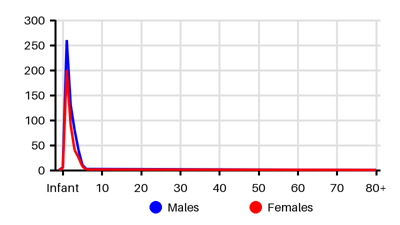
Incidence per 100.000 [uym][rfq][giv]
Symptoms & findings
Symptoms
Agitation, Amnesia, Confusion, Decreased consciousness, Fatigue, Fever, Seizure, Unconsciousness, Weakness
Clinical findings
None listed.
Anamneses
None listed.
Approach
Blood test
Blood gas
CT caput when complex febrile seizures
Lumbar puncture
EEG if recurring seizures
Treatment
Most febrile seizures resolve spontaneously without associated complications
Supportive care:
Airway management
High-flow oxygen
Anticonvulsants if necessary
Antipyretics as appropriate
Differential diagnoses
Acute disseminated encephalomyelitis, Basilar artery thrombosis, Brain abscess, Encephalitis, Epidural hematoma, Epilepsy, Meningitis, Otitis media, Pharyngitis, Sepsis, Stroke
References
[1] Xixis KL, Samanta D, Smith T, et al. Febrile Seizure. [Updated 2024 Jan 19]. In: StatPearls [Internet]. Treasure Island (FL): StatPearls Publishing; 2025 Jan-. Available from: https://www.ncbi.nlm.nih.gov/books/NBK448123/
[2] http://emedicine.medscape.com/article/801500 (2014-02-08); [Medscape]
[3] Christensen KJ, Dreier JW, Skotte L, Feenstra B, Grove J, Børglum AD, Mitrovic M, Cotsapas C, Christensen J. Seasonal Variation and Risk of Febrile Seizures: A Danish Nationwide Cohort Study. Neuroepidemiology. 2022;56(2):138-146.
[4] Christensen KJ, Dreier JW, Skotte L, Feenstra B, Grove J, Børglum A, Mitrovic M, Cotsapas C, Christensen J. Birth characteristics and risk of febrile seizures. Acta Neurol Scand. 2021 Jul;144(1):51-57.
[5] Byeon JH, Kim GH, Eun BL. Prevalence, Incidence, and Recurrence of Febrile Seizures in Korean Children Based on National Registry Data. J Clin Neurol. 2018 Jan;14(1):43-47.
[6] http://emedicine.medscape.com/article/1176205 (2014-02-08); [Medscape]
[7] Keum HR, Lee SJ, Kim JM, Kim SW, Baek HS, Byun JC, Kim YK, Kim S, Lee JM. Seasonal Trend of Viral Prevalence and Incidence of Febrile Convulsion: A Korea Public Health Data Analysis. Children (Basel). 2023 Mar 9;10(3):529.