Diagnosis
Meningitis
Inflammation of the meninges (dura mater, arachnoid, and pia mater).
Etiology
Cause [24b]
Bacterial: Streptococcus pneumonia, Haemophilus influenzae, Staphylococcus aureus, Neisseria meningitidis, Listeria monocytogenes, Escherichia coli, Pseudomonas aeruginosa, Tuberculosis, Syphilis
Viral: Enteroviruses (coxsackievirus, echovirus, coxsackievirus), Arboviruses (West Nile virus), Mumps (Paramyxovirus), Herpes family viruses (HSV-1, HSV-2, VZV, EBV, CMV, HHV-6), Adenovirus, Measles (Morbillivirus) and HIV
Fungal: Cryptococcus, Coccidioides immitis, Blastomyces dermatitidis, Histoplasma capsulatum, Candida species, S schenckii, Aspergillus, Candida, Mucormycosis
Parasitic: Amebic (Naegleria fowleri, Acanthamoeba, Balamuthia)
Lyme meningitis: Borrelia burgdorferi
Aseptic meningitis: NSAIDs, metronidazole, IV immunoglobulin and carcinomatosis
Pathophysiology [24b]
An agent can invade the CNS and cause meningitis via the following pathways:
Invasion of the bloodstream (hematogenous seeding of the CNS)
A retrograde neuronal pathway (Naegleria fowleri or Gnathostoma spinigerum)
Direct contiguous spread (sinusitis, otitis media, congenital malformations, trauma, surgery, osteomyelitic erosion)
The inflammatory response release free radical molecules that are cytotoxic
Neuronal damage: Ventriculitis, empyema, cerebritis, abscess, obliteration of CSF pathways causing hydrocephalus, vasculitis and thrombophlebitis
Elevated ICP:
Hydrocephalus: obliteration of CSF pathways
Cytotoxic edema: toxic factors from bacteria/neutrophils cause cellular swelling
Vasogenic edema: increased blood brain barrier permeability
Complications [24b]
Hearing loss
Blindness
Paralysis
Retardation
Focal neurologic deficits: Cranial nerve dysfunction, Ataxia, Seizure,
Hydrocephalus
Cerebral atrophy
Waterhouse-Friderichsen syndrome
Risk factors [24b]
Chronic medical disorders (renal failure, diabetes, adrenal insufficiency, cystic fibrosis)
Extremes of age: <5 years and >65 years
Incomplete vaccination
Immunodeficiency (transplant recipients, congenital immunodeficiency, AIDS)
Crowded conditions (military barracks, college dorms)
Exposures: Travel to endemic areas, vectors (mosquitoes, ticks)
Alcohol use disorder
Ventriculoperitoneal shunt
Endocarditis
Malignancy
Dural defects
IV drug use
Sickle cell anemia/thalassemia
Splenectomy
Sinusitis
Dural defect (trauma, surgery)
Epidemiology
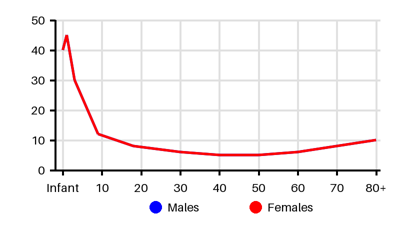
Incidence per 100.000 [1vq][vm1][zss][ymb][i6z]
Symptoms & findings
Symptoms
Anorexia, Arthritis, Brudzinski's sign, Coma, Confusion, Decreased consciousness, Delirium, Fatigue, Fever, Headache, Hypotension, Hypotonia, Irritability, Kernig's sign, Lymphadenopathy, Malaise, Myalgia, Nausea, Neck stiffness, Photophobia, Seizure, Somnolence, Tachycardia, Tachypnea, Tense fontanelle, Vomiting
Clinical findings
Elevated CRP, Elevated Intracranial Pressure, Hypocalcemia, Hyponatremia, Hyposmolality, Hypoxemia, Leukocytosis, Papilledema, Pleocytosis
Anamneses
None listed.
Localized findings
Approach
Blood test
Blood culture
Blood gas
Toxicology
Nasopharynx
Lumbar puncture: cell count, pH, lactate, protein, glucose, culture, PCR, microscopy, serology for antibodies
Viral: Multiplex and specific PCRs
Fungal: CSF fungal culture, India ink stain for Cryptococcus
Mycobacterial: CSF Acid-fast bacilli smear and culture
Syphilis: CSF VDRL
Lyme disease: CSF burgdorferi antibody
CT caput
MR caput
Brain biopsy
Treatment
Airway protection in case of altered mental status [6zi][24b]
Breathing: oxygen mask
Circulation: IV) access for crystalloid infusion
Obtain blood cultures (lumbar puncture/CSF unless signs of increased ICP)
Bacterial meningitis:
Antibiotic: [24b]
3rd generation cephalosporin: S pneumoniae and N meningitidis
Ampicillin: L monocytogenes
Vancomycin: penicillin-resistant S pneumoniae and S aureus
Age 0-4 wk: Ampicillin + Cefotaxime or Aminoglycoside + Acyclovir IV
Age 1 mo-50 y: Ampicillin/Vancomycin + Cefotaxime or Ceftriaxone
Age >50 y: Ampicillin + Vancomycin + Ceftriaxone or Cefotaxime
Intrathecal antibiotics: considered in meningitis after neurosurgery
Dexamethasone: 0.15 mg/kg every 6 hours for 2-4 days)
Viral menigitis:
CMV: Ganciclovir 5 mg/kg IV every 12 hours for 21 days
Enteroviruses: Immunoglobulin replacement in immunocompromised individuals
HSV: Acyclovir 10 mg/kg IV every 8 hours (controversial)
HIV: Antiretroviral therapy
Fungal menigitis:
Cryptococcal: Amphotericin B 0.7-1 mg/kg/day IV for at least 2 weeks + flucytosine (100 mg/kg orally) + Fluconazole 400 mg/day for 8 weeks
C immitis: oral fluconazole (400 mg/day)
Histoplasma capsulatum: Liposomal amphotericin B (5 mg/kg/day IV for a total of 175 mg/kg given over 4-6 weeks), followed by oral itraconazole (200-300 mg 2 or 3 times daily for at least 1 year
Candidal meningitis: Amphotericin B (0.7 mg/kg/day) + Flucytosine (25 mg/kg every 6 hours)
Sporothrix schenckii: Liposomal amphotericin B + itraconazole 200 mg x 2
Tuberculosis: Isoniazid 300 mg + Rifampin 600 mg/day + Pyrazinamide 15-30 mg/kg/day + Ethambutol 15-25 mg/kg/day + Streptomycin 7.5 mg/kg every 12 hours for 9 to 12 months
Syphilis: Penicillin G (2-4 million U/day IV every 4 hours for 10-14 days)
Parasitic meningitis: usually fatal, high-dose IV and intrathecal amphotericin B or miconazole and rifampin
Lyme meningitis: Ceftriaxone (2 g/day for 14-28 days)
Symptomatic treatment:
Fever
Pain
Increased ICP: elevate head, hyperventilation, furosemide 20 mg or mannitol 1 g/kg
Seizure
Hyponatremia (SIADH)
Cardiac arrhythmias and ischemia
Stroke
Exacerbation of chronic diseases
Prophylaxis: H influenzae vaccine, N meningitidis vaccines, Pneumococcal vaccine
Differential diagnoses
Brain abscess, Brain tumor, Delirium tremens, Encephalitis, Endocarditis, Epilepsy, Febrile seizure, Leptospirosis, Migraine, Stroke, Subarachnoid hemorrhage, Subdural empyema, Subdural hematoma, Syndrome of inappropriate antidiuretic hormone secretion, Systemic lupus erythematosus
References
[1] Hersi K, Gonzalez FJ, Kondamudi NP. Meningitis. [Updated 2023 Aug 12]. In: StatPearls [Internet]. Treasure Island (FL): StatPearls Publishing; 2025 Jan-. Available from: https://www.ncbi.nlm.nih.gov/books/NBK459360/
[2] GBD 2019 Meningitis Antimicrobial Resistance Collaborators. Global, regional, and national burden of meningitis and its aetiologies, 1990-2019: a systematic analysis for the Global Burden of Disease Study 2019. Lancet Neurol. 2023 Aug;22(8):685-711.
[3] Kojouharova M, Gatcheva N, Setchanova L, Robertson SE, Wenger JD. Epidemiology of meningitis due to Haemophilus influenzae type b in children in Bulgaria: a prospective, population-based surveillance study. Bull World Health Organ. 2002;80(9):690-5.
[4] Walling AD, Kallail KJ, Phillips D, Rice RB. The epidemiology of bacterial meningitis. J Am Board Fam Pract. 1991 Sep-Oct;4(5):307-11.
[5] Thigpen MC, Whitney CG, Messonnier NE, Zell ER, Lynfield R, Hadler JL, Harrison LH, Farley MM, Reingold A, Bennett NM, Craig AS, Schaffner W, Thomas A, Lewis MM, Scallan E, Schuchat A; Emerging Infections Programs Network. Bacterial meningitis in the United States, 1998-2007. N Engl J Med. 2011 May 26;364(21):2016-25.
[6] Giorgi Rossi, P., Mantovani, J., Ferroni, E. et al. Incidence of bacterial meningitis (2001–2005) in Lazio, Italy: the results of a integrated surveillance system. BMC Infect Dis 9, 13 (2009).
[7] http://emedicine.medscape.com/article/232915 (2014-01-14); [Medscape]