Diagnosis
Brain abscess
Abscess formation in the brain parenchyma due to bacterial infection.
Cerebritis is the early, non-encapsulated bacterial infection of brain tissue before the pus is fully walled off by a capsule forming a brain abscess.
Also known as: Cerebritis, Intracranial abscess
Etiology
Cause - The 3 mechanisms of entry into the brain [ukh]
Direct extension: Infections stemming from the sinuses, teeth, middle ear, or mastoid may gain access to the venous drainage of the brain. Due to improved antibiotic therapy for ear infections, this mechanism is decreasing in incidence, accounting for only approximately 12-25% of cases. However, in developing countries, this is still a significant source accounting for at least 50% of cases.
Microbe: Streptococcus, Bacteroides, Enterobacteriaceae, Pseudomonas, Fusobacterium, Prevotella, Peptococcus, Propionibacterium.
Hematogenous: Seeding of the brain occurs from distant infection sites and often results in multiple brain abscesses.
Microbe: Streptococcus viridans, Staphylococcus aureus, Fusobacterium, Corynebacterium, Peptococcus species, Klebsiella species, E coli + other Enterobacteriaceae, Streptococcus species, anaerobes and Pseudomonas.
Penetrating head injury or neurosurgery: A case series found that 37% of brain abscesses were associated with head penetration.
Microbe: Penetrating head injury or neurosurgery: Staphylococcus aureus, gram-negative bacilli, Staphylococcus epidermidis, Clostridium species, anaerobes, Pseudomonas and Propionibacterium acnes.
Opportunistic infection in immunecompromised state: Toxoplasma gondii, Nocardia, Aspergillus, and Candida species.
Pathophysiology
Entry to the brain parenchyma
Inflammation during the early cerebritis stage
Evolves into a necrotic collection of pus
Eventually surrounded by a well-vascularized capsule after 2 weeks --> abscess
Risk factors [sri]
Penetrating head trauma / neurosurgery
Infections: dental infection, ear, sinusitis, endocarditis, pneumonia
Intravenous drug use
Cardiac abnormalities
Congenital heart disease
Diabetes
Immunocomprimised: steroid use, HIV, immunosuppression
Alcoholism
Neoplasm
Epidemiology
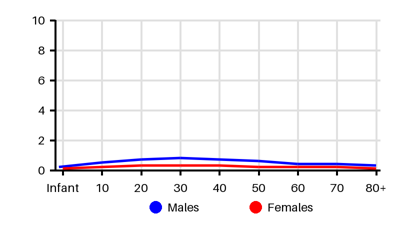
Incidence per 100.000 [sqw][npd][crc][asn][sri]
Symptoms & findings
Symptoms
Aphasia, Decreased consciousness, Diplopia, Facial nerve paralysis, Fever, Headache, Nausea, Neck stiffness, Paralysis, Paresis, Paresthesia, Photophobia, Scotoma, Seizure, Tense fontanelle, Visual disturbances, Vomiting
Clinical findings
Elevated CRP, Elevated Intracranial Pressure, Elevated Sedimentation Rate, Leukocytosis, Papilledema
Anamneses
None listed.
Localized findings
Approach
Blood test: complete blood count, platelet count, ESR, CRP, serological testing [ukh]
Blood culture
Lumbar puncture
CT caput
MR caput
MR Spectroscopy
Brain biopsy / culture
Treatment
Antibiotic treatment (i.v.) for 6–8 weeks [sri][ukh]
Neurosurgical aspiration: depends on the location, size (>2.5cm), and the clinical condition [sri]
Corticosteroids: Controversial due to its immunosuppressive effect. Consider if profound edema with brain shift and risk of cerebral herniation [sri]
Differential diagnoses
Brain tumor, Candidiasis, Cat scratch disease, Cerebral venous sinus thrombosis, Cluster headache, Cryptococcosis, Encephalitis, Epidural hematoma, Febrile seizure, Intracerebral hemorrhage, Malignant hypertension, Meningitis, Migraine, Multiple sclerosis, Mycotic cerebral aneurysm, Neurocysticercosis, Parasitic infestations, Retinal artery occlusion, Spinal cord infection, Stroke, Subarachnoid hemorrhage, Subdural empyema, Tension headache, Tuberculosis
References
[1] Hall WA, Mesfin FB. Brain Abscess. [Updated 2024 Sep 21]. In: StatPearls [Internet]. Treasure Island (FL): StatPearls Publishing; 2025 Jan-. Available from: https://www.ncbi.nlm.nih.gov/books/NBK441841/
[2] Brouwer MC, van de Beek D. Epidemiology, diagnosis, and treatment of brain abscesses. Curr Opin Infect Dis. 2017 Feb;30(1):129-134.
[3] Nicolosi et al. Incidence and prognosis of brain abscess in a defined population: Olmsted County, Minnesota, 1935–1981. Neuroepidemiology 1991; 10:122–131.
[4] Helweg-Larsen et al. Pyogenic brain abscess, a 15 year survey. BMC Infect Dis 2012; 12:332.
[5] Bodilsen et al. Incidence and mortality of brain abscess in Denmark: a nationwide population-based study. Clin Microbiol Infect. 2020 Jan;26(1):95-100.
[6] Laulajainen-Hongisto et al. Intracranial abscesses over the last four decades; changes in aetiology, diagnostics, treatment and outcome. Infect Dis (Lond) 2015; 1–7.
[7] http://emedicine.medscape.com/article/781021 (2014-01-16); [Medscape]
[8] Menon et al. Current epidemiology of intracranial abscesses: a prospective 5 year study. J Med Microbiol. 2008 Oct;57(Pt 10):1259-1268.