Diagnosis
Gastric lymphoma
A rare type of extra-nodal lymphoma in the stomach. Includes: [9me]
Mucosa-associated lymphoid tissue (MALT) lymphoma (low-grade)
Diffuse large B-cell lymphoma (DLBCL) (high-grade)
Mantle cell lymphoma (rare)
Follicular lymphoma (rare)
Etiology
Cause [pma]
H pylori (the most common)
Other infections: HIV, EBV, hepatitis B, and HTLV-1
Pathophysiology [pma]
A minority of patients with chronic H pylori-associated gastritis undergo this transformation
H pylori infection
--> Antigen stimulation
--> Recruits B-cells and T-cells to the gastric mucosa
--> Chronic inflammation
--> Malignant transformation into alow-grade gastric MALT lymphoma
--> Progress independently of the presence of H pylori
--> High-grade gastric lymphomas (DLBCL)
DLBCL has a worse prognosis than MALT lymphoma
Can arise from a transformation of MALT lymphoma or de novo
Classification [pma]
Mucosa-associated lymphoid tissue (MALT) lymphoma (low-grade)
Diffuse large B-cell lymphoma (DLBCL) (high-grade)
Mantle cell lymphoma (rare)
Follicular lymphoma (rare)
Epidemiology
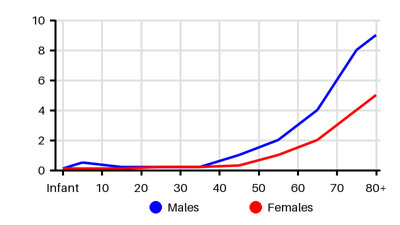
Incidence per 100.000 [tdc][un9][qh4][pma]
Symptoms & findings
Symptoms
Anorexia, Dysphagia, Fever, Hematemesis, Hematochezia, Lymphadenopathy, Melena, Nausea, Night sweats, Postprandial fullness, Vomiting, Weight loss
Clinical findings
Anemia, Elevated Lactic Dehydrogenase, Elevated Sedimentation Rate
Anamneses
None listed.
Localized findings
Approach
Blood test
Gastroscopy
Colonoscopy
Endoscopic ultrasound
Endoscopic biopsy with immunohistochemical testing
Bone arrow aspiration
CT
MRI
PET-CT
Staging
Stage I: Confined to the gastrointestinal tract
Stage II: Extending into the abdomen from the primary gastrointestinal site
Stage IIA: Local nodal involvement.
Stage IIB: Distant nodal involvement.
Stage III: Lymphoma penetrates the serosa to involve adjacent organs or tissues
Stage IV: Disseminated extranodal involvement or supradiaphragmatic nodal involvement
Treatment
Eradicate H pylori: two weeks of antibiotics and proton pump inhibitors [pma]
Early-stage low-grade gastric MALT lymphoma:
Endoscopic biopsy 3 to 6 months after H pylori eradication
Histologic remission may take 1 to 14 months post-H pylori eradication
If complete remission --> endoscopic biopsy every 6 months for the first 2 years
If incomplete eradication:
observation approach with gastric mapping biopsies every 3 to 6 months
localized radiation (remission rates >95%) or chemotherapy, with or without rituximab (screen for HIV, hepatitis B, and hepatitis C before starting rituximab)
90% survival at 10 years
High-grade gastric MALT lymphoma:
H pylori treatment alone may lead to the remission in a minority of patients
Observation approach with gastric mapping biopsies every 3 to 6 months
Or an aggressive strategy according to patient preference:
Observation with endoscopy and abdominal imaging every 6 months
Radiation, chemotherapy, or immunotherapy with rituximab
5-year survival: 70-99% (depending on histology, staging, comorbidities)
Surgery:
Acute bleeding not amenable to endoscopic therapy
Perforation
Obstruction
Differential diagnoses
Acute pancreatitis, Celiac disease, Cholelithiasis, Crohn disease, Diabetic gastroparesis, Diverticulitis, Gastric cancer, Gastritis, Gastroesophageal reflux disease, Menetriers disease, Pancreatic cancer, Ulcer disease
References
[1] Howell JM, Auer-Grzesiak I, Zhang J, Andrews CN, Stewart D, Urbanski SJ. Increasing incidence rates, distribution and histological characteristics of primary gastrointestinal non-Hodgkin lymphoma in a North American population. Can J Gastroenterol. 2012 Jul;26(7):452-6.
[2] Herlevic V, Reynolds SB, Morris JD. Gastric Lymphoma. [Updated 2024 Jul 11]. In: StatPearls [Internet]. Treasure Island (FL): StatPearls Publishing; 2025 Jan-. Available from: https://www.ncbi.nlm.nih.gov/books/NBK567799/
[3] Ducreux M, Boutron MC, Piard F, Carli PM, Faivre J. A 15-year series of gastrointestinal non-Hodgkin's lymphomas: a population-based study. Br J Cancer. 1998;77(3):511-4.
[4] Gurney KA, Cartwright RA, Gilman EA. Descriptive epidemiology of gastrointestinal non-Hodgkin's lymphoma in a population-based registry. Br J Cancer. 1999 Apr;79(11-12):1929-34.
[5] Ullrich A, Fischbach W, Blettner M. Incidence of gastric B-cell lymphomas: a population-based study in Germany. Ann Oncol. 2002 Jul;13(7):1120-7.