Diagnosis
Ulcer disease
Damage to the digestive tract (stomach or duodenum) with mucosal ruptures greater than 3–5 mm making the submucosa visible.
Also known as: Duodenal ulcer, Gastric ulcer, Peptic ulcer disease
Etiology
Cause [huc]
Gastric acid or pepsin cases the damage
Co-factors are usually essential to the mucous injury:
H.pylori (responsible for 90% of duodenal ulcers and ~80% of gastric ulcers)
Drug side effects: NSAIDs, SSRIs, corticosteroids, anticoagulants, bisphosphonates
Other rare causes:
Zollinger-Ellison syndrome
Malignancy (gastric/lung cancer, lymphomas)
Stress (acute illness, burns, head injury)
Viral infection
Vascular insufficiency
Radiation therapy
Crohn disease
Chemotherapy
Pathophysiology
Mucosal injury and peptic ulcer occur when the balance between the aggressive factors and the defensive mechanisms is disrupted
Aggresive factors: H.pylori, drug side effects (NSAIDs, SSRIs, corticosteroids, and anticoagulants), bile salts, smoking, alcohol, Zollinger-Ellison syndrome
Defensive mechanisms: bicarbonate secretion, mucus, mucosal blood flow, epithelial renewal
Once the protective superficial mucosal layer is damaged, the inner layers are susceptible to acidity
Helicobacter Pylori --> mucosal inflammation and host tissue damage
NSAIDs --> inhibit COX-enzyme --> block prostaglandin synthesis --> decreased gastric mucus and bicarbonate production and a decrease in mucosal blood flow
Alcohol --> irritate the gastric mucosa and induce acidity
Hypersecretion of acid:
Zollinger Ellison syndrome
Systemic mastocytosis
Cystic fibrosis
Hyperparathyroidism
Antral G cell hyperplasia
Clinical manifestation:
Epigastric abdominal pain
Bloating/dysphagia
Abdominal fullness
Nausea and vomiting
Weight loss/weight gain
Hematemesis
Melena
Complications [huc]
Bleeding
Perforation
Gastric cancer
Stenosis (Gastric outlet obstruction)
Epidemiology
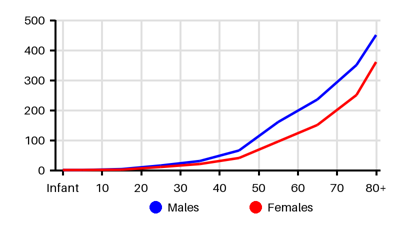
Incidence per 100.000 [wz9][gt9][onf][ygn][9pi][yyw][8an][9p6]
Symptoms & findings
Symptoms
Anorexia, Belching, Bloating, Dizziness, Dysphagia, Heartburn, Hematemesis, Hematochezia, Loss of appetite, Melena, Nausea, Odynophagia, Syncope, Vomiting, Weight loss
Clinical findings
Anamneses
None listed.
Localized findings
Approach
Blood test: Hb, liver function, amylase and lipase
Hemofec
Gastroscopy
Helicobacter pylori testing:
Serelogy
Urea breath test (high sensitivity and specificity)
Antibodies to H.pylori
Stool antigen test
Urine-based ELISA and rapid urine test
Endoscopic biopsy
CT abdomen if complications (perforation, GI obstruction)
Treatment
Lifestyle changes: NSAIDs, smoking, alcohol consumption [huc]
Antisecretory drugs: Proton pump inhibitor (PPI), H2 blocker
Eradication of H.pylori -> triple regimen comprising two antibiotics and a PPI:
Pantoprazole, clarithromycin, and metronidazole/amoxicillin for 7 to 14 days
If failure to response: Quadruple therapy with bismuth
Surgical treatment: if unresponsive to medical treatment
Vagotomy or partial gastrectomy
Differential diagnoses
Acute pancreatitis, Aortic dissection, Arteriovenous malformation, Cholangitis, Cholecystitis, Cholelithiasis, Chronic mesenteric ischemia, Chronic pancreatitis, Colorectal cancer, Crohn disease, Diverticulitis, Drug side effects, Esophageal perforation, Esophageal varices, Esophagitis, Functional dyspepsia, Gastric cancer, Gastritis, Gastroenteritis, Gastroesophageal reflux disease, Gastrointestinal obstruction, Gastrointestinal perforation, Hemobilia, Mallory-Weiss tear, Myocardial infarction, Perforated ulcer, Ruptured aortic aneurysm, Ulcerative colitis, Viral hepatitis, Volvulus, Zollinger-Ellison syndrome
References
[1] Malik TF, Gnanapandithan K, Singh K. Peptic Ulcer Disease. Updated 2023 Jun 5: https://www.ncbi.nlm.nih.gov/books/NBK534792/
[2] Sun J, Huang L, Li R, Wang T, Wang S, Yu C, Gong J. Comparison of Secular Trends in Peptic Ulcer Diseases Mortality in China, Brazil and India during 1990-2019: An Age-Period-Cohort Analysis. Healthcare (Basel). 2023 Apr 11;11(8):1085.
[3] Kurata JH, Nogawa AN, Abbey DE, Petersen F. A prospective study of risk for peptic ulcer disease in Seventh-Day Adventists. Gastroenterology. 1992 Mar;102(3):902-9.
[4] Sung JJ, Kuipers EJ, El-Serag HB. Systematic review: the global incidence and prevalence of peptic ulcer disease. Aliment Pharmacol Ther. 2009 May 1;29(9):938-46.
[5] Malmi H, Kautiainen H, Virta LJ, Färkkilä N, Koskenpato J, Färkkilä MA. Incidence and complications of peptic ulcer disease requiring hospitalisation have markedly decreased in Finland. Aliment Pharmacol Ther. 2014 Mar;39(5):496-506.
[6] García Rodríguez LA, Hernández-Díaz S. Risk of uncomplicated peptic ulcer among users of aspirin and nonaspirin nonsteroidal antiinflammatory drugs. Am J Epidemiol. 2004 Jan 1;159(1):23-31.
[7] Pérez-Aisa MA, Del Pino D, Siles M, Lanas A. Clinical trends in ulcer diagnosis in a population with high prevalence of Helicobacter pylori infection. Aliment Pharmacol Ther. 2005 Jan 1;21(1):65-72.
[8] Bartholomeeusen S, Vandenbroucke J, Truyers C, Buntinx F. Time trends in the incidence of peptic ulcers and oesophagitis between 1994 and 2003. Br J Gen Pract. 2007 Jun;57(539):497-9.
[9] Kang JY, Tinto A, Higham J, Majeed A. Peptic ulceration in general practice in England and Wales 1994-98: period prevalence and drug management. Aliment Pharmacol Ther. 2002 Jun;16(6):1067-74.
[10] Rosenstock SJ, Jørgensen T. Prevalence and incidence of peptic ulcer disease in a Danish County--a prospective cohort study. Gut. 1995 Jun;36(6):819-24.
[11] http://emedicine.medscape.com/article/181753 (2014-01-02); [Medscape]
[12] Lassen A, Hallas J, Schaffalitzky de Muckadell OB. Complicated and uncomplicated peptic ulcers in a Danish county 1993-2002: a population-based cohort study. Am J Gastroenterol. 2006 May;101(5):945-53.