Diagnosis
Gastric cancer
Cancer in stomach.
Also known as: Stomach cancer
Etiology
Pathophysiology [zss]
Chronic inflammation --> Precancerous lesions
Gastric ulcers
Atrophic gastritis
Pernicious anemia
Dysplasia --> carcinoma (a mass or a nonhealing ulcer)
Adenocarcinoma comprises 95% of malignant gastric cancer
Linitis plastica (leather bottle): extensive infiltration --> nondistended stomach
Disease often goes undiagnosed until its advanced stages due to the late onset of symptoms, complicating treatment and lowering survival rates
Risk factors [zss]
Chronic gastritis
H. pylori infection
Epstein-Barr virus
Gastric ulcer
Gastroesophageal reflux
Post-partial gastrectomy
Diet (salt --> gastritis, smoked or cured foods, contaminated drinking water)
Obesity
Cigarette smoking
Alcohol
Age
Environmental factors: Rubber manufacturing, tin mining, metal processing, and coal
Blood type A
Genetic factors (10% of stomach cancer cases are familial in origin)
Hereditary Nonpolyposis Colorectal Cancer
Familial Adenomatous Polyposis
Peutz-Jeghers syndrome
Li-Fraumeni syndrome
Hereditary breast and ovarian cancer syndrome
Cowden Disease
Epidemiology
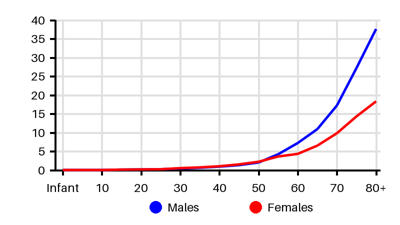
Incidence per 100.000 [vhd][tnc][ysw][9o9]
Symptoms & findings
Symptoms
Anorexia, Bloating, Dysphagia, Hematemesis, Hematochezia, Lymphadenopathy, Melena, Nausea, Postprandial fullness, Sister Mary Joseph's nodule, Virchow's node, Vomiting, Weight loss
Clinical findings
Anemia, Decreased Vitamin B12, Elevated CEA, Elevated Sedimentation Rate
Anamneses
None listed.
Localized findings
Approach
Blood test
Gastroscopy
Biopsy
CT abdomen
Endoscopic ultrasound
Pelvic exam
Rectal examination
Hemofec
Treatment
Treatment depends on: [cur]
The stage of the disease
The severity of symptoms
Wishes and preferences
General health
Endoscopic resection: Possible if the cancer is in the very early stages
Curative surgery: the best option if the cancer is stage 1, 2 or 3
Partial gastrectomy: Open or laparoscopic
Total gastrectomy: Open or laparoscopic
Chemotherapy before (down staging) or after surgery (reduce risk of recurrence)
Palliative care:
Feeding tube
Chemotherapy
Radiation therapy
Targeted therapy (Trastuzumab if HER2-positive stomach cancer)
Immunotherapy (stimulate the immune system to attack cancer cells)
Endoluminal stent placement
Endoluminal laser therapy
Gastrojejunostomy or gastric bypass
Differential diagnoses
Eosinophilic esophagitis, Esophageal cancer, Esophageal stricture, Esophagitis, Familial adenomatous polyposis, Gastric lymphoma, Gastritis, Gastroenteritis, Gastroesophageal reflux disease, Gastrointestinal stromal tumor, Menetriers disease, Pancreatic cancer, Pernicious anemia, Ulcer disease
References
[1] Menon G, El-Nakeep S, Babiker HM. Gastric Cancer. [Updated 2024 Oct 28]. In: StatPearls [Internet]. Treasure Island (FL): StatPearls Publishing; 2025 Jan-. Available from: https://www.ncbi.nlm.nih.gov/books/NBK459142/
[2] Rawla P, Barsouk A. Epidemiology of gastric cancer: global trends, risk factors and prevention. Prz Gastroenterol. 2019;14(1):26-38.
[3] Alghamdi IG. Epidemiology of gastric cancer in Saudi Arabia from 2004 to 2017. Mol Clin Oncol. 2023 Oct 4;19(5):93.
[4] Silva PFO, Souza BDSN, Melanda FN, Soares EFG, Bringhenti MV, Lima FCDS, Andrade ACS. Stomach cancer incidence and mortality in Greater Cuiabá, Mato Grosso, Brazil, 2000-2016. Rev Bras Epidemiol. 2022 Jun 24;25(Supl 1):e220015.
[5] Kim Y, Park J, Nam BH, Ki M. Stomach cancer incidence rates among Americans, Asian Americans and Native Asians from 1988 to 2011. Epidemiol Health. 2015 Feb 16;37:e2015006.
[6] https://emedicine.medscape.com/article/278744