Diagnosis
Pancreatic cancer
Cancer in the pancreas.
Etiology
Cause [mmq]
Sporadic DNA mutation --> cancer
Genetic mutations or association with syndromes: Lynch syndrome, Peutz-Jeghers syndrome, Von Hippel-Lindau syndrome, and MEN1
Classification of pancreatic cancer
Exocrine Pancreatic Cancer: 95% of all pancreatic cancer cases
Adenocarcinoma: 90%
Acinar cell carcinoma: 1-2%
Squamous cell carcinoma: Extremely rare
Adenosquamous carcinoma: 1-4%
Colloid carcinoma: 1-3%
Neuroendocrine Pancreatic Tumors/NET (Endocrine/islet cell tumors): <5%
Other rare types include:
Pancreatoblastoma: Mainly occurs in children
Sarcomas of the pancreas: Extremely rare cancers of the connective tissue
Lymphoma: Cancer of the lymphatic system that can develop in the pancreas
Benign/Precancerous: Mucinous pancreatic cysts
Pathophysiology [mmq]
Growing tumor in the pancreatic parenchyma
Two-thirds arise in the pancreatic head
One-third arise in the rest (body and tail)
Compression of the common bile duct --> Painless jaundice (50%)
Late symptoms:
Weight loss, pain, weakness, pruritus, distended gallbladder, pale stools, dark urine, DVT
Metastasis pattern: 52% have distant metastasis at the time of diagnosis
Regional lymph nodes, surrounding visceral organs such as the duodenum, stomach, colon, peritoneum, and the liver (less commonly to the lungs)
Risk Factors [cu7][mmq]
Age > 55 years
Male gender
Tobacco
Diabetes mellitus
Obesity
Diet (red meat, animal fat)
Alcohol abuse
Liver cirrhosis
Helicobacter pylori infection
Chronic pancreatitis
Physical inactivity
Work exposure to chemicals (dry cleaning and metalworking)
Complications [mmq]
After surgery:
Pancreatic fistula, ileus, anastomotic leak, bleeding, and infection
Epidemiology
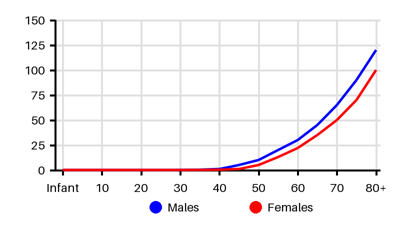
Incidence per 100.000 [neb][a82][w5r][7ek]
Symptoms & findings
Symptoms
Anorexia, Courvoisier's sign, Hepatomegaly, Icterus, Lymphadenopathy, Nausea, Pruritus, Sister Mary Joseph's nodule, Splenomegaly, Thrombophlebitis, Trousseau's sign, Virchow's node, Weight loss
Clinical findings
Ascites, Cholestasis, Double duct sign, Elevated ALP, Elevated Amylase, Elevated Bilirubin, Elevated CA 19-9, Elevated CEA, Elevated GGT, Elevated Lipase, Hyperglycemia, Jaundice
Anamneses
None listed.
Localized findings
Approach
Blood test
CT abdomen
ERCP
PTC
Angiography
Staging
Stage I: Tumor is located in the pancreas and does not extend elsewhere
Stage II: Tumor infiltrates bile duct and other near structures; however, lymph nodes are negative
Stage III: Any positive lymph nodes
Stage IVA: Metastases into nearby organs such as stomach, liver, diaphragm, adrenals
Stage IVB: Tumor infiltrates distant organs
Inoperability is decided on imaging by superior mesenteric artery encasement, liver metastases, peritoneal implants, distal lymph node metastases, and distant metastases.
Treatment
Surgical options: [xqf]
Pancreaticoduodenectomy (Whipple procedure), with/without pylorus
Total pancreatectomy
Distal pancreatectomy
Chemotherapy: if locally advanced unresectable tumor
FOLFIRINOX (folinic acid, 5-fluorouracil, irinotecan, oxaliplatin): Neadjuvant and and adjuvant
Albumin-bound paclitaxel plus gemcitabine
Irinotecan liposome with oxaliplatin, 5-FU, and leucovorin: metastatic disease
Gemcitabine monotherapy: palliative setting
Gemcitabine + capecitabine (GemCap): adjuvant with FOLFIRINOX-intolerance
Erlotinib plus gemcitabine: Third-line therapy
OFF (oxaliplatin, folinic acid, 5-FU): 2nd/3rd-line therapy
CapeOx (capecitabine, oxaliplatin): 2nd/3rd-line therapy
Larotrectinib or entrectinib: Tumors with NTRK fusions
Pembrolizumab (+/- ipilimumab): MSI-H or deficient mismatch repair or Lynch syndrome
Gemcitabine + cisplatin: BRCA1/2 or PALB2 mutations
Maintenance therapy:
Olaparib: deleterious germline BRCA-mutated metastatic pancreatic adenocarcinoma
Supportive care:
Pain relief: Non-opioid and opioid analgesics, celiac plexus lysis
Endoscopic interventions for biliary or duodenal obstruction
Dietary support: Management of pancreatic insufficiency
Behavioral support: Coping mechanisms, anxiety, depression
Differential diagnoses
Abdominal aortic aneurysm, Acute pancreatitis, Ampullary carcinoma, Benign bile duct tumor, Bile duct stricture, Cholangiocarcinoma, Cholangitis, Cholecystitis, Choledochal cysts, Choledocholithiasis, Cholelithiasis, Chronic mesenteric ischemia, Chronic pancreatitis, Cirrhosis, Gallbladder cancer, Gastric cancer, Gastric lymphoma, Gastrinoma, Glucagonoma, Hepatocellular carcinoma, Insulinoma, Pancreatic lymphoma, Primary biliary cirrhosis, Primary sclerosing cholangitis, Ulcer disease, VIPoma
References
[1] Puckett Y, Garfield K. Pancreatic Cancer. [Updated 2024 Sep 10]. In: StatPearls [Internet]. Treasure Island (FL): StatPearls Publishing; 2025 Jan-. Available from: https://www.ncbi.nlm.nih.gov/books/NBK518996/
[2] Khalaf N, El-Serag HB, Abrams HR, Thrift AP. Burden of Pancreatic Cancer: From Epidemiology to Practice. Clin Gastroenterol Hepatol. 2021 May;19(5):876-884.
[3] https://www.cancerresearchuk.org/health-professional/cancer-statistics/statistics-by-cancer-type/pancreatic-cancer/incidence
[4] Pancreatic cancer 1993-2021. Northern Ireland Cancer Registry, 2024.
[5] Fest J, Ruiter R, van Rooij FJ, van der Geest LG, Lemmens VE, Ikram MA, Coebergh JW, Stricker BH, van Eijck CH. Underestimation of pancreatic cancer in the national cancer registry - Reconsidering the incidence and survival rates. Eur J Cancer. 2017 Feb;72:186-191.
[6] Weble, T. C., Bjerregaard, J. K., Kissmeyer, P., Vyberg, M., Hansen, C. P., Holländer, N. H., & Johansen, C. (2017). Incidence of pancreatic cancer in Denmark: 70 years of registration, 1943–2012. Acta Oncologica, 56(12), 1763–1768.
[7] http://emedicine.medscape.com/article/280605 (2014-01-02); [Medscape]