Diagnosis
Inhalation injury
Damage to the respiratory tract caused by inhaling hot air, smoke, toxic gases, steam, combustible vapors, or particles in the mouth, nose, throat, and trachea.
Etiology
Cause [cuk]
Direct heat from fire
Toxic chemicals in the smoke: carbon monoxide, ammonia, carbon dioxide, hydrogen cyanide, aldehydes, sulfur dioxides, and nitrogen dioxide
Pathophysiology [t5c]
Carbon monoxide impairs tissue oxygenation by decreasing oxygen carrying capacity of blood, shifting oxygen-hemoglobin dissociation curve to the left, binding myoglobin and terminal cytochrome oxidase.
Upper airway injury:
Thermal injury --> erythema, ulcerations, edema and external compression of the airway
Damage of ciliary function impairs physiological clearance --> increased risk of bacterial infection
Increased production of thick secretions can cause distal airway obstruction, atelectasis, and impaired gas exchange
Tracheobronchial injury: usually caused by chemicals in smoke
Inflammatory response
Bronchoconstriction
Increased vascular permeability, and vasodilation
Exudate leading to alveolar collapse
Ventilation-perfusion mismatch as a primary mechanism of hypoxemia
Parenchymal injury:
Injury to the lung parenchyma is characterized by atelectasis and alveolar collapse resulting in increased transvascular fluid flux, a decrease in surfactant, and a loss of hypoxic vasoconstriction and therefore impaired oxygenation
Complications [cuk]
Pneumonia
Acute respiratory distress syndrome
Pulmonary edema
Subglottic stenosis
Bronchiectasis
Bronchiolitis obliterans
Brain damage (carbon monoxide poisoning)
Epidemiology
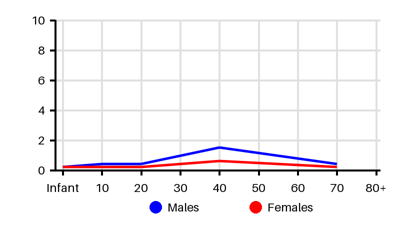
Incidence per 100.000 [fug][ak6][t5c][boz][q93][hws]
Symptoms & findings
Symptoms
Accessory muscles of respiration, Bronchorrhea, Burns, Carbonaceous sputum, Cough, Dizziness, Dyspnea, Hoarseness, Intercostal retraction, Nausea, Stridor, Tachypnea, Vomiting, Wheezing
Clinical findings
Anamneses
None listed.
Localized findings
Approach
Blood test: blood count, electrolytes, blood urea nitrogen, creatinine, lactate level, and toxicology screen
Blood gas: carboxyhemoglobin level (CO-oximetry), methemoglobin, cyanide
Chest x-ray
Nasopharyngoscopy
Direct laryngoscopy
Bronchoscopy
Ventilation-perfusion (V/Q) scan
Treatment
Respiratory support [fiv]
Fluid resuscitation and cardiovascular stabilization
Pain control
Local management of burn wounds
Profylaxis: thromboprophylaxis, antimicrobial therapy
Nutrition support
Treatment of complications: exacerbation of underlying medical comorbidities, sepsis, ileus, abdominal compartment syndrome, extremity compartment syndrome, pulmonary edema, adult respiratory distress syndrome, pressure-related wounds
Differential diagnoses
Acute respiratory distress syndrome, Asthma, COPD, Heart failure, Interstitial lung disease, Pneumonia, Pneumonitis, Pneumothorax, Pulmonary embolism
References
[1] Shubert J, Sharma S. Inhalation Injury. Available from: https://www.ncbi.nlm.nih.gov/books/NBK513261/
[2] https://www.uptodate.com/contents/inhalation-injury-from-heat-smoke-or-chemical-irritants
[3] Xiao, S., Pan, Z., Li, H. et al. The impact of inhalation injury on fluid resuscitation in major burn patients: a 10-year multicenter retrospective study. Eur J Med Res 29, 283 (2024).
[4] Barrow RE, Spies M, Barrow LN, Herndon DN. Influence of demographics and inhalation injury on burn mortality in children. Burns. 2004 Feb;30(1):72-7.
[5] Theodore E Habarth-Morales, Arturo J Rios-Diaz, Emily Isch, Shreyas Chandragiri, Lucy Qi, Roselind Ni, Edward J Caterson, Increased Incidence of Suspected Smoke Inhalation During the Coronavirus Disease 2019 Pandemic: A National Database Study, Journal of Burn Care & Research, Volume 44, Issue 4, July/August 2023, Pages 945–948.
[6] Dokter, J. (2016, December 20). Epidemiology of burns. Retrieved from https://hdl.handle.net/1887/45227
[7] Mason SA, Nathens AB, Byrne JP, Gonzalez A, Fowler R, Karanicolas PJ, Moineddin R, Jeschke MG. Trends in the epidemiology of major burn injury among hospitalized patients: A population-based analysis. J Trauma Acute Care Surg. 2017 Nov;83(5):867-874.
[8] https://www.uptodate.com/contents/overview-of-the-management-of-the-severely-burned-patient