Diagnosis
COPD
A progressive lung disease characterized by progressive airflow limitation and tissue destruction defined by the presence of:
Chronic bronchitis: obstructive ventilatory pattern (forced expiratory volume in 1 s (FEV1) to forced vital capacity (FVC) ratio <70%)
Chronic respiratory failure: chronic obstructive bronchitis with hypoxemia
Emphysema: destruction of the walls of the alveolar sacs/ducts beyond the terminal bronchiole with an abnormal increase in size of distal airways
Centrolobular emphysema is a result of the dilation or destruction of respiratory bronchioles. It is a form of emphysema associated with cigarette smoking.
Panlobular emphysema is more often associated with a deficit in α1-antitrypsin, and is the result of dilation or destruction of all the lobules.
Also known as: Chronic obstructive airway disease, Chronic obstructive lung disease, Chronic obstructive pulmonary disease
Etiology
Cause [wmf]
Prolonged exposure to harmful particles or gases
Cigarette smoking (the most common cause)
Second-hand smoke
Environmental and occupational exposures
Alpha-1 antitrypsin deficiency
Pathophysiology
Smoking/chronic inflammation -> free radicals -> oxidative stress -> apoptosis or necrosis -> activated leukocytes and macrophages -> elastase -> lung destruction -> inflammation and emphysema.
Chronic bronchitis in airways -> chronic productive cough -> narrowing of airway caliber -> loss of the alveolar supporting structure leads to further airway narrowing -> airflow obstruction and prolonged expiration
Emphysema in lung parenchyma -> permanent destruction of the alveolar walls and loss of alveoli -> loss of elastic recoil -> dramatic decline in the alveolar surface area available for gas exchange -> respiratory failure
Rapid circulation in a poorly ventilated lung (V/Q mismatch) --> hypoxemia, polycythemia, hypercapnia, respiratory acidosis, pulmonary artery vasoconstriction and cor pulmonale
Alpha1-antitrypsin: protect the lung parenchyma from elastolytic breakdown. Deficiency predisposes to elastolysis with the clinical sequela of an early onset of emphysema.
Complications [wmf]
Acute exacerbation of COPD
Acute and/or chronic respiratory failure
Pulmonary hypertension
Cor pulmonale
Weight loss
Bacterial infections
Adverse reactions to glucocorticoids
Epidemiology
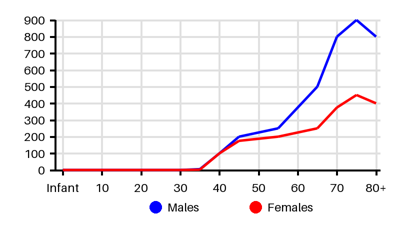
Incidence per 100.000 [sm9][1gv][esy][4kz]
Symptoms & findings
Symptoms
Anorexia, Bronchorrhea, Cough, Crepitations, Cyanosis, Decreased consciousness, Decreased respiratory sounds, Depression, Distant heart sounds, Dyspnea, Edema, Hoover's sign, Nail clubbing, Prolonged expiration, Tachypnea, Weight loss, Wheezing
Clinical findings
Acidosis, Anemia, Cardiomegaly, Cor pulmonale, Elevated Hematocrit, Elevated Jugular Venous Pressure, Heart failure, Hypercapnia, Hypoxemia, Osteoporosis, Polycythemia, Pulmonary bullae, Pulmonary hyperinflation, Pulmonary hypertension, Pulsus paradoxus, Respiratory acidosis
Anamneses
Approach
Blood test (BNP)
Blood gas
Pulse oximetry
ECG
Chest x-ray
CT thorax
MR thorax
Spirometry
Sputum culture
Echocardiography
Alpha1-antitrypsin
Bronchoscopy
Biopsy
Treatment
There is no cure for COPD, since the lung tissue damage is irreversible. Treatment allow improvement of health, relief of symptoms and prevention of deterioration of the lungs: [ll1]
Behavioral change: Stop smoking, avoid environmental pollutants
Medication:
Bronchodilators (Beta2 agonists and cholinergic/muscarinic antagonists)
Inhaled steroids (anti-inflamatory), Montelukast (anti-inflamatory)
Vaccines (flu and pneumonia)
Surgery:
Bullectomy: Giant bullae may compress adjacent lung tissue, thereby reducing blood flow and ventilation to healthier tissue.
Lung transplant in limited numbers of cases.
Severe Cases and Exacerbations: Airway, Breathing, Circulation. Systemic steroids (per oral or intravenous), bronchodilator, oxygen, breathing assistance through a mask, BiPAP or endotracheal tube, antibiotics to treat infections.
Differential diagnoses
Alpha1-antitrypsin deficiency, Asthma, Bronchiectasis, Bronchiolitis obliterans, Cystic fibrosis, Heart failure, Interstitial lung disease, Lung cancer, Pulmonary embolism, Tuberculosis
References
[1] Agarwal AK, Raja A, Brown BD. Chronic Obstructive Pulmonary Disease. [Updated 2023 Aug 7]. In: StatPearls [Internet]. Treasure Island (FL): StatPearls Publishing; 2025 Jan-. Available from: https://www.ncbi.nlm.nih.gov/books/NBK559281/
[2] Wang H, Ye X, Zhang Y, Ling S. Global, regional, and national burden of chronic obstructive pulmonary disease from 1990 to 2019. Front Physiol. 2022 Aug 9;13:925132.
[3] Leem AY, Park B, Kim YS, Jung JY, Won S. Incidence and risk of chronic obstructive pulmonary disease in a Korean community-based cohort. Int J Chron Obstruct Pulmon Dis. 2018 Feb 5;13:509-517.
[4] Afonso AS, Verhamme KM, Sturkenboom MC, Brusselle GG. COPD in the general population: prevalence, incidence and survival. Respir Med. 2011 Dec;105(12):1872-84.
[5] Rycroft CE, Heyes A, Lanza L, Becker K. Epidemiology of chronic obstructive pulmonary disease: a literature review. Int J Chron Obstruct Pulmon Dis. 2012;7:457-94.
[6] http://emedicine.medscape.com/article/297664 (2014-02-03); [Medscape]
[7] http://www.uptodate.com/contents/chronic-obstructive-pulmonary-disease-definition-clinical-manifestations-diagnosis-and-staging (2014-02-03); [Uptodate]
[8] Lindberg A, Eriksson B, Larsson LG, Rönmark E, Sandström T, Lundbäck B. Seven-year cumulative incidence of COPD in an age-stratified general population sample. Chest. 2006 Apr;129(4):879-85.