Diagnosis
Laryngeal cancer
Malignant tumors of the larynx and pharynx.
Etiology
Etiology [ncu]
Spontaneous
Genetic
Pathophysiology [ncu]
Larynx is responsible for: maintaining an open air way, vocalizing, swallowing, protection of the lungs from chemical and thermal exposure and Valsalva maneuver
Chronic inflammation --> increased cellular turnover --> increased risk of mutation --> squamous cell carcinoma
Classification: supraglottic, glottic, and subglottic
Risk factors [ncu][mk1]
Tobacco and alcohol (90% of overall mortality)
HPV-infection
Males
Age
Salt
Radiation
Laryngopharyngeal reflux
Epidemiology
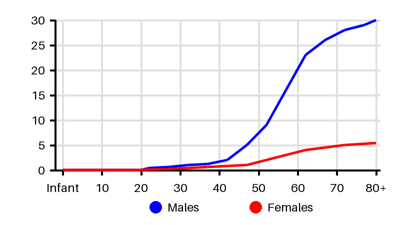
Incidence per 100.000 [mk1][swr][bam][nb1][n6h][ofi]
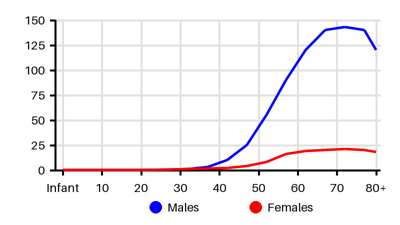
Prevalence per 100.000 [mk1][swr][bam][nb1][n6h][ofi]
Symptoms & findings
Symptoms
Anorexia, Aphonia, Cachexia, Dysphagia, Dysphonia, Dyspnea, Fatigue, Halitosis, Hemoptysis, Hoarseness, Lymphadenopathy, Odynophagia, Otalgia, Weakness, Weight loss
Clinical findings
None listed.
Anamneses
None listed.
Localized findings
Approach
Blood tests: Thyroid function, renal and hepatic function
Laryngoscopy (persistent hoarse voice for > 2 weeks
CT collum
PET-CT
MRI
Biopsy
Treatment
Treatment depends on the stage of the disease and the location of the primary tumor (glottic, supraglottic or subglottic). [ncu]
Carcinoma in situ or early stage invasive glottic or supraglottic cancer:
Endoscopic surgical excision or radiation therapy
Transoral laser microsurgery
Transoral robotic surgery
Early stage laryngeal carcinomas (stage I-II):
Radiation or laryngeal preservation resection
Open partial laryngectomy
Advanced-stage laryngeal carcinomas (stage III-IV):
Total laryngectomy, reconstruction, and adjuvant postoperative chemoradiation therapy
Laryngeal preservation resection + chemotherapy and radiation
Differential diagnoses
Acute laryngitis, Benign vocal cord lesion, Branchial cleft cyst, Croup, Epiglottitis, Gastroesophageal reflux disease, Hemangioma, Human papillomavirus, Laryngopharyngeal reflux disease, Lymphadenopathy, Reinkes edema, Sarcoidosis, Sialadenitis, Subglottic stenosis, Syphilis, Thyroglossal duct cyst, Tuberculosis, Wegener's granulomatosis
References
[1] Koroulakis A, Agarwal M. Laryngeal Cancer: https://www.ncbi.nlm.nih.gov/books/NBK526076/
[2] Nocini R, Molteni G, Mattiuzzi C, Lippi G. Updates on larynx cancer epidemiology. Chin J Cancer Res. 2020 Feb;32(1):18-25.
[3] da Fonte ALF, Costa GJ, da Fonte Neto AS, Pinto RA, de Mello MJG. Epidemiology of laryngeal cancer in Brazil: Historical data from 2000 to 2019. Cancer Epidemiol. 2023 Aug;85:102397.
[4] Li H, Wang Y, Zhu C, Wang X, Du L. Incidence and mortality of laryngeal cancer in Zhejiang cancer registry, 2000-2011. J Cancer Res Ther. 2015 Oct;11 Suppl 2:C155-60.
[5] Wünsch Filho V. The epidemiology of laryngeal cancer in Brazil. Sao Paulo Med J. 2004 Sep 2;122(5):188-94.
[6] Mousavi SE, Ilaghi M, Aslani A, Najafi M, Yekta Z, Nejadghaderi SA. Laryngeal cancer incidence trends in the United States over 2000-2020: a population-based analysis. Arch Public Health. 2024 Jul 10;82(1):106.
[7] Nahavandipour, A., Jakobsen, K. K., Grønhøj, C., Hebbelstrup Jensen, D., Kim Schmidt Karnov, K., Klitmøller Agander, T., von Buchwald, C. (2019). Incidence and survival of laryngeal cancer in Denmark: a nation-wide study from 1980 to 2014. Acta Oncologica, 58(7), 977–982.
[8] http://emedicine.medscape.com/article/848592 (2014-01-02); [Medscape]
[9] https://seer.cancer.gov/statfacts/html/laryn.html