Diagnosis
Malignant hyperthermia
A rare life threatning hyperthermia assosiated with hypermatabolic syndrome after exposure to anestethic agents.
Etiology
Cause [rrv][fmm]
Defect in the ryanodine receptor (inherited in autosomal dominant pattern)
Triggered by anestethic agents: Halothane, sevoflurane, desflurane, succinylcholine
Pathophysiology [rrv]
Impaired reuptake of calcium by sarcoplasmic reticulum in muscles
Uncontrolled lasting muscle activation
ATP depletion --> compromised muscle membrane
Severe hyperthermia (core temperature > 44°C) may occur
Increased oxygen consumption, carbon dioxide production, worsening metabolic acidosis, heart failure, bowel ischemia, compartment syndrome, myocyte death, rhabdomyolysis myoglobinuria, acute renal failure, life-threatening hyperkalemia and disseminated intravascular coagulation
Complications [rrv]
Brain damage
Cardiac arrest
Death
Heart failure
Internal bleeding
Kidney failure
Pulmonary edema
Skeletal muscle degeneration
Epidemiology
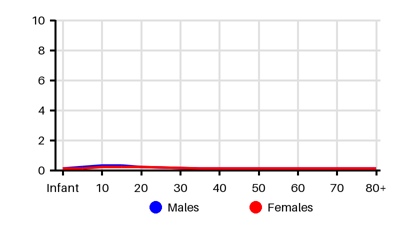
Incidence per 100.000 [fmm]
Symptoms & findings
Symptoms
Arrhythmia, Dark urine, Fever, Hyperthermia, Muscle hypertonia, Tachycardia, Tachypnea
Clinical findings
Acidosis, Elevated Creatine Kinase, Hypercapnia, Hyperkalemia, Hypoxemia
Anamneses
None listed.
Approach
Blood test
Blood gas
Elevation of end-expired carbon dioxide
Genetic test
Muscle biopsy and in vitro contracture test: contracture response to halothane, caffeine, and other drugs (caffeine halothane contracture test)
Treatment
Immediate discontinuation of trigger agents (inhalation agents, succinylcholine) [fmm]
Hyperventilation to lower ETCO2
Dantrolene initial dose 2.5 mg/kg repeated pro re nata, upper limit 10 mg/kg, titrate to tachycardia and hypercarbia, then 1 mg/kg every 4–8 hours for 24–48 hours
Cooling by all routes available:
Nasogastric lavage
Ice Packs to groin, axilla, and neck
Treat hyperkalemia and arrhythmias (do not use calcium channel blockers)
Insure urine output of 2 ml/kg/hour with mannitol, furosemide, and fluids as needed
Monitor blood gases, electrolytes, creatine kinase, blood and urine for myoglobin, coagulation profile
Evaluate need for invasive monitoring and continued mechanical ventilation
Observe patient in Intensive Care Unit for at least 36 hours
Differential diagnoses
Becker muscular dystrophy, Cocaine toxicity, Cystinosis, Diabetic ketoacidosis, Drug side effects, Duchenne muscular dystrophy, Febrile seizure, Heatstroke, Hyperthyroidism, Muscular dystrophy, Neuroleptic malignant syndrome, Pheochromocytoma, Rhabdomyolysis, Sepsis, Thyrotoxicosis
References
[1] Watt S, McAllister RK. Malignant Hyperthermia. [Updated 2023 Aug 17]. In: StatPearls [Internet]. Treasure Island (FL): StatPearls Publishing; 2025 Jan-. Available from: https://www.ncbi.nlm.nih.gov/books/NBK430828/
[2] Rosenberg H, Davis M, James D, Pollock N, Stowell K. Malignant hyperthermia. Orphanet J Rare Dis. 2007 Apr 24;2:21.
[3] Kim DC. Malignant hyperthermia. Korean J Anesthesiol. 2012 Nov;63(5):391-401.
[4] https://emedicine.medscape.com/article/2231150
[5] Brady JE, Sun LS, Rosenberg H, Li G. Prevalence of malignant hyperthermia due to anesthesia in New York State, 2001-2005. Anesth Analg. 2009 Oct;109(4):1162-6.
[6] Sumitani M, Uchida K, Yasunaga H, Horiguchi H, Kusakabe Y, Matsuda S, Yamada Y. Prevalence of malignant hyperthermia and relationship with anesthetics in Japan: data from the diagnosis procedure combination database. Anesthesiology. 2011 Jan;114(1):84-90.
[7] Litman RS, Rosenberg H. Malignant hyperthermia: update on susceptibility testing. JAMA. 2005 Jun 15;293(23):2918-24.
[8] Rosenberg H, Pollock N, Schiemann A, Bulger T, Stowell K. Malignant hyperthermia: a review. Orphanet J Rare Dis. 2015 Aug 4;10:93.
[9] Hopkins PM, Girard T, Dalay S, Jenkins B, Thacker A, Patteril M, McGrady E. Malignant hyperthermia 2020: Guideline from the Association of Anaesthetists. Anaesthesia. 2021 May;76(5):655-664.