Diagnosis
Hyperthyroidism
A syndrome associated with excess thyroid hormone production.
Etiology
Cause [kc1]
Graves autoimmune hyperthyroidism (most common in younger population)
Autoimmune disease with antibodies against the TSH receptor
Trophic effect --> thyroid gland hypertrophy
Toxic multinodular goiter (common in older population)
Nodular disease --> nodules develop autonomy for thyroid hormone production
Toxic adenoma:
Solitary nodules with autonomous thyroid hormone production due to somatic mutations in the TSH receptor
Iodine-induced hyperthyroidism (iodinated contrast, amiodarone, iodine supplements)
TSH-secreting pituitary adenoma
Conditions with high hCG levels:
Choriocarcinomas
Hydatiform moles in females
Germ cell tumors in males
Ovarian teratoma with ectopic thyroid hormone production
Extensive metastasis from functionally differentiated thyroid carcinoma
Drug-induced thyroiditis: amiodarone, lithium, tyrosine kinase inhibitors, interferon-alpha, immune checkpoint inhibitor therapy
Other thyroiditis: Hashitoxicosis, painless thyroiditis, painful subacute thyroiditis, suppurative thyroiditis, and Riedel thyroiditis
Factitious thyroiditis (due to excess exogenous thyroid hormone use)
Pathophysiology
Thyroid stimulating hormone (TSH) --> triiodothyronine (T3) and thyroxine (T4)
Excessive thyroid hormone:
Hyperadrenergic and hypermetabolic state
weight loss, palpitation, tremor, heat intolerance, anxiety, irritability, fatigue, muscle weakness, diarrhea, hair loss, loss of libido, and oligomenorrhea or amenorrhea
Complications [kc1]
Thyroid storm - an extreme case of hyperthyroidism
Cardiovascular events: atrial fibrillation, ischemic stroke
Osteoporosis
Infertility, abnormalities of menstrual cycles
Epidemiology
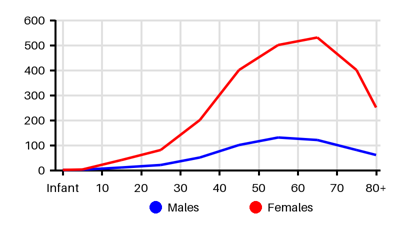
Incidence per 100.000 [kc1][uiu][vsu]
Symptoms & findings
Symptoms
Alopecia, Amenorrhea, Anxiety, Decreased libido, Diarrhea, Diplopia, Dyspnea, Fatigue, Fever, Heat intolerance, Hyperreflexia, Hypertension, Irritability, Muscle weakness, Nail clubbing, Oligomenorrhea, Palpitations, Tachycardia, Tremor, Weight loss
Clinical findings
Atrial fibrillation, Decreased TSH, Elevated T3, Elevated T4, Elevated TSH, Heart failure
Anamneses
None listed.
Localized findings
Approach
Blood test: TSH, free T4, total T3, thyrotropin receptor antibody (anti-TR/TRAb is elevated at Graves disease)
PET-scan with radioiodine thyroid uptake
Thyroid ultrasound
Treatment
Treatment of hyperthyroidism depends on the underlying etiology and severity: [kc1]
Overt hyperthyroidism
Subclinical hyperthyroidism (TSH <0.1)
Symptomatic treatment (palpitations, anxiety, and tremor):
Beta-adrenergic antagonist (or Calcium channel blockers)
Definitive treatments:
Antithyroid Drugs (Thionamide) block thyroid hormone synthesis:
Methimazole: 5-10mg/day (FT4 1-1.5 times of normal limit), 10-20 mg/day (FT4 1.5-2 times of normal limit), 30-40 mg/day (FT4 2-3 times of normal limit)
Carbimazole, Propylthiouracil (preferred during pregnancy)
Risk of remission: 20-50%
Radioactive iodine therapy: destruction of thyroid follicular cells
Contraindications for the use of thionamides and surgery (high-risk comorbidities)
Cannot be used during pregnancy and breast feeding
Subtotal thyroidectomy:
Indications: Pregnancy, Graves orbitopathy, side effects to thionamides, thyroid malignancy, large compressive goiters, co-existing hyperparathyroidism needing surgery
Graves disease and Toxic multinodular goiter: Near-total or total thyroidectomy
Toxic adenoma: Ipsilateral thyroid lobectomy or isthmusectomy
Differential diagnoses
Anxiety, Atrial fibrillation, Cocaine toxicity, Diarrhea, Graves disease, Hashimotos thyroiditis, Pheochromocytoma, Pituitary adenoma, Postpartum thyroiditis, Radiation, Struma ovarii, Subacute thyroiditis, Thyroid cancer, Toxic nodular goiter, Toxic thyroid adenoma, Wolff-Parkinson-White Syndrome
References
[1] Mathew P, Kaur J, Rawla P. Hyperthyroidism. https://www.ncbi.nlm.nih.gov/books/NBK537053/
[2] Ahn HY, Cho SW, Lee MY, Park YJ, Koo BS, Chang HS, Yi KH. Prevalence, Treatment Status, and Comorbidities of Hyperthyroidism in Korea from 2003 to 2018: A Nationwide Population Study. Endocrinol Metab (Seoul). 2023 Aug;38(4):436-444.
[3] Abraham-Nordling M, Byström K, Törring O, Lantz M, Berg G, Calissendorff J, Nyström HF, Jansson S, Jörneskog G, Karlsson FA, Nyström E, Ohrling H, Orn T, Hallengren B, Wallin G. Incidence of hyperthyroidism in Sweden. Eur J Endocrinol. 2011 Dec;165(6):899-905.