Diagnosis
Pheochromocytoma
A tumor arising from adrenomedullary chromaffin cells most commonly in the adrenal medulla (> 90%) that commonly produces catecholamines: epinephrine, norepinephrine, and/or dopamine [hz1][nsf]
Etiology
Cause [nth]
Sporadic (two-thirds)
Small percentage can be malignant)
Genetic:
MEN IIA and IIB
Von Hippel-Lindau disease
Neurofibromatosis
Pathophysiology [nth]
Catecholamines (dopamine --> norepinephrine --> epinephrine) are a group of hormones and neurotransmitters essential for maintaining homeostasis and regulating the body's response to stress
Intermittently or continuously excessive secretion
Episodic hypertension, headaches, diaphoresis, palpitations, sweating, and flushing
Hypertensive crisis: cardiovascular shock, stroke, myocardial infarction, or multiorgan failure
Asymptomatic (incidentaloma): 40%
Complications [nth]
Myocardial infarction
Cardiogenic shock
Cerebrovascular accident
Renal failure
Pulmonary edema
Acute respiratory distress syndrome
Cardiac arrhythmias
Lactic acidosis
Hypertensive retinopathy
Hypertensive encephalopathy
Seizures (in children)
Polydipsia (in children)
Polyuria (in children)
Cerebral vasculitis
Ischemic enterocolitis
Renal infarction
Anxiety
Depression
Epidemiology
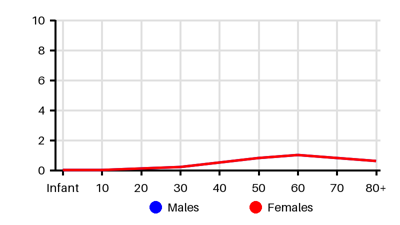
Incidence per 100.000 [pmc][a2o][23r][ivp][tcg][hzi][rsv][hz1]
Symptoms & findings
Symptoms
Anxiety, Cafe au lait spot, Constipation, Diaphoresis, Dizziness, Headache, Heat intolerance, Hypertension, Ileus, Nausea, Neurofibroma, Pallor, Palpitations, Polydipsia, Polyuria, Tachycardia, Tremor, Vomiting, Weakness
Clinical findings
Elevated Hematocrit, Elevated Hemoglobin, Elevated Metanephrines, Elevated Normetanephrines, Elevated Vanillylmandelic Acid, Polycythemia
Anamneses
None listed.
Localized findings
Approach
Blood test: plasma metanephrines [hz1][nsf]
Urine test: 24-h urinary catecholamines and metanephrines
Clonidine test
CT abdomen
MR abdomen
Scintigraphy
PET
Genetic screening
Treatment
Preoperative α-blockade: henoxybenzamine, prazosin, doxazosin, or urapidil [hz1][ket]
β-blockers after sufficient α-blockage due to vasoconstriction: propranolol or atenolol
Laparoscopic (adrenal sparing) resection
Embolization in Pheochromocytoma
Malignant pheochromocytoma: 5-year survival rates of 50% [ket]
Radical adrenalectomy
Myeloablative chemotherapy?
Differential diagnoses
Acute intermittent porphyria, Alcohol withdrawal, Angina pectoris, Anxiety, Arrhythmia, Autonomic neuropathy, Carcinoid syndrome, Carcinoid tumor, Cardiomyopathy, Cushing syndrome, Drug side effects, Epilepsy, Essential hypertension, Heart failure, Hyperaldosteronism, Hyperthyroidism, Hyperventilation, Hypoglycemia, Insulinoma, Lead toxicity, Mastocytosis, Meningioma, Menopause, Migraine, Orthostatic hypotension, Paroxysmal supraventricular tachycardia, POEMS syndrome, Polyneuropathy, Preeclampsia, Pulmonary edema, Renal artery stenosis, Stroke, Subarachnoid hemorrhage, Thyroid cancer
References
[1] Reisch N, Peczkowska M, Januszewicz A, Neumann HP. Pheochromocytoma: presentation, diagnosis and treatment. J Hypertens. 2006 Dec;24(12):2331-9.
[2] Lenders JW, Duh QY, Eisenhofer G, Gimenez-Roqueplo AP, Grebe SK, Murad MH, Naruse M, Pacak K, Young WF Jr; Endocrine Society. Pheochromocytoma and paraganglioma: an endocrine society clinical practice guideline. J Clin Endocrinol Metab. 2014 Jun;99(6):1915-42.
[3] Gupta PK, Marwaha B. Pheochromocytoma. [Updated 2024 Nov 7]. In: StatPearls [Internet]. Treasure Island (FL): StatPearls Publishing; 2025 Jan-. Available from: https://www.ncbi.nlm.nih.gov/books/NBK589700/
[4] Al Subhi AR, Boyle V, Elston MS. Systematic Review: Incidence of Pheochromocytoma and Paraganglioma Over 70 Years. J Endocr Soc. 2022 Jul 3;6(9):bvac105.
[5] Kim JH, Moon H, Noh J, Lee J, Kim SG. Epidemiology and Prognosis of Pheochromocytoma/Paraganglioma in Korea: A Nationwide Study Based on the National Health Insurance Service. Endocrinol Metab (Seoul). 2020 Mar;35(1):157-164.
[6] Berends AMA, Buitenwerf E, de Krijger RR, Veeger NJGM, van der Horst-Schrivers ANA, Links TP, Kerstens MN. Incidence of pheochromocytoma and sympathetic paraganglioma in the Netherlands: A nationwide study and systematic review. Eur J Intern Med. 2018 May;51:68-73.
[7] Beard CM, Sheps SG, Kurland LT, Carney JA, Lie JT. Occurrence of pheochromocytoma in Rochester, Minnesota, 1950 through 1979. Mayo Clin Proc. 1983 Dec;58(12):802-4.
[8] Yeo H, Roman S. Pheochromocytoma and functional paraganglioma. Curr Opin Oncol. 2005 Jan;17(1):13-8.
[9] Stenström G, Svärdsudd K. Pheochromocytoma in Sweden 1958-1981. An analysis of the National Cancer Registry Data. Acta Med Scand. 1986;220(3):225-32.
[10] Guerrero MA, Schreinemakers JM, Vriens MR, Suh I, Hwang J, Shen WT, Gosnell J, Clark OH, Duh QY. Clinical spectrum of pheochromocytoma. J Am Coll Surg. 2009 Dec;209(6):727-32.
[11] Lenders JW, Eisenhofer G, Mannelli M, Pacak K. Phaeochromocytoma. Lancet. 2005 Aug 20-26;366(9486):665-75.
[12] http://emedicine.medscape.com/article/124059 (2014-01-02); [Medscape]