Diagnosis
Scabies
A highly contagious skin infestation caused by Sarcoptes scabiei hominis producing intense nocturnal pruritus.
Etiology
Cause [2ir]
Infestation of the parasitic mite Sarcoptes scabiei hominis (8-legged arthropods measuring up to 0.45 × 0.35 mm)
Pathophysiology
Transmission of scabies is predominantly through direct skin-to-skin contact
Eggs -> Larvae -> Nymps -> Adult female
Proteolytic enzymes in the saliva lyses the stratum corneum
This enables intraepidermal tunnel/burrow (elevations in the superficial epidermis)
The mite ingest intercellular fluid that accumulates within the tunnel and lay eggs
Does not penetrate deeper than the superficial layer of the epidermis
Able to live on bedding, clothes, or other surfaces at room temperature for 2-3 days
Mite antigens trigger a delayed type IV hypersensitivity reaction in the dermis:
Intense nocturnal pruritus
Skin lesions: excoriated papules, eczematous or lichenified plaques, nodules and pathognomonic burrows (short, wavy white lines with a vesicle or erosion at the distal end that harbors the mite)
Risk factors [ttm]
Travel
Younger age
Low Socioeconomic status:
Refugees, asylum seekers
Lack of drinking water
Lack of appropriate hygiene, irregular use of showers
Illiteracy
Low family income, poor housing
Sharing clothes and towels
Complications [2ir]
Insomnia
Secondary bacterial infection (impetigo)
Superimposed cellulitis/abscess
Poststreptococcal glomerulonephritis
Epidemiology
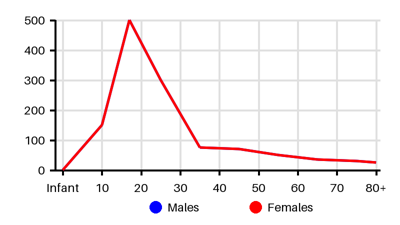
Incidence per 100.000 [vk7][sko][vzb][nhd][4ee][sms][fpn]
Symptoms & findings
Symptoms
Clinical findings
Anamneses
None listed.
Localized findings
Approach
Dermatoscope: Pruritic rash and characteristic linear burrows
Light microscopy of skin scraping to identify mites, larvae, ova, or scybala (feces)
Biopsy
PCR
Diagnostic criteria [2ir]
Suspected scabies: Characteristic rash and intense (nocturnal) pruritus
Clinical scabies: The above, plus visible burrows
Confirmed scabies: Previous criteria, plus visualization of mites, eggs, or feces
Treatment
Scabicidal agent: [ttm][2ir]
Permethrin (topical 5% cream) applied once weekly for 2 weeks
If age > 2 months: Sulfur ointment (5%-10%)
Ivermectin (oral) 200 μg/kg repeated after 14 days
Lindane 1% (neurotoxicity and hematologic sideeffects)
In case of secondary infection: Antimicrobial agent
Pruritus: Oral antihistamine (Atarax)
Differential diagnoses
Acropustulosis of infancy, Bullous pemphigoid, Chickenpox, Contact dermatitis, Dermatitis artefacta, Dermatitis herpetiformis, Dermatographism, Drug eruptions, Eczema, Erythroderma, Folliculitis, Gianotti-Crosti syndrome, Ichthyosis vulgaris, Impetigo, Insect Bite, Kyrle disease, Langerhans cell histiocytosis, Leukemia, Lice, Lichen planus, Lymphoma, Mastocytosis, Necrotizing vasculitis, Parapsoriasis, Parasitic infestations, Pemphigus vulgaris, Prurigo nodularis, Psoriasis, Seabathers eruption, Syphilis, Systemic lupus erythematosus, Urticaria
References
[1] Ziebold C, Crane JS. Scabies. [Updated 2025 Dec 13]. In: StatPearls [Internet]. Treasure Island (FL): StatPearls Publishing; 2025 Jan-. Available from: https://www.ncbi.nlm.nih.gov/books/NBK544306/
[2] http://emedicine.medscape.com/article/1109204; [Medscape]
[3] Zhang W, Zhang Y, Luo L, Huang W, Shen X, Dong X, Zeng W, Lu H. Trends in prevalence and incidence of scabies from 1990 to 2017: findings from the global Burden of disease study 2017. Emerg Microbes Infect. 2020 Dec;9(1):813-816.
[4] Li J, Liu Z, Xia X. The disability-adjusted life years (DALYs), prevalence and incidence of scabies, 1990-2021: A systematic analysis from the Global Burden of Disease Study 2021. PLoS Negl Trop Dis. 2024 Dec 26;18(12):e0012775.
[5] Pannell RS, Fleming DM, Cross KW. The incidence of molluscum contagiosum, scabies and lichen planus. Epidemiol Infect. 2005 Dec;133(6):985-91.
[6] Ristić, M., Štrbac, M., Dragić, N., Šeguljev, Z., Dragovac, G., Ilić, S., & Petrović, V. (2017). Frequency and distribution of scabies in Vojvodina, Serbia, 2006-2015. Srpski Arhiv Za Celokupno Lekarstvo, 145, 503-507.
[7] Yun-ji Lee, Yoonsung Lee, Man S Kim, Bark-Lynn Lew, Soon-Hyo Kwon Epidemiology of Scabies in Korea (2010~2021): An Updated Report. JMI [Internet]. 2023. Dec ; 28 (4).
[8] Aždajić MD, Bešlić I, Gašić A, Ferara N, Pedić L, Lugović-Mihić L. Increased Scabies Incidence at the Beginning of the 21st Century: What Do Reports from Europe and the World Show? Life (Basel). 2022 Oct 13;12(10):1598.
[9] Amato E, Dansie LS, Grøneng GM, Blix HS, Bentele H, Veneti L, Stefanoff P, MacDonald E, Blystad HH, Soleng A. Increase of scabies infestations, Norway, 2006 to 2018. Euro Surveill. 2019 Jun;24(23):190020.