Diagnosis
Spinal disc herniation
Herniation of intervertebral disk material that is displaced into the spinal canal causing nerve compression and inflammatory response.
Also known as: Cervical radiculopathy, Disc herniation, Lumbar radiculopathy, Lumbosacral radiculopathy, Radiculopathy, Sciatica
Etiology
Cause [qry]
Progressive degeneration of the intervertebral disks with age
Trauma
Connective tissue disorders
Congenital disorders (short pedicles)
Pathophysiology [qry]
The intervertebral disks is typically 7 to 10 mm thick and 4 cm in diameter and act as shock absorbers between the vertebrae
They have a central area composed of a colloidal gel (nucleus pulposus) which is surrounded by a fibrous capsule (annulus fibrosis)
This structure is held together by the anterior longitudinal ligament and the posterior longitudinal ligament
Mechanical degeneration
Thinning and weakening of the posterior longitudinal ligament
Alterations in capillaries, cell morphology, density within the nucleus pulposus
Formation of small clefts in the annulus fibrosus
Loss of disk height
Herniation of nucleus pulposus --> nerve compression and inflammatory response
Most common in the lumbar/cervical spine (biomechanical stress in flexible areas)
Posterolateral (lack of structural support from the longitudinal ligaments)
Clinical manifestation depend on the level and severity of compression
Back pain
Radiculopathy (nerve compression)
Sensory disturbances
Motor weakness
Myelopathy (spinal cord compression/dysfunction)
Bilateral affection of extremities
Coordination/balance
Bowel and bladder dysfunction
Risk factors [uq3][qry]
Middle age (30-50 years)
Activity
Heavy lifting
Cumulative occupational lumbar load from forward bending postures
Smoking
Obesity
Vibration
Sedentary lifestyle
Psychosocial factors
Complications [qry]
Chronic back pain
Prolonged nerve damage
Recurrence
Complications of surgery: paralysis
Epidemiology
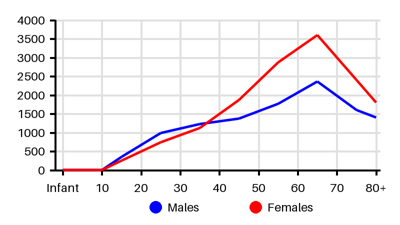
Incidence per 100.000 [nit][ssr][uq3][g4a][gcp][ibe]
Symptoms & findings
Symptoms
Ataxia, Foot drop, Hyporeflexia, Lasegue's test, Paresis, Paresthesia
Clinical findings
Anamneses
Localized findings
Approach
Neurology: motor, sensory, reflex, anal sphincter tone
Vascular status
Blood test: Sedimentation rate, ALP, calcium, serum protein electrophoresis
MRI
CT
Treatment
Cervical radiculopathy: [nit][yob]
Non-surgical treatment is the initial treatment of choice with good to excellent outcomes in up to 90% of patients:
Immobilization
Physiotherapy, traction, acupuncture, chiropractic manipulation
Medications: NSAIDs, acetaminophen, gabapentin, temporary low-dose opiates, systemic steroids, cervical steroid injection
Surgery: progressive neurologic deficits or signs of myelopathy
Lumbosacral radiculopathy: Mostly resolve spontaneously with conservative care [qry]
Non-surgical treatment is prefered:
NSAIDs
Physical therapy and structured exercise programs
Surgery:
Epidural corticosteroid injections are effective for short-term pain management
Diskectomy (surgical intervention is less effective after 1 year)
Chemonucleolysis
Spinal fusion
Differential diagnoses
Acute extremity ischemia, Angina pectoris, Aortic dissection, Cauda equina syndrome, Chronic limb ischemia, Compression fracture, Constipation, Discitis, Diverticulitis, Ependymoma, Epidural abscess, Epidural hematoma, Hemangioma, Herpes zoster, HIV, Lipoma, Lyme disease, Lymphoma, Metastatic bone tumors, Multiple myeloma, Neurofibroma, Osteoblastoma, Osteomyelitis, Osteosarcoma, Paraganglioma, Pelvic fracture, Pelvic inflammatory disease, Rheumatoid arthritis, Ruptured aortic aneurysm, Sickle cell disease, Spinal cord infection, Spinal cord injury, Spinal cord tumor, Spinal stenosis, Spondylolisthesis, Spondylolysis, Urolithiasis
References
[1] Stretanski MF, Hu Y, Mesfin FB. Disk Herniation. [Updated 2025 Sep 14]. In: StatPearls [Internet]. Treasure Island (FL): StatPearls Publishing; 2025 Jan-. Available from: https://www.ncbi.nlm.nih.gov/books/NBK441822/
[2] Frymoyer JW. Back pain and sciatica. N Engl J Med. 1988 Feb 4;318(5):291-300.
[3] Yoon WW, Koch J. Herniated discs: when is surgery necessary? EFORT Open Rev. 2021 Jun 28;6(6):526-530.
[4] Radhakrishnan K, Litchy WJ, O'Fallon WM, Kurland LT. Epidemiology of cervical radiculopathy. A population-based study from Rochester, Minnesota, 1976 through 1990. Brain. 1994 Apr;117 ( Pt 2):325-35.
[5] Schoenfeld AJ, Laughlin M, Bader JO, Bono CM. Characterization of the incidence and risk factors for the development of lumbar radiculopathy. J Spinal Disord Tech. 2012 May;25(3):163-7.
[6] Jung JM, Lee SU, Hyun SJ, Kim KJ, Jahng TA, Oh CW, Kim HJ. Trends in Incidence and Treatment of Herniated Lumbar Disc in Republic of Korea : A Nationwide Database Study. J Korean Neurosurg Soc. 2020 Jan;63(1):108-118.
[7] Kim YK, Kang D, Lee I, Kim SY. Differences in the Incidence of Symptomatic Cervical and Lumbar Disc Herniation According to Age, Sex and National Health Insurance Eligibility: A Pilot Study on the Disease's Association with Work. Int J Environ Res Public Health. 2018 Sep 25;15(10):2094.
[8] Alexander CE, Weisbrod LJ, Varacallo MA. Lumbosacral Radiculopathy. Updated 2024 Feb 27: https://www.ncbi.nlm.nih.gov/books/NBK430837/
[9] http://emedicine.medscape.com/article/1263961 (2014-01-02); [Medscape]
[10] http://emedicine.medscape.com/article/827016 (2014-01-02); [Medscape]