Diagnosis
Spinal stenosis
Progressive degenerative narrowing of the spinal canal or neural foramen that produces pressure on the nerve roots.
Etiology
Cause [3em][znh][c5m]
Aquired spinal stenosis (91%):
Degenerative osteoarthritis of the spine or spondylosis
Space-occupying lesions
Synovial or neural cyst
Neoplasm/lipoma
Traumatic/postoperative changes: Fibrosis
Skeletal disease: Ankylosing spondylitis, rheumatoid arthritis, or Paget disease
Congenital spinal stenosis (9%):
Spinal dysraphism, segmentation failure, achondroplasia, osteopetrosis, early vertebral arch ossification, shortened pedicles, thoracolumbar kyphosis, apical vertebral wedging, anterior vertebral beaking (Morquio syndrome), osseous exostosis, spina bifida, spondylolisthesis, and myelomeningocele
Pathophysiology [zrz][c5m][kgy]
Spinal stenosis is part of the aging process (common in the lumbar and cervical level)
Degenerative osteoarthrites lead to narrowing of the central canal and neural foramina
Facet joints hypertrophy/arthropathy
Ligamentum flavum hypertrophy
Posterior longitudinal ligament
Vertebral body osteophyte formation (bone spurs)
Intervertebral disk herniation
Loss of disc height
Epidural fat
Spondylolisthesis (translation of one vertebral body anteriorly or posteriorly)
No clear association between spinal stenosis and the presence of symptoms
Mechanical compression from spinal stenosis may result in:
Reduced blood flow --> neurogenic claudication --> spinal ischemia
Myelopathy
Radicular pain
Decreased impulse conduction at the nerve roots: Paresis/paresthesia
Risk factors [c5m]
Age
Heavy work
BMI
Family history
Complications [c5m][kgy]
Lower extremity radicular pain
Muscle wasting
Disability
Spinal deformity
Pulmonary embolism
Reduced quality of life
Cauda equina or conus medullaris syndrome
Epidemiology
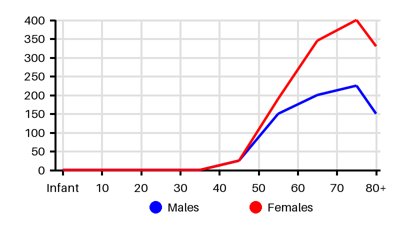
Incidence per 100.000 [wur][tsc][3vb][f9h]
Symptoms & findings
Symptoms
Anesthesia, Ataxia, Babinski reflex, Claudication, Clonus, Hoffman's sign, Hyperreflexia, Muscle weakness, Numbness, Paresis, Paresthesia
Clinical findings
Anamneses
None listed.
Localized findings
Approach
Neurology: motor, sensory, reflex, anal sphincter tone
Vascular status
Blood test: Sedimentation rate, ALP, calcium, serum protein electrophoresis
MRI
CT myelography
Electromyography: not routinely used, may be helpful in some special clinical conditions where the radiographic images cannot explain the symptoms of patients [znh]
Diagnostic criteria: [bdg]
Clinical findings: age, neurogenic claudication, radiating buttock/leg pain, exacerbated with lumbar extension and relieved with lumbar flexion, wide based gait
Radiological findings:
Normal diameter of the lumbar canal: 22-25 mm
Relative spinal stenosis: 10-12 mm
Diameter <10 mm is considered absolute stenosis
Treatment
Prophylaxis: Exercise, diet or changes in lifestyle
Conservative treatment: [bdg][znh][c5m]
Lifestyle modifications (weight loss, quit smoking), NSAIDs, muscle relaxants, physiotherapy (strength/flexibility exercises, balance training, acupuncture), cervical collar, corset
Epidural injections: local anesthetic injection with or without steroids (short term effect)
Surgery: severe symptoms and/or progressive myelopathy
Decompressive laminectomy with or without fusion
Interspinous spacers
Lumbar fusion: transforaminal lumbar interbody fusion (TLIF) and oblique lumbar interbody fusion (OLIF)
Minimally invasive posterior microdecompression or TLIF (MI-TLIF): percutaneous endoscopic interlaminar and transforaminal microdecompression
Differential diagnoses
Amyotrophic lateral sclerosis, Ankylosing spondylitis, Brain tumor, Cauda equina syndrome, Chronic limb ischemia, Compression fracture, Discitis, Hydrocephalus, Hyperparathyroidism, Metastatic bone tumors, Multiple myeloma, Multiple sclerosis, Myofascial pain, Osteoarthritis, Osteomalacia, Osteomyelitis, Peripheral neuropathy, Polyneuropathy, Rheumatoid arthritis, Scoliosis, Spinal cord infarction, Spinal cord infection, Spinal cord tumor, Spinal disc herniation, Spinal hematoma, Spondylodiscitis, Spondylolisthesis, Spondylolysis
References
[1] Arnoldi CC, Brodsky AE, Cauchoix J, Crock HV, Dommisse GF, Edgar MA, Gargano FP, Jacobson RE, Kirkaldy-Willis WH, Kurihara A, Langenskiöld A, Macnab I, McIvor GW, Newman PH, Paine KW, Russin LA, Sheldon J, Tile M, Urist MR, Wilson WE, Wiltse LL. Lumbar spinal stenosis and nerve root entrapment syndromes. Definition and classification. Clin Orthop Relat Res. 1976 Mar-Apr;(115):4-5.
[2] Wu AM, Zou F, Cao Y, Xia DD, He W, Zhu B, Chen D, Ni WF, Wang XY, Kwan K. Lumbar spinal stenosis: an update on the epidemiology, diagnosis and treatment. AME Med J 2017;2:63.
[3] Munakomi S, Foris LA, Varacallo MA. Spinal Stenosis and Neurogenic Claudication. [Updated 2023 Aug 13]. In: StatPearls [Internet]. Treasure Island (FL): StatPearls Publishing; 2025 Jan-. Available from: https://www.ncbi.nlm.nih.gov/books/NBK430872/
[4] Neal, Joseph M. “Neuraxis Mechanical Injury.” Anesthesia and pain medicine (2007): 89-97.
[5] Munakomi S, Cruz R. Lumbar Spinal Stenosis. [Updated 2024 Jan 30]. In: StatPearls [Internet]. Treasure Island (FL): StatPearls Publishing; 2025 Jan-. Available from: https://www.ncbi.nlm.nih.gov/books/NBK531493/
[6] Lee CH, Chung CK, Kim CH, Kwon JW. Health Care Burden of Spinal Diseases in the Republic of Korea: Analysis of a Nationwide Database From 2012 Through 2016. Neurospine. 2018 Mar;15(1):66-76.
[7] Jensen RK, Schiøttz-Christensen B, Skovsgaard CV, Thorvaldsen M, Mieritz RM, Andresen AK, Christensen HW, Hartvigsen J. Surgery rates for lumbar spinal stenosis in Denmark between 2002 and 2018: a registry-based study of 43,454 patients. Acta Orthop. 2022 May 24;93:488-494.
[8] Yabuki S, Fukumori N, Takegami M, Onishi Y, Otani K, Sekiguchi M, Wakita T, Kikuchi S, Fukuhara S, Konno S. Prevalence of lumbar spinal stenosis, using the diagnostic support tool, and correlated factors in Japan: a population-based study. J Orthop Sci. 2013 Nov;18(6):893-900.
[9] LaBan MM, Green ML. "Young" cervical spinal stenotic: a review of 118 patients younger than 51 years of age. Am J Phys Med Rehabil. 2004 Feb;83(2):162-5.
[10] Barbano RL. Mechanical and Other Lesions of the Spine, Nerve Roots, and Spinal Cord. Goldman's Cecil Medicine (24th Edition) Volume 2, 2012, Pages 2258-2269.
[11] Berney J. Epidémiologie des canaux lombaires étroits [Epidemiology of narrow spinal canal]. Neurochirurgie. 1994;40(3):174-8. French.
[12] http://emedicine.medscape.com/article/1913265 (2014-01-02); [Medscape]
[13] Kirkaldy-Willis WH: Managing low back pain, p. 103, New York, 1983, Churchill-Livingstone. (Diff.diagnosis)
[14] Kalichman L, Cole R, Kim DH, Li L, Suri P, Guermazi A, Hunter DJ. Spinal stenosis prevalence and association with symptoms: the Framingham Study. Spine J. 2009 Jul;9(7):545-50.