Diagnosis
Cholangiocarcinoma
An aggressive malignancy of biliary epithelium that may arise anywhere in the biliary tract:
Intrahepatic cholangiocarcinoma (iCCA)
Extrahepatic cholangiocarcinoma:
Perihilar cholangiocarcinoma (pCCA)
Distal cholangiocarcinoma (dCCA) - 70% of cases
Also known as: Bile duct cancer
Etiology
Cause [7wz][wqo]
The etiology of most bile duct cancers remains undetermined
Adenocarcinoma (95%)
Squamous cell tumor (5%)
Pathophysiology [7wz]
Long-standing inflammation
Hyperplasia, cellular proliferation
Ultimately malignant transformation: mutations K-RAS, B-RAF, TP53, SMAD4
Risk factors [7wz][wqo]
Chronic liver infection --> Cirrhosis:
Parasite: liver fluke
Viral hepatitis
Autoimmune/inflammatory conditions --> Cirrhosis:
Metabolic dysfunction-associated steatotic liver disease (MASLD)
Primary sclerosing cholangitis
Ulcerative colitis
Crohns disease
Chronic cholecystitis
Toxins (alcohol)
Chemical exposure (asbestos)
Choledochal stones
Anatomical conditions:
Choledochal cysts
Caroli disease
Bile duct adenoma
Biliary papillomatosis
Genetic: Alpha 1-antitrypsin deficiency, Lynch syndrome, multiple biliary papillomatosis, cystic fibrosis, hemochromatosis
Lifestyle: Type 2 diabetes, obesity, alcohol, cigarette smoking
Complications [wqo]
Liver failure
Cholangitis
Cirrhosis
Metastasis
Epidemiology
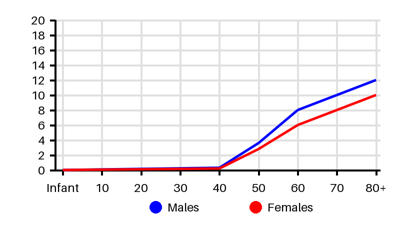
Incidence per 100.000 [tis][8pd][pqb]
Symptoms & findings
Symptoms
Acholia, Dark urine, Icterus, Lymphadenopathy, Malaise, Pruritus, Weight loss
Clinical findings
Bile duct dilation, Bilirubinuria, Cholestasis, Elevated ALP, Elevated Bilirubin, Elevated CA 19-9, Elevated GGT, Jaundice
Anamneses
None listed.
Localized findings
Approach
Diagnosing cholangiocarcinoma can be difficult: [wqo]
Biopsy techniques lack diagnostic sensitivity
Surgical intervention may be indicated even without a confirmatory biopsy
Blood test: CA 19-9, complete blood count, comprehensive metabolic profile, liver function tests, coagulation studies
Ultrasound abdomen
CT abdomen
MRI abdomen
PET-CT
MRCP
ERCP-guided biopsy
EUS-guided biopsy
PTC for decompression of dilated bile ducts
Treatment
Surgical resection --> 10% with early-stage disease --> curative resection [wqo]
Intrahepatic Cholangiocarcinoma
Hepatic resection with microscopically negative margins (R0)
Liver transplantation with variable 5-year survival (53-80%) [zte][pm2]
Perihilar Cholangiocarcinoma: Bismuth Corlette Classification
Resection of the extrahepatic bile duct and adjacent liver (or hemihepatectomy)
Liver transplantation
Distal Cholangiocarcinoma:
Pancreaticoduodenectomy
Palliative treatment:
Stenting (ERCP or PTC) --> treat biliary obstruction --> relieve pruritus
Photodynamic therapy --> restoring biliary drainage
Localized radiofrequency ablation:
An electrode is placed in the center of the tumor --> microwave energy
Localized radiation therapy --> reduce tumors --> resectable [wqo]
Transarterial radioembolization (TARE): Yttrium 90 via the hepatic artery directly into the tumor, followed by vessel embolization. This results in a high dose of radiation in the immediate vicinity of the tumor
Localized chemotherapy: [wqo]
Transarterial chemoembolization (TACE): Chemotherapeutic agents (Doxorubicin and platinum agents) directly instilled into the hepatic artery, followed by embolization of the artery
Hepatic artery infusion: chemotherapy is instilled directly into the hepatic artery proper via a subcutaneously placed pump
Targeted Therapy: fibroblast growth factor receptor 2-inhibitors
Differential diagnoses
Benign bile duct tumor, Bile duct stricture, Biliary obstruction, Cholangitis, Cholecystitis, Choledochal cysts, Choledocholithiasis, Cholelithiasis, Gallbladder cancer, Hepatocellular carcinoma, Pancreatic cancer, Primary biliary cirrhosis, Primary sclerosing cholangitis
References
[1] http://emedicine.medscape.com/article/277393 (2014-01-02); [Medscape]
[2] Menon G, Garikipati SC, Roy P. Cholangiocarcinoma. [Updated 2024 May 6]. In: StatPearls [Internet]. Treasure Island (FL): StatPearls Publishing; 2025 Jan-. Available from: https://www.ncbi.nlm.nih.gov/books/NBK560708/
[3] Qurashi et al. Epidemiology of cholangiocarcinoma. Eur J Surg Oncol. 2023 Sep 9:107064.
[4] Javle et al. Temporal Changes in Cholangiocarcinoma Incidence and Mortality in the United States from 2001 to 2017. Oncologist. 2022 Oct 1;27(10):874-883.
[5] Shin et al. Descriptive epidemiology of cholangiocarcinoma and clonorchiasis in Korea. J Korean Med Sci. 2010 Jul;25(7):1011-6.
[6] Heimbach JK, Haddock MG, Alberts SR, Nyberg SL, Ishitani MB, Rosen CB, Gores GJ. Transplantation for hilar cholangiocarcinoma. Liver Transpl. 2004 Oct;10(10 Suppl 2):S65-8.
[7] Tan EK, Taner T, Heimbach JK, Gores GJ, Rosen CB. Liver Transplantation for Peri-hilar Cholangiocarcinoma. J Gastrointest Surg. 2020 Nov;24(11):2679-2685.
[8] Kumar et al. Widening Health Disparities: Increasing Cholangiocarcinoma Incidence in an Underserved Population. Gastro Hep Advances 2022;1:180–185.
[9] Jiang et al. The epidemiological trends of biliary tract cancers in the United States of America. BMC Gastroenterol 22, 546 (2022).