Diagnosis
Cholecystitis
Inflammation of the gallbladder wall.
Also known as: Acute Cholecystitis
Etiology
Cause
Gallstones (95%)
Gas-forming bacteria
Acalculous cholecystitis (non-obstructive cholestasis due to critical illness/TPN)
Pathophysiology [qiz]
Bile produced in the liver --> hepatic duct --> entering the gallbladder
Ingestion of fatty food --> cholecystokinin (CCK) --> bile flow via the cystic duct --> common bile duct --> Ampulla of Vater --> GI tract --> fat emulsification for efficient absorption
Gallstone --> obstruction of the cystic duct:
Biliary colic: episodic pain or discomfort in the right upper quadrant or epigastrium
Persistent obstruction --> distention and inflammation --> Cholecystitis
Acute acalculous cholecystitis: critically ill patients or TPN
Elevated intraluminal pressure within the gallbladder --> increased transmural pressure--> impaired perfusion --> ischemia may progress to gangrene --> infection by gas-forming organisms --> emphysematous cholecystitis --> gallbladder perforation
Complications [qiz]
Pancreatitis
Cholangitis
Gallbladder perforation
Cholecystoenteric fistula
Intraabdominal abscess
Biloma
Sepsis
Epidemiology
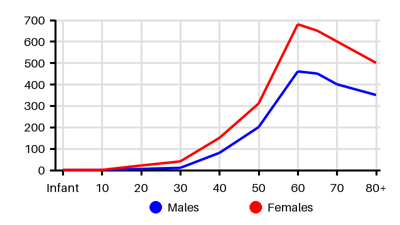
Incidence per 100.000 [4sk][cov][dff][agu]
Symptoms & findings
Symptoms
Anorexia, Courvoisier's sign, Diarrhea, Fever, Murphy's sign, Nausea, Vomiting
Clinical findings
Bile duct dilation, Cholestasis, Decreased Albumin, Elevated ALP, Elevated Amylase, Elevated Bilirubin, Elevated CRP, Elevated PT-INR, Gallbladder wall thickening, Leukocytosis, Pericholecystic fluid, Peritonitis, Pneumobilia
Anamneses
None listed.
Localized findings
Approach
Blood test
Ultrasound abdomen
HIDA scan
Treatment
Unstable patient --> immediate percutaneous transhepatic cholecystostomy
Infection --> Antibiotics
Choledocholithiasis --> ERCP
Definitive therapy: [f7s]
--> laparoscopic cholecystectomy (early operation within 72 hours of admission)
--> contraindication: high risk anaesthesia, morbid obesity, perforation, abscess, gallbladder cancer, end-stage liver disease, portal hypertension
Differential diagnoses
Acute mesenteric ischemia, Acute pancreatitis, Aortic dissection, Appendicitis, Autoimmune hepatitis, Cholangiocarcinoma, Cholangitis, Choledocholithiasis, Cholelithiasis, Esophageal hiatal hernia, Gallbladder cancer, Gastritis, Gastrointestinal obstruction, Perforated ulcer, Pyelonephritis, Ruptured aortic aneurysm, Ulcer disease
References
[1] Jones MW, Santos G, Patel PJ, et al. Acute Cholecystitis. [Updated 2025 Jul 6]. In: StatPearls [Internet]. Treasure Island (FL): StatPearls Publishing; 2025 Jan-. Available from: https://www.ncbi.nlm.nih.gov/books/NBK459171/
[2] Papadopoulos et al. (2006). Hospitalization rates for cholelithiasis and acute cholecystitis doubled for the aged population in Greece over the past 30 years. Scandinavian Journal of Gastroenterology, 41(11), 1330–1335.
[3] Murphy et al. The increasing incidence of gallbladder disease in children: A 20year perspective. J Pediatr Surg. 2016 May;51(5):748-52.
[4] Maram et al. The incidence of cholelithiasis and cholecystitis in Rochester, Minn, 1950 through 1969. Arch Intern Med. 1990 Sep;150(9):1833-6.
[5] Kimura et al. Definitions, pathophysiology, and epidemiology of acute cholangitis and cholecystitis: Tokyo Guidelines. J Hepatobiliary Pancreat Surg. 2007;14(1):15-26.
[6] https://emedicine.medscape.com/article/171886