Diagnosis
Femoral hernia
A form of indirect hernia (abnormal protrusion through a defect) arising out of the femoral canal bordered by the inguinal ligament anterosuperiorly, Cooper's ligament inferiorly, the femoral vein laterally.
Also known as: Femorocele
Etiology
Etiology/Epidemiology [afq]
Physical activity --> increased intra-abdominal pressure
The femoral canal: a congenital weakness in the abdominal wall
Increasing age/muscular atrophy --> Widening or weakness of the femoral ring
Herniation of the abdominal viscera (usually contain small bowel or omentum)
Classification
Reducible hernia: The protruding viscus can be returned to the abdomen
Irreducible (incarcerated) hernia: The protruding viscus cannot be returned
Strangulated hernia: The vascularity of the viscus is compromised
Risk Factors [afq]
Advanced age
Obesity
Smoking
Pregnancy
Connective tissue disorders
Complications [afq]
Incarceration
Bowel strangulation
Fecal contamination
Epidemiology
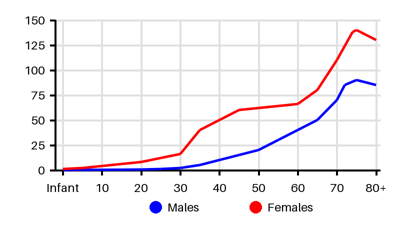
Incidence per 100.000 [7q1][n7i][gum]
Symptoms & findings
Symptoms
Absent feces, Absent flatus, Carnett's sign, Confusion, Constipation, Fever, Hypotension, Ileus, Tachycardia, Tachypnea, Vomiting
Clinical findings
Absent distal rectal air, Acidosis, Air-fluid level, Elevated CRP, Elevated Lactate, Gastrointestinal dilatation, Gastrointestinal obstruction, Leukocytosis
Anamneses
None listed.
Localized findings
Approach
Physical exam (diagnosis is usually clinical)
Blood test
Blood gas
Ultrasound abdomen
CT abdomen
Treatment
Watchful waiting [qsv]:
Asymptomatically or minimally symptomatic
Do not wish to undergo elective hernia repair
Surgery: [qsv]
Bowel obstruction
Signs of strangulation (painful groin mass, fever, tachycardia, hypotension, emesis)
Open repair with mesh (Lichtenstein tension-free) technique
TransAbdominal Preperitoneal (TAP) approach
Totally ExtraPeritoneal approach (TEP)
Differential diagnoses
Adhesion, Colorectal cancer, Diverticulitis, Femoral artery aneurysm, Gastrointestinal obstruction, Hematoma, Hydrocele, Inguinal hernia, Lipoma, Lymphadenopathy, Psoas abscess, Varices, Varicocele, Volvulus
References
[1] Goethals A, Azmat CE, Patel PJ, et al. Femoral Hernia. [Updated 2025 May 3]. In: StatPearls [Internet]. Treasure Island (FL): StatPearls Publishing; 2025 Jan-. Available from: https://www.ncbi.nlm.nih.gov/books/NBK535449/
[2] Matovu, A., Löfgren, J., Wladis, A. et al. Incidence of groin hernia repairs in women and parity: a population-based cohort study among women born in Sweden between 1956 and 1983. Hernia (2024).
[3] Burcharth J, Pedersen M, Bisgaard T, Pedersen C, Rosenberg J. Nationwide prevalence of groin hernia repair. PLoS One. 2013;8(1):e54367.
[4] Karatas T, Ozbag D, Kanlioz M. Retrospective analysis of inguinofemoral hernias. Medicine Science | International Medical Journal. 2020;9(1):86.
[5] McBee, P.J., Walters, R.W., & Fitzgibbons, R.J. (2022). Current status of inguinal hernia management: A review. International Journal of Abdominal Wall and Hernia Surgery, 5, 159 - 164.
[6] http://emedicine.medscape.com/article/189563 (2014-01-02); [Medscape]
[7] http://emedicine.medscape.com/article/775630 (2014-01-02); [Medscape]