Diagnosis
Splenic abscess
Collection of pus within the splenic capsule.
Etiology
Cause [esf]
Contamination of the spleen in a patient with risk factors such as immunosuppression
Bacteria: Staphylococcus, Streptococcus, Klebsiella, Pseudomonas, Salmonella (typhoid fever), Escherichia coli, Mycobacterium tuberculosis, Proteus mirabilis, Bacteroides fragilis, Clostridium difficile, Serratia marcescens, Enterococcus faecalis
Fungus: Candida, Aspergillus, Cryptococcus
Parasite: Malaria (less frequent)
Virus: Epstein-Barr virus (mononucleosis)
Pathophysiology [ria][nnh][akb][t2z][esf]
Hematogenous dissemination
Sepsis, endocarditis, pneumonia, ototis media, osteomyelitis, urinary tract infection, diverticulitis, appendicitis, melioidosis, Typhoid fever colitis, tuberculosis, dental extractions
Contiguous spread from nearby structures
Pancreatic/subphrenic abscesses, gastric/colonic perforations, pneumonia, pneumothorax, empyema, pulmonary embolism, and nephroureterolithiasis
Direct contamination
Trauma
Surgery (superinfected hematoma)
Infected splenic infarction (thalassemia, sickle cell anemia, leukemia, catheter embolization)
Systemic infection --> microbe collections are transferred to the spleen ("lymph node")
Immunosuppresion reduce the capacity of the spleen to manage microbial intruders
Contiguous spread occurs through microperforations and dissemination of microbes
The formation of a splenic abscess
Risk factors [esf]
Immunodeficiency:
HIV
Diabetes mellitus
Immunodeficiency syndrome
Immunosuppressive therapy
Transplant patients
Malignancy (lymphoma)
Chemotherapy
Kidney failure
Cirrhosis
Endocarditis
Pancreatitis
Inflammatory bowel disease (Morbus Crohn, Ulcerative colitis)
IV drug use/alcoholism
Other lesions of the spleen [ria]
Posttraumatic: Pseudocyst
Inflammatory: Hydatid (parasitic) cyst
Congenital: Epidermoid/mesothelial/dermoid cyst
Vascular: Post-infarction, peliiosis
Benign neoplasms: Hemangioma, lymphangioma
Malignant neoplasms:
Primary: Mucinous cystadenocarcinoma, primary splenic lymphoma
Metastatic: Melanoma, breast, ovarian, gastric, colon, pancreatic cancer
Complications [esf]
Splenic rupture --> Hemorrhage
Septic shock
Left-sided pleural effusion
Splenic artery/vein thrombosis
Subphrenic abscess
Complication to splenectomy:
Viscus perforation
Pancreatic fistula
Pancreatic duct injury
Postsplenectomy thrombocytosis
Pneumonia
Pneumothorax
Epidemiology
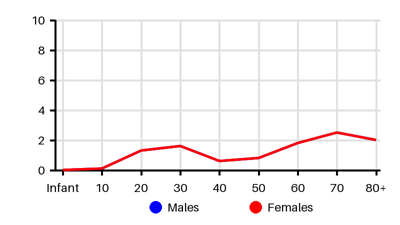
Incidence per 100.000 [ria][gq6][t2z][akb][esf][gsv][ukd]
Symptoms & findings
Symptoms
Anorexia, Chills, Fever, Nausea, Splenomegaly, Vomiting
Clinical findings
Elevated CRP, Leukocytosis, Peritonitis
Anamneses
None listed.
Localized findings
Approach
Blood test: CBC with differential, erythrocyte sedimentation rate, CA 19-9, CEA, IGRA
Blood culture
Ultrasound abdomen
CT abdomen (the gold standard)
MRI
Echocardiography
Treatment
Antibiotics [ria][t2z][esf]
Percutaneous drainage: <3 cm and few septations (unilocular or bilocular)
Surgery: >3 cm
Spleen-preserving procedure: partial splenectomy, marsupialization, fenestration
Splenectomy
Differential diagnoses
Diverticulitis, HIV, Hydronephrosis, Immunodeficiency, Leukemia, Lymphoma, Pleural empyema, Pneumonia, Pneumothorax, Pulmonary embolism, Pyelonephritis, Pyonephrosis, Sickle cell disease, Thalassemia, Urolithiasis
References
[1] Marietta M, Patel PJ, Zemaitis MR. Splenic Abscess. Updated 2025 Mar 20: https://www.ncbi.nlm.nih.gov/books/NBK519546/
[2] Khan Z, Chetty R. A review of the cysts of the spleen. Diagnostic Histopathology, Volume 22, Issue 12, 479 - 484.
[3] Neligan, P. Anesthesia and Uncommon Diseases, 6th Edition, 2012: Chapter 12 - Infectious Diseases and Biologic Weapons, Pages 369-400.
[4] Mustafa M, Menon J, Muniandy R, Rahman MDS and Tan TS. Splenic Abscess: Etiology, clinical spectrum and Therapy. IOSR Journal Of Pharmacy. Volume 5, Issue 1 (January 2015), PP. 37-41.
[5] Radcliffe C, Tang Z, Gisriel SD, Grant M. Splenic Abscess in the New Millennium: A Descriptive, Retrospective Case Series. Open Forum Infect Dis. 2022 Feb 17;9(4):ofac085.
[6] Nelken N, Ignatius J, Skinner M, Christensen N. Changing clinical spectrum of splenic abscess. A multicenter study and review of the literature. Am J Surg. 1987 Jul;154(1):27-34.
[7] Carbonell AM, Kercher KW, Matthews BD, Joels CS, Sing RF, Heniford BT. Laparoscopic splenectomy for splenic abscess. Surg Laparosc Endosc Percutan Tech. 2004 Oct;14(5):289-91.
[8] Fotiadis C, Lavranos G, Patapis P, Karatzas G. Abscesses of the spleen: report of three cases. World J Gastroenterol. 2008 May 21;14(19):3088-91.