Diagnosis
Sickle cell disease
An genetic disorder of the globin chains that causes hemolytic anemia, pain crises, and organ damage.
Also known as: Sickle cell anemia
Etiology
Cause [sma]
A genetic autosomal recessive disorder caused by mutation of hemoglobin and occurs in children of carriers who inherit the sickle cell gene from both parents (homozygote HbSS) or double heterozygote for HbS and b-0 thalassemia
Pathophysiology [sma]
Under deoxy conditions, HbS have decreased solubility (coagulopathy), decreased molecular stability, increased viscosity, and polymerization forming a gel-like substance containing Hb crystals called tactoids
If oxygen is present, the liquid state prevails
Vaso-occlusive crises are often precipitated by cold weather (vasospasm), hypoxia, infection, dehydration, acidosis, alcohol intoxication, emotional stress and pregnancy
In addition, RBC lifespan is greatly shortened (10-20 days)
Clinical manifestation
Hemolytic anemia --> Hepatosplenomegaly
Vaso-occlusive crisis --> Multiple organ damage from microinfarcts:
Heart
Skeleton
Central nervous system
Spleen
Kidney
Immune deficiency and severe infections with encapsulated organisms such as Haemophilus influenzae, Streptococcus pneumoniae: pneumonia, osteomyelitis
Acute Chest Syndrome (pulmonary embolism, fluid overload, infection): cough, dyspnea, fever
Stroke: headache, altered mental status, slurred speech, seizures, and paralysis
Aplastic crises from Parvovirus B-19: Fatigue, anemia, dyspnea, and even syncope
Acute intrahepatic cholestasis: RUQ pain, jaundice, hepatomegaly and liver failure
Priapism
Acute Ocular Complications: Hyphema, retinal artery occlusion, orbital infarction, Orbital Compression Syndrome
Chronic Complications:
Avascular Necrosis of Joints
Leg ulcers
Pulmonary Artery Hypertension
Iron overload
Risk factors [sma]
Subsaharan Africa: Heterozygotes who carry one HbS allele have some resistance to malaria caused by Plasmodium falciparum, thus more prevalent in endemic areas
Complications [sma]
Acute vaso-occlusive crisis:
Acute chest syndrome
Sequestration crises: splenic or hepatic sequestration
Fat embolism
Bone infarction/necrosis
Coagulopathy: stroke, myocardial infarction, venous thrombosis
Ophthalmic: vitreous hemorrhage, retinal detachment, retinal artery/vein occlusion
Aplastic crises
Papillary necrosis
Chronic Complications
Delayed growth and development and growth retardation
Cardiac: cardiomegaly, cardiomyopathy, left ventricular hypertrophy, arrhythmia, congestive heart failure
Pulmonary: pulmonary edema, sickle cell lung disease, pulmonary hypertension
Hepatobiliary: hepatomegaly, intrahepatic cholestasis, cholelithiasis, viral hepatitis
Splenic complications: splenomegaly, hyposplenia, asplenia
Renal: acute and chronic renal failure, pyelonephritis, renal medullary carcinoma
Musculoskeletal: degenerative changes, osteomyelitis, septic arthritis, osteonecrosis, osteopenia/osteoporosis
Neurologic: aneurysm, mental retardation
Ophthalmic: proliferative sickle retinopathy, vitreous hemorrhage, retinal detachment, nonproliferative retinal changes
Endocrine: primary hypogonadism, hypopituitarism, hypothalamic insufficiency
Iron overload due to repeated transfusions
Epidemiology
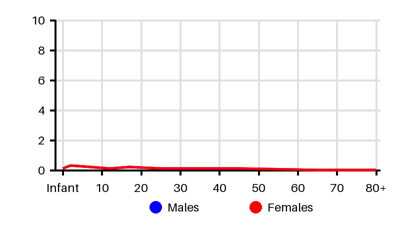
Incidence per 100.000 [sma][tq6][qot][u39][two]
Symptoms & findings
Symptoms
Cough, Dyspnea, Fever, Hepatomegaly, Icterus, Malaise, Ptosis, Retinitis, Splenomegaly, Tachypnea
Clinical findings
Anemia, Avascular necrosis, Cholelithiasis, Decreased Haptoglobin, Decreased MCV, Elevated Bilirubin, Elevated Creatinine, Elevated Lactic Dehydrogenase, Hyphema, Jaundice, Leukocytosis, Osteomyelitis, Priapism, Proteinuria, Pulmonary hypertension, Stroke
Anamneses
None listed.
Localized findings
Approach
Blood test: CBC with differential and reticulocyte count, electrolytes, creatinine, BUN, ALAT, bilirubin, secretory phospholipase A2 (sPLA2) [u39]
Blood gas
Blood culture
Urinanalysis
Blood smear
Electrophoresis: presence of homozygous hemoglobin S (HbS)
Lumbar puncture: CSF analysis
Chest x-ray
CT femur
Nuclear medicine scanning: osteonecrosis
MRI
Abdominal ultrasonography
Echocardiography
Transcranial near-infrared spectroscopy or cerebral oximetry: screen for low cerebral venous oxygen saturation in children with SCD
Treatment
Blood transfusion and Erythrocytapheresis: [sma][u39]
Pregnant females if Hb > 7 gm/dL
Preoperative transfusion for medium-risk surgery
Symptomatic patients as listed below
Vaso-occlusive crises: Cold weather (vasospasm), hypoxia, infection, dehydration, acidosis, alcohol, emotional stress, pregnancy
Vigorous intravenous hydration
Analgesics: NSAIDs, opioids
Supplemental oxygen
Acute Chest Syndrome: (Fat embolism, Infections, Asthma)
Antibiotics, including coverage for atypical bacteria
Supplemental oxygen
Blood transfusion is recommended for hypoxic patients
Respiratory system: beta-adrenergic dilators (if asthma), incentive spirometry
Prophylaxis: Disease-modifying therapy (hydroxyurea) or chronic blood transfusion program
Sequestration Crises: sequestered blood --> hepatosplenomegaly
IV fluids, pain control, and simple/exchange blood transfusion
Splenectomy if life-threatening or recurrent splenic sequestration or hypersplenism
Acute Stroke:
Acute and prophylactic simple or exchange blood transfusion
Disease-modifying therapy
Aplastic Crises (parvovirus infection, folic acid deficiency, bone marrow toxins):
Exchange/simple transfusion
Infections: Oral or intravenous antibiotics
Priapism:
Conservative measures: Analgesics, hydration, and sedation
Penile aspiration or irrigation of corpora cavernosa with alpha-adrenergic drugs
Acute ocular Complications:
Hyphema: Anterior chamber paracentesis or surgical intervention
Reducing intraocular pressure
Infections: antibiotics
OCS: Corticosteroids to relieve excessive pressure
Avascular Necrosis: Pain management, physical therapy and hip arthroplasty
Leg Ulcer: wound care, wet-to-dry dressings, pain control, antibiotics (osteomyelitis)
Pulmonary Hypertension: Referred to pulmonologists for management
Renal Complications: albuminuria, ACE-inhibitor, kidney transplantation
Ophthalmologic Complications:
Laser photocoagulation therapy to manage proliferative sickle retinopathy
Vitrectomy or retinal repair if vitreal hemorrhage or retinal detachment
Iron Overload: good transfusion practices
Transfusion restricted to the management of symptoms
Exchange transfusion over simple transfusion
Iron chelation therapy (if serum ferritin > 1000 mcg/L, LIC >7mg Fe/gm dry weight)
Deferasirox: 10-20mg/kg/day
Deferoxamine injection 1 to 2 g/day (SC) or 40-50 mg/kg/day (IV)
Deferiprone
Hematopoietic Stem Cell Transplant: A potentially curative option
Differential diagnoses
Anemia, Aortic arch syndrome, Aortic regurgitation, Aortic stenosis, Babesiosis, Blood transfusion, Carotid cavernous fistula, Cholelithiasis, Clostridium difficile, Drug side effects, Glucose-6-phosphate dehydrogenase deficiency, Heart failure, Hemoglobinopathy, Hemolytic anemia, Hemolytic uremic syndrome, Henoch-Schönlein purpura, Hereditary spherocytosis, Incontinentia pigmenti, Legg-Calve-Perthes disease, Leukemia, Macroglobulinemia, Malaria, Microscopic polyangiitis, Mitral regurgitation, Mitral stenosis, Muscular dystrophy, Myocardial infarction, Osteomyelitis, Paroxysmal nocturnal hemoglobinuria, Pneumonia, Polycythemia vera, Priapism, Pulmonary embolism, Pulmonary hypertension, Pyruvate kinase deficiency, Retinopathy, Rheumatoid arthritis, Rickettsia, Sepsis, Septic arthritis, Stroke, Systemic lupus erythematosus, Thalassemia, Thrombotic thrombocytopenic purpura, Tricuspid stenosis, Uveitis, Wegener's granulomatosis
References
[1] Mangla A, Agarwal N, Maruvada S. Sickle Cell Anemia. [Updated 2023 Sep 4]. In: StatPearls [Internet]. Treasure Island (FL): StatPearls Publishing; 2025 Jan-. Available from: https://www.ncbi.nlm.nih.gov/books/NBK482164/
[2] World Health Assembly, 59. (2006). Sickle-cell anaemia: report by the Secretariat. World Health Organization. https://iris.who.int/handle/10665/20890
[3] Hemminki K, Li X, Försti A, Sundquist J, Sundquist K. Thalassemia and sickle cell anemia in Swedish immigrants: Genetic diseases have become global. SAGE Open Med. 2015 Nov 23;3:2050312115613097.
[4] http://emedicine.medscape.com/article/205926 (2014-01-02); [Medscape]
[5] Nascimento MID, Przibilski ALF, Coelho CSG, Leite KFA, Makenze M, Jesus SB. Mortality attributed to sickle cell disease in children and adolescents in Brazil, 2000-2019. Rev Saude Publica. 2022 Jul 1;56:65.