Diagnosis
HIV
Acquired Immune Deficiency Syndrome is a disease of the human immune system caused by infection with Human Immunodeficiency Virus.
Also known as: Acquired Immune Deficiency Syndrome, AIDS, Human Immunodeficiency Virus
Etiology
Cause [3xw]
HIV virus: a blood-borne retrovirus (HIV-1 and HIV-2 subtypes)
Transmission: sexual intercourse, shared intravenous drug needles, and mother-to-child transmission (birth, breastfeeding)
Pathophysiology [3xw][5iy]
Acute HIV infection present with a flulike illness for 2 to 4 weeks --> antibodies against HIV are detected but the immune response is unable to achieve control of the infection
The primary viral targets: CD4+ antigen, T cells and macrophages
Viral surface glycoproteins facilitates viral entry into the host cell
The viral reverse transcriptase enzyme initiates reverse transcription using host transfer RNA as primers --> exponential viral replication
Chronic HIV
Lymphadenopathy, candidiasis, VZV reactivation, molluscum contagiosum
HIV causes depletion of helper T lymphocytes (CD4+ cells) by:
Disrupting cell cycling
Down-regulating the CD4 molecule
Direct cytotoxic effects of viral replication is not the cause of CD4 T-cell loss
Loss of CD4+ cells --> Dysregulation of B-cell antibody production
AIDS: Severe cellular immune deficiency --> opportunistic infections/malignancies:
Bacterial infections: Tuberculosis, mycobacterium avium, pneumonia, salmonella
Fungus: Pneumocystis jiroveci, candida, coccidioidomycosis, cryptococcosis, histoplasmosis
Parasite: Toxoplasmosis, cryptosporidiosis, isosporiasis
Virus: CMV, HSV
Immunology: Encephalopathy, Progressive multifocal leukoencephalopathy
Cancer: Kaposi sarcoma, lymphoma, cervical cancer (HPV), anal cancer (HPV)
Classification [5iy]
Category A: Asymptomatic HIV infection
Category B: HIV infection with symptoms that are directly attributable to HIV infection
Category C: HIV infection with AIDS-defining opportunistic infections
These 3 categories are further subdivided on the basis of the CD4+ T-cell count:
> 500/µL: Categories A1, B1, C1
200-400/µL: Categories A2, B2, C2
< 200/µL: Categories A3, B3, C3
Complications [5iy]
AIDS: opportunistic infections and HIV-associated malignancies
Neurocognitive disorders and psychiatric complications
Polyneuropathy
Lipodystrophy
Mitochondrial toxicity
Kaposi sarcoma
Inflammatory cytokine syndrome
Castleman disease
Lymphoma: follicular, non-Hodgkin, Burkitt, and diffuse large B-cell
ART-Related Complications
Epidemiology
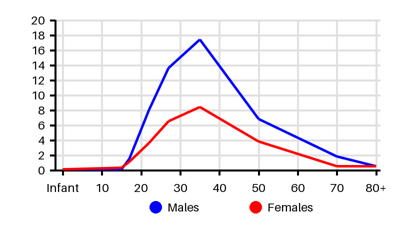
Incidence per 100.000 [ag4][pfm]
Symptoms & findings
Symptoms
Diarrhea, Fatigue, Fever, Headache, Lymphadenopathy, Malaise, Myalgia, Night sweats, Sore throat, Weight loss
Clinical findings
Anamneses
None listed.
Localized findings
Approach
HIV-detection: [5iy]
No test can detect HIV during the initial viremic phase (up to 20 days)
PCR: HIV RNA (viral load) 6 to 8 days after infection, up to 33 days
Antigen test: Viral proteins as early as 13 to 20 days after infection
Antigen-antibody tests:
Anti-HIV IgM antibodies around 20 days after infection
Anti-HIV IgG antibodies around 30 days after infection
Viral culture
Lymph node biopsy
Blood test: CD4 T-cell count, complete blood count, glucose, blood urea nitrogen, creatinine, liver enzymes, bilirubin, urinalysis, serum lipids, and serology for hepatitis A, B, and C
Detection of co-infections: tuberculosis, CMV, syphilis, gonorrhea, chlamydia, hepatitis, toxoplasmosis
Treatment
Treatment depends on the stage of the disease and any concomitant opportunistic infections.
Prevention: [3xw]
Sexual abstinence
Reduction in number of sexual partners
Using barrier contraception
Treatment of concurrent sexually transmitted diseases (STDs)
Testing of self and partner for HIV infection and other STDs
Effective control of maternal infection
Prenatal antiviral therapy and treatment of mother and infant during labor
Cesarean delivery
Avoidance of breastfeeding
Blood-product and donor screening
Avoidance of reusing needles
Screening in HIV-patients: diabetes, osteoporosis, colon cancer, cardiovascular risk factors (lipids), trichomoniasis, gonorrhea, chlamydia
Prophylaxis: Pneumocystis jiroveci (trimethoprim-sulfamethoxazole), candida or cryptococcus and CMV (fluconazole + ganciclovir if CD4 T-cell counts under 50/µL), Herpes Simplex (acyclovir), Histoplasma capsulatum, Mycobacterium avium complex, Toxoplasma gondii
Vaccination: pneumococcal infection, influenza, varicella, hepatitis A and B
Treatment: Highly active antiretroviral therapy (HAART) treatment responce:
A gradual recovery of CD4 T-cell number
Improvement of immune responses
Treatment of opportunistic infections
Differential diagnoses
Acne vulgaris, Candidiasis, Contact dermatitis, Cryptococcosis, Cytomegalovirus, Eczema, Folliculitis, Gastroenteritis, Herpes simplex, Herpes zoster, Kaposi sarcoma, Lymphoma, Molluscum contagiosum, Mononucleosis, Oral hairy leukoplakia, Pneumonia, Prurigo nodularis, Psoriasis, Scabies, Seborrheic dermatitis, Severe combined immunodeficiency, Systemic lupus erythematosus, Toxoplasmosis, Tuberculosis, Verruca vulgaris, Viral hepatitis
References
[1] http://emedicine.medscape.com/article/211316 (2014-01-29); [Medscape]
[2] Swinkels HM, Nguyen AD, Gulick PG. HIV and AIDS. [Updated 2024 Jul 27]. In: StatPearls [Internet]. Treasure Island (FL): StatPearls Publishing; 2025 Jan-. Available from: https://www.ncbi.nlm.nih.gov/books/NBK534860/
[3] Crepaz N, Hess KL, Purcell DW, Hall HI. Estimating national rates of HIV infection among MSM, persons who inject drugs, and heterosexuals in the United States. AIDS. 2019 Mar 15;33(4):701-708.
[4] https://www.canada.ca/en/public-health/services/publications/diseases-conditions/hiv-2022-surveillance-highlights.html