Diagnosis
Esophageal hiatal hernia
A hernia in which an anatomical part (such as the stomach) protrudes through the esophageal hiatus of the diaphragm.
Also known as: Hiatal hernia, Hiatus hernia
Etiology
Cause
Congenital (children): [piw]
Congenital defect in infants and children causing gastroesophageal reflux, feeding problems, malnutrition and suppression of growth
Acquired (adults): Hiatal hernia in adults can lead to reflux and esophagitis
Traumatic [ozu]
Non-traumatic:
Sliding hiatal hernia (95% of hiatal hernias, often asymptomatic) [swn]
Para-esophageal hiatal hernia (require surgical treatment)
Pathophysiology [swn]
Increased intraabdominal pressure (overweight, pregnancy, ascites, chronic constipation, sneezing, chronic coughing, chronic obstructive pulmonary disease)
Negative pressure in the chest
Congenital anatomical defects
Short esophagus (chronic esophagitis --> fibrosis)
Old age (muscle weakening and loss of elasticity)
Complications (paraesophageal hiatal hernia) [nrt]
Bleeding
Incarceration
Obstruction
Gastric volvulus
Perforation
Surgical complications: pneumothorax, gastro/esophageal/hepato/splenic injuries, and dysphagia
Epidemiology
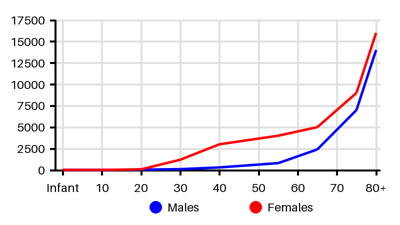
Prevalence per 100.000 [87s]
Symptoms & findings
Symptoms
Choking, Cough, Dysphagia, Failure to thrive, Globus sensation, Heartburn, Hematemesis, Hoarseness, Nausea, Postprandial fullness, Regurgitation, Respiratory failure, Vomiting, Wheezing
Clinical findings
Anamneses
None listed.
Localized findings
Approach
Barium contrast study
Endoscopy
Mannometry
CT thorax/abdomen
Treatment
Congenital (infants and children): Open or laparoscopic herniorrhaphy
Paraesophageal hiatal hernia: require surgical repair due to risk of complications (bleeding, incarceration, obstruction and perforation) [nrt]
Sliding hiatal hernia: usually do not require surgical treatment. If symptoms (GERD):
Lifestyle modifications: weight loss, elevation of head of bed
Medication: antacids, prokinetics, H2-receptor blocker and proton pump inhibitor
Surgery:
Open or laparoscopic herniorrhaphy
Nissen fundoplication (360° wrap)
Differential diagnoses
Achalasia, Acute laryngitis, Angina pectoris, Esophageal cancer, Esophageal diverticula, Esophageal perforation, Esophageal spasm, Esophagitis, Gastroesophageal reflux disease, Lung cancer, Myocardial infarction, Pneumonia
References
[1] Lilly JR, Randolph JG. Hiatal hernia and gastroesophageal reflux in infants and children. J Thorac Cardiovasc Surg. 1968 Jan;55(1):42-54.
[2] https://emedicine.medscape.com/article/178393
[3] Smith RE, Sharma S, Shahjehan RD. Hiatal Hernia. [Updated 2024 Jul 17]. In: StatPearls [Internet]. Treasure Island (FL): StatPearls Publishing; 2025 Jan-. Available from: https://www.ncbi.nlm.nih.gov/books/NBK562200/
[4] Hyun JJ, Bak YT. Clinical significance of hiatal hernia. Gut Liver. 2011 Sep;5(3):267-77.
[5] Kim J, Hiura GT, Oelsner EC, et al Hiatal hernia prevalence and natural history on non-contrast CT in the Multi-Ethnic Study of Atherosclerosis (MESA) BMJ Open Gastroenterology 2021;8:e000565.