Diagnosis
Esophageal cancer
Cancer in the esophagus.
Etiology
Cause [b4o]
Squamous cell carcinoma
Adenocarcinoma
Secondary cancer:
Sarcomas
Small cell carcinomas
Lymphomas
Melanomas
Pathophysiology [b4o]
In squamous cell carcinoma:
Genetic, environmental, and lifestyle factors (smoking, alcohol, hot beverages, and poor nutrition)
In adenocarcinoma:
Repeated exposure to stomach acid --> replacement of the normal squamous epithelium with metaplastic columnar epithelium (Barrett esophagus)
Chronic irritation/inflammation + exposure to carcinogens
Genetic alterations --> mutations in tumor suppressor genes (p53) and oncogenes
Disruption of normal cell cycle regulation --> promoting uncontrolled cell growth
Dysplasia --> carcinoma in situ (cancer cells are confined to the epithelial layer)
Cancer cells breach the basement membrane and invade the submucosa and muscularis propria --> Cancer
Cancer cells enter the lymphatic system or bloodstream --> metastasis to lymph nodes, the liver, lungs, and bones
Risk factors [b4o]
Squamous cell carcinoma:
Smoking
Alcohol
A diet low in fruits and vegetables
Hot beverages (thermic damage --> inflammation)
Human papillomavirus
Genetic syndromes (tylosis, Bloom syndrome, and Fanconi anemia)
Adenocarcinoma:
Barrett esophagus
Smoking
High body mass index
Gastroesophageal reflux disease
Complications [b4o]
Malnutrition: Dysphagia, anorexia, cachexia
Obstruction
Aspiration
Bleeding
Fistula Formation
Perforation
Metastatis
Treatment-Related Complications:
Chemotherapy: infection, anemia, bleeding, nausea/vomiting, diarrhea, neuropathy
Radiation therapy: esophagitis, strictures, perforation, fistula
Surgery: anastomotic leak, pulmonary complications, arrhythmia, chylothorax
Epidemiology
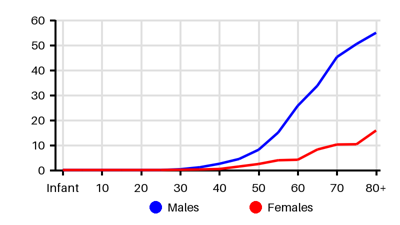
Incidence per 100.000 [akg]
Symptoms & findings
Symptoms
Anorexia, Aphonia, Cachexia, Cough, Dysphagia, Globus sensation, Hematemesis, Hemoptysis, Hoarseness, Lymphadenopathy, Melena, Nausea, Odynophagia, Stridor, Vomiting, Weight loss
Clinical findings
Anemia, Elevated Sedimentation Rate, Esophageal stricture, Esophageal ulcer
Anamneses
None listed.
Localized findings
Approach
Barium enema
Gastroscopy + Biopsy
CT scan
TNM-classification
Tumor:
Tis: High-grade dysplasia
T1: Tumor invades the lamina propria, muscularis mucosae, or submucosa
T1a: Tumor invades the lamina propria or muscularis mucosae
T1b: Tumor invades the submucosa
T2: Tumor invades the muscularis propria
T3: Tumor invades the adventitia
T4: Tumor invades adjacent structures
T4a: Invades the pleura, pericardium, azygos vein, diaphragm, or peritoneum
T4b: Invades other adjacent structures: aorta, vertebral body, or trachea
Node:
N0: No regional lymph node metastasis
N1: Metastasis in 1-2 regional lymph nodes
N2: Metastasis in 3-6 regional lymph nodes
N3: Metastasis in 7 or more regional lymph nodes
Metastasis:
M0: No distant metastasis
M1: Distant metastasis
Treatment
Early-stage: T1a or superficial cT1b [b4o]
Endoscopic resection
Mid-stage: lesions penetrating the submucosa with negative lymph nodes (<3 cm)
Esophagectomy with lymphadenectomy
Local lymph node-positive:
Esophagectomy + neoadjuvant chemo(radio)therapy
Advanced: T4a or T4b
Definitive chemoradiation
Palliative stage:
Chemotherapy
Radiotherapy
Brachytherapy
Stents (treatment of dysphagia)
Differential diagnoses
Achalasia, Eosinophilic esophagitis, Esophageal diverticula, Esophageal perforation, Esophageal spasm, Esophageal stricture, Gastric cancer, Gastroesophageal reflux disease, Lipoleiomyoma, Myasthenia gravis, Pneumonia, Systemic sclerosis, Tuberculosis
References
[1] Wang Y, Mukkamalla SKR, Singh R, et al. Esophageal Cancer. [Updated 2024 Aug 17]. In: StatPearls [Internet]. Treasure Island (FL): StatPearls Publishing; 2025 Jan-. Available from: https://www.ncbi.nlm.nih.gov/books/NBK459267/
[2] Liu CQ, Ma YL, Qin Q, Wang PH, Luo Y, Xu PF, Cui Y. Epidemiology of esophageal cancer in 2020 and projections to 2030 and 2040. Thorac Cancer. 2023 Jan;14(1):3-11.
[3] New York State Cancer Registry: https://www.health.ny.gov/statistics/cancer/registry/table6/tb6esophagusupstate.htm
[4] Al-Kaabi, A., Baranov, N. S., van der Post, R. S., Schoon, E. J., Rosman, C., van Laarhoven, H. W. M., … Siersema, P. D. (2022). Age-specific incidence, treatment, and survival trends in esophageal cancer: a Dutch population-based cohort study. Acta Oncologica, 61(5), 545–552.
[5] Jiang Y, Lin Y, Wen Y, Fu W, Wang R, He J, Zhang J, Wang Z, Ge F, Huo Z, Wang R, Peng H, Wu X, He J, Li S. Global trends in the burden of esophageal cancer, 1990-2019: results from the Global Burden of Disease Study 2019. J Thorac Dis. 2023 Feb 28;15(2):348-364.