Diagnosis
Gastrinoma
Neuroendocrine tumor causing overproduction of gastrin also known as Zollinger-Ellison syndrome.
Also known as: Neuroendocrine tumor, Zollinger-Ellison syndrome
Etiology
Cause [zof][adw]
80% sporadic arise from enteroendocrine G-cells
20-30% in association with multiple endocrine neoplasia type 1 (MEN1):
Dysregulation of the MEN1 pathway, chromosomal instability, and alterations in key signaling pathways
Other causes of hypergastrinemia [aui]
Appropriate (physiological) hypergastrinemia
Chronic atrophic gastritis/pernicious anemia
Gastric acid antisecretory agents (proton pump inhibitors)
Chronic renal failure
Pangastritis H. pylori infection
Postacid-reducing surgery/vagotomy
Inappropriate hypergastrinemia with hyperchlorhydria
Antral predominant H. pylori infection
Gastric outlet obstruction
Antral G cell hyperfunction/hyperplasia
Chronic renal failure
Short bowel syndrome
Retained gastric antrum syndrome
Juvenile polyposis of the stomach
Zollinger–Ellison syndrome
Pathophysiology [adw]
Elevated gastrin independent of luminal pH --> sustaining persistent acid hypersecretion:
G-cells autonomously secrete gastrin
Ectopic secretion of gastrin
Hydrochloric acid production --> Hyperchlorhydria:
Refractory peptic disease
Gastroesophageal reflux
Diarrhea
Acid-mediated inactivation of pancreatic enzymes and bile salts:
Impairs lipid digestion and absorption
Anatomic location [zof][ub1]
Duodenum (30%)
Pancreas (60%)
Stomach/liver (10%)
Complications [adw]
Metastatsis
GI bleeding
GI perforation
Epidemiology
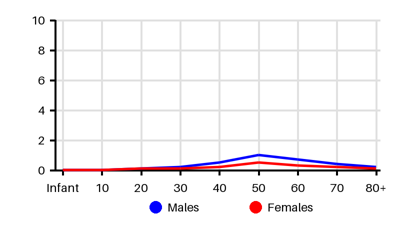
Incidence per 100.000 [1uf][hsn][fcs][rda][wga][sgy][ub1]
Symptoms & findings
Symptoms
Anorexia, Diarrhea, Dizziness, Dysphagia, Heartburn, Hematemesis, Melena, Steatorrhea, Syncope, Vomiting, Weight loss
Clinical findings
Elevated Gastrin, Esophageal stricture, Esophageal ulcer, Gastric ulcer, Gastroesophageal Reflux Disease, Hypercalcemia, Peritonitis
Anamneses
None listed.
Localized findings
Approach
Blood test: chromogranin A
Gastroscopy
Secretin stimulation test (performed off PPIs) demonstrating an increase in serum gastrin of >120 pg/ml has a sensitivity of 94% and specificity of 100% [aui]
Fasting hypergastrinemia (and hyperchlorhydria) in the absence of antisecretory therapy (sensitivity: 98–100%) [aui]
Fasting gastrin >1000 pg/ml (normal <100 pg/ml)
Gastric pH ≤ 2
Somatostatin PET-CT
CT scan
MRI
WHO classification [adw]
Grade 1: Low-grade, well-differentiated tumor exhibiting benign or uncertain behavior at diagnosis: mitotic count <2 per 10 high-power fields and Ki-67 index of <3%.
Grade 2: Low-grade, well-differentiated tumor with intermediate proliferative activity: mitotic count 2 to 20 per 10 HPF and Ki-67 index of 3% to 20%.
Grade 3: High-grade, poorly differentiated carcinoma with aggressive clinical behavior: mitotic count >20 per 10 HPF and Ki-67 index of >20%.
TNM-classification [adw]
Primary tumor (T):
T1: Tumor ≤2 cm, confined to the pancreas; tumor invades the mucosa or submucosa of the duodenum only and is ≤1 cm in greatest dimension
T2: Tumor >2 cm but ≤4 cm, confined to the pancreas; Tumor invades the muscularis propria of the duodenum or is >1 cm in greatest dimension
T3: Tumor >4 cm or invading adjacent structures (excluding major vessels); duodenal tumor invades the pancreas or peripancreatic adipose tissue
T4: Tumor invades adjacent organs, visceral peritoneum, or large vessels
Regional lymph nodes (N):
N0: No regional lymph node involvement
N1: Regional lymph node metastasis present
Distant metastasis (M):
M0: No distant metastasis
M1: Distant metastasis present (commonly the liver, but may also include bones or lungs)
Treatment
Medication: [zof][adw]
Lifelong high-dose proton pump inhibitors (PPIs are preferable to H2 receptor blockers due to their higher potency and longer duration of action)
Surgical resection: [adw]
The only curative treatment in the absence of unresectable metastatic disease
Chemotherapy is an option for patients with widespread metastasis: [adw]
Streptozotocin and 5-fluorouracil or doxorubicin
Differential diagnoses
Achlorhydria, Acute pancreatitis, Arteriovenous malformation, Brain damage, Esophageal varices, Esophagitis, Gastric outlet obstruction, Gastritis, Gastrointestinal obstruction, Gastrointestinal perforation, Mallory-Weiss tear, Pernicious anemia, Ulcer disease
References
[1] https://www.uptodate.com/contents/zollinger-ellison-syndrome-gastrinoma-clinical-manifestations-and-diagnosis
[2] Helbing A, Menon G, Karanchi H. Gastrinoma. [Updated 2025 Feb 19]. In: StatPearls [Internet]. Treasure Island (FL): StatPearls Publishing; 2025 Jan-. Available from: https://www.ncbi.nlm.nih.gov/books/NBK441842/
[3] Metz DC, Cadiot G, Poitras P, Ito T, Jensen RT. Diagnosis of Zollinger-Ellison syndrome in the era of PPIs, faulty gastrin assays, sensitive imaging and limited access to acid secretory testing. Int J Endocr Oncol. 2017;4(4):167-185.
[4] Metz DC, Jensen RT. Gastrointestinal neuroendocrine tumors: pancreatic endocrine tumors. Gastroenterology. 2008 Nov;135(5):1469-92.
[5] Oberg K. Pancreatic endocrine tumors. Semin Oncol. 2010 Dec;37(6):594-618.
[6] Berna MJ, Hoffmann KM, Serrano J, Gibril F, Jensen RT. Serum gastrin in Zollinger-Ellison syndrome: I. Prospective study of fasting serum gastrin in 309 patients from the National Institutes of Health and comparison with 2229 cases from the literature. Medicine (Baltimore). 2006 Nov;85(6):295-330.
[7] Carvão J, Dinis-Ribeiro M, Pimentel-Nunes P, Libânio D. Neuroendocrine Tumors of the Gastrointestinal Tract: A Focused Review and Practical Approach for Gastroenterologists. GE Port J Gastroenterol. 2021 Sep;28(5):336-348.
[8] Sonbol MB, Mazza GL, Mi L, Oliver T, Starr J, Gudmundsdottir H, Cleary SP, Hobday T, Halfdanarson TR. Survival and Incidence Patterns of Pancreatic Neuroendocrine Tumors Over the Last 2 Decades: A SEER Database Analysis. Oncologist. 2022 Jul 5;27(7):573-578.
[9] Jensen RT, Ito T. Gastrinoma. Updated 2023 Sep 27: https://www.ncbi.nlm.nih.gov/books/NBK279075
[10] Thom AK, Norton JA, Axiotis CA, Jensen RT. Location, incidence, and malignant potential of duodenal gastrinomas. Surgery. 1991 Dec;110(6):1086-91; discussion 1091-3.
[11] Kulke MH, Anthony LB, Bushnell DL, de Herder WW, Goldsmith SJ, Klimstra DS, Marx SJ, Pasieka JL, Pommier RF, Yao JC, Jensen RT; North American Neuroendocrine Tumor Society (NANETS). NANETS treatment guidelines: well-differentiated neuroendocrine tumors of the stomach and pancreas. Pancreas. 2010 Aug;39(6):735-52.
[12] Falconi M, Plockinger U, Kwekkeboom DJ, Manfredi R, Korner M, Kvols L, Pape UF, Ricke J, Goretzki PE, Wildi S, Steinmuller T, Oberg K, Scoazec JY; Frascati Consensus Conference; European Neuroendocrine Tumor Society. Well-differentiated pancreatic nonfunctioning tumors/carcinoma. Neuroendocrinology. 2006;84(3):196-211.