Diagnosis
Hyperaldosteronism
Overproduction of aldosterone resulting in sodium retention, potassium excretion, hypertension and hypokalemia.
Also known as: Conn´s syndrome
Etiology
Cause [kab]
Primary (due to excessive aldosterone secretion and suppressed renin levels):
Idiopathic adrenocortical hyperplasia (bilateral)
Conn´s syndrome / aldosterone-producing adenoma with renin suppression (unilateral)
Adrenal carcinoma
Ectopic aldosterone-secreting tumors (kidneys or ovaries)
Familial hyperaldosteronism
Secondary (due to elevated renin --> resulting in elevated aldosterone):
Renal artery stenosis
Renin-producing tumors
Renal tubular acidosis
Pheochromocytoma
Nutcracker syndrome
Hyperkalemia due to chronic renal failure
Generalized edematous states:
Heart failure
Pregnancy
Cor pulmonale
Bartter or Gitelman syndromes
Hepatic cirrhosis: impaired metabolism
Obstructive sleep apnea
Nephrotic syndrome
Pathophysiology [kab]
Aldosterone:
A mineralocorticoid hormone secreted by the zona glomerulosa (the outermost layer of the adrenal cortex)
Aldosterone production is regulated by angiotensin II, potassium, and ACTH levels
Promotes sodium/water retention
To maintain electrical neutrality in the tubular lumen:
Increased urinary potassium excretion --> hypokalemia
Increased urinary hydrogen ions excretion --> aciduria --> metabolic alkalosis
Hypotension --> decrease in GFR --> release of renin --> angiotensin I --> angiotensin II
Angiotensin II: Vasoconstrictor + Aldosterone production
Result: increased intravascular volume and higher blood pressure
Riskfactors for hyperaldosteronism [kab]
Atrial fibrillation
Family history of early-onset hypertension or cardiovascular events (age < 35)
Family history of hyperaldosteronism
Hypertension at age < 40 years
Hypokalemia
Adrenal adenoma in a hypertensive patient
Obstructive sleep apnea
Resistant or intractable hypertension
Sleep apnea
Complications [kab]
Hypertension
Atrial fibrillation
Left ventricular hypertrophy
Myocardial infarction
Stroke
Albuminuria
Renal failure
Epidemiology
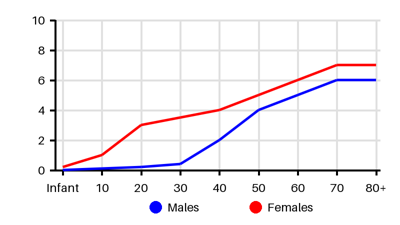
Incidence per 100.000 [man][ike][5iq][oav][555][kab]
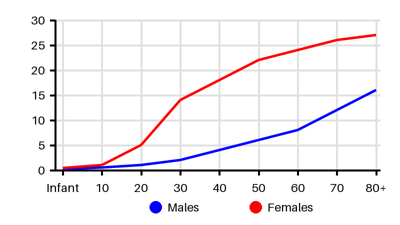
Prevalence per 100.000 [man][ike][5iq][oav][555][kab]
Symptoms & findings
Symptoms
Constipation, Headache, Hypertension, Muscle cramps, Muscle weakness, Polydipsia, Polyuria
Clinical findings
Decreased Renin, Elevated Aldosterone, Hypokalemia, Kaliuresis, Metabolic alkalosis
Anamneses
None listed.
Localized findings
Approach
Blood test: aldosterone > 20 ng/dL, plasma renin activity, aldosterone to renin ratio > 20:1, potassium [nms][man][kab]
Urine sample: 24h urinary potassium > 30mmol/day
Captopril-test
CT abdomen
Iodocholesterol scan
Bilateral adrenal vein sample for aldosterone and cortisol pre- and post-ACTH
Treatment
Treat hypertension and hypokalemia
Unilateral (aldosterone producing adenoma): [kab]
Percutaneous and transcatheter ablation of unilateral adrenal adenoma
Total unilateral adrenalectomy
If no effect of surgery, consider:
Incorrect initial diagnosis
Underlying essential hypertension
Irreversible damage from chronic hyperaldosteronism
Other causes of hypertension: pheochromocytoma or renovascular disease
Bilateral:
Mineralocorticoid receptor blockade (spironolactone and eplerenone)
Potassium-sparing diuretic antihypertensive: amiloride and triamterene
Bilateral adrenalectomy is not recommended
Bilateral super-selective adrenal artery embolization
Differential diagnoses
Adrenal cortical adenoma, Adrenal cortical carcinoma, Clostridium tetani, Congenital adrenal hyperplasia, Cushings disease, Cushing syndrome, Diabetes insipidus, Essential hypertension, Hyperkalemia, Hyperphosphatemia, Hyperventilation, Hypocalcemia, Hypocapnia, Hypokalemia, Hypomagnesemia, Hypoparathyroidism, Liddle syndrome, Metabolic alkalosis, Milk-alkali syndrome, Pheochromocytoma, Preeclampsia, Renal artery stenosis
References
[1] Leslie SW, Muppidi V, Gupta S. Hyperaldosteronism. [Updated 2025 Jun 24]. In: StatPearls [Internet]. Treasure Island (FL): StatPearls Publishing; 2025 Jan-. Available from: https://www.ncbi.nlm.nih.gov/books/NBK499983/
[2] Amar L, Plouin PF, Steichen O. Aldosterone-producing adenoma and other surgically correctable forms of primary aldosteronism. Orphanet J Rare Dis. 2010 May 19;5:9.
[3] https://health.mil/News/Articles/2018/12/01/Adrenal-Gland-Disorders?type=Fact+Sheets
[4] Gkaniatsa E, Ekerstad E, Gavric M, Muth A, Trimpou P, Olsson DS, Johannsson G, Ragnarsson O. Increasing Incidence of Primary Aldosteronism in Western Sweden During 3 Decades - Yet An Underdiagnosed Disorder. J Clin Endocrinol Metab. 2021 Aug 18;106(9):e3603-e3610.
[5] Rossi GP, Bernini G, Caliumi C, Desideri G, Fabris B, Ferri C, Ganzaroli C, Giacchetti G, Letizia C, Maccario M, Mallamaci F, Mannelli M, Mattarello MJ, Moretti A, Palumbo G, Parenti G, Porteri E, Semplicini A, Rizzoni D, Rossi E, Boscaro M, Pessina AC, Mantero F; PAPY Study Investigators. A prospective study of the prevalence of primary aldosteronism in 1,125 hypertensive patients. J Am Coll Cardiol. 2006 Dec 5;48(11):2293-300.
[6] Satoh F, Abe T, Tanemoto M, Nakamura M, Abe M, Uruno A, Morimoto R, Sato A, Takase K, Ishidoya S, Arai Y, Suzuki T, Sasano H, Ishibashi T, Ito S. Localization of aldosterone-producing adrenocortical adenomas: significance of adrenal venous sampling. Hypertens Res. 2007 Nov;30(11):1083-95.
[7] Rossi GP, Seccia TM, Pessina AC. Clinical use of laboratory tests for the identification of secondary forms of arterial hypertension. Crit Rev Clin Lab Sci. 2007;44(1):1-85.
[8] Rossi GP, Pessina AC, Heagerty AM. Primary aldosteronism: an update on screening, diagnosis and treatment. J Hypertens. 2008 Apr;26(4):613-21.