Diagnosis
Cushing syndrome
The clinical state resulting from excess tissue exposure to cortisol and/or other glucocorticoids.
Also known as: Hypercortisolemia, Hypercortisolism
Etiology
Cause [eo9][s87]
Exogenic: Iatrogenic Cushing syndrome (the most common cause) [eo9]
Endogenic:
ACTH dependent:
Pituitary tumor secreting ACTH (Cushings disease): common endogenic cause
Ectopic ACTH secretion by tumor (small cell lung cancer)
ACTH independent:
Functional adrenal adenoma secretes cortisol
Functional adrenal carcinoma
Adrenal hyperplasia
Pseudo-Cushing syndrome: Other causes for elevated plasma cortisol:
Psychiatry: Chronic stress, depression, anorexia nervosa, OCD, panic disorder
Excessive exercise
Drugs: Chronic alcoholism, alcohol and nicotine withdrawal
Metabolic: Diabetes mellitus, central obesity, hyperthyroidism, premenstrual tension syndrome, pregnancy
Pathophysiology [eo9]
The hypothalamic-pituitary-adrenal axis:
Hypothalamus: Corticotrophin Releasing Hormone (CRH
Adenohypophysis (pituitary gland): AdrenoCorTicotropic Hormone (ACTH)
Adrenal cortex:
Zona glomerulosa: aldosterone
Zona fasciculata: Baseline cortisol production + Secretory responses to stimuli
Zona reticularis: adrenal androgens
Cortisol inhibit pituitary ACTH and hypothalamic CRH (negative feedback)
Derangement of the hypothalamic-pituitary-adrenal axis:
Fatigue, muscle weakness, osteoporosis, hypertension, hyperglycemia/diabetes, facial plethora, proximal myopathy, pigmented palpable striae, cutaneous bruising, central weight gain, headaches, dizziness, visual blurring, polyuria, polydipsia, polyphagia, anorexia, oligomenorrhea, amenorrhea, infertility, reduced libido, erectile dysfunction, arrested growth, sleep deprivation, mood decline, depression, psychotic episodes, hirsutism, acne, moon face, facial flushing, malar telangiectasia, enlarged dorsocervical pad (buffalo hump), supraclavicular fat pad, scalp hair loss, hyperpigmentation
Complications [eo9]
Obesity
Coronary artery disease,
Cerebrovascular disease
Diabetes mellitus
Dyslipidemia
Growth retardation in children
Hypertension
Atherosclerosis
Osteoporosis
Hypercoagulability: deep venous thrombosis and embolism
Immune suppression
Neuropsychiatric disturbances
Infertility
Gastro-esophageal reflux disease
Nephrolithiasis
Cataracts / glaucoma
Psychosis, depression, bipolar state, dysthymia, chronic anxiety
Cognitive decline: progressive memory loss
Epidemiology
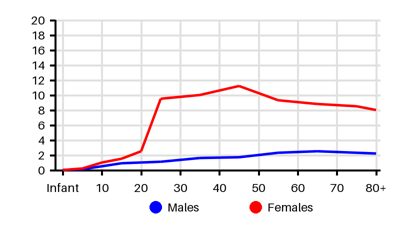
Incidence per 100.000
Symptoms & findings
Symptoms
Acne, Amenorrhea, Buffalo hump, Decreased libido, Depression, Hirsutism, Hyperpigmentation, Hypertension, Impaired memory, Moon face, Muscle atrophy, Muscle weakness, Obesity, Stria, Weight gain
Clinical findings
Elevated Cortisol, Elevated Hematocrit, Elevated Hemoglobin, Hyperglycemia, Osteoporosis, Polycythemia
Anamneses
Localized findings
Approach
Blood test: ACTH, cortisol (morning and midnight)
Urinary cortisol (24-hour)
Salivary cortisol (midnight)
Dexamethasone test
CT abdomen
MR caput
Petrosal sinus sampling
Treatment
Medical treatment: [zft]
Iatrogenic: gradual withdrawal of the causative drug
Inhibitors of ACTH: Pasireotide (somatostatin receptor ligand)
Adrenal inhibition: Ketoconazole, Metyrapone, Mitotane and Etomidate
Glucocorticoid receptor blockade: Mifepristone
Treatment of comorbidities (hypertension, diabetes, obesity, dyslipidemia)
Surgical resection of the causative tumor [zft]
Pituitary surgery
Adrenalectomy (bilateral if pituitary therapy fail or ectopic ACTH-producing tumors are difficult to locate/resect)
Ectopic ACTH --> resection of metastatic adrenal carcinoma
Pituitary radiation therapy
Differential diagnoses
Alcoholism, Cancer origo incerta, Cushings disease, Depression, Lipodystrophy Syndromes, Obesity, Primary Generalized Glucocorticoid Resistance Syndrome
References
[1] Uwaifo GI, Hura DE. Hypercortisolism. [Updated 2023 Jul 4]. In: StatPearls [Internet]. Treasure Island (FL): StatPearls Publishing; 2025 Jan-. Available from: https://www.ncbi.nlm.nih.gov/books/NBK551526/
[2] Lindholm J, Juul S, Jørgensen JO, et al. Incidence and late prognosis of Cushing’s syndrome: a population-based study. J Clin Endocrinol Metab. 2001;86(1):117-123.
[3] https://emedicine.medscape.com/article/2233083
[4] Broder MS, Neary MP, Chang E, Cherepanov D, Ludlam WH. Incidence of Cushing's syndrome and Cushing's disease in commercially-insured patients <65 years old in the United States. Pituitary. 2015 Jun;18(3):283-9.
[5] Bolland MJ, Holdaway IM, Berkeley JE, et al. Mortality and morbidity in Cushing’s syndrome in New Zealand. Clin Endocrinol (Oxf). 2011;75(4):436-442.
[6] Wengander S, Trimpou P, Papakokkinou E, Ragnarsson O. The incidence of endogenous Cushing’s syndrome in the modern era. Clin Endocrinol (Oxf). 2019;91(2):263-270.
[7] Hakami OA, Ahmed S, Karavitaki N. Epidemiology and mortality of Cushing's syndrome. Best Pract Res Clin Endocrinol Metab. 2021 Jan;35(1):101521.
[8] Lindholm J, Juul S, Jørgensen JO, Astrup J, Bjerre P, Feldt-Rasmussen U, Hagen C, Jørgensen J, Kosteljanetz M, Kristensen L, Laurberg P, Schmidt K, Weeke J. Incidence and late prognosis of cushing's syndrome: a population-based study. J Clin Endocrinol Metab. 2001 Jan;86(1):117-23.