Diagnosis
Hypomagnesemia
Abnormally low magnesium levels in the blood:
Serum Mg < 0,7 mmol / 1,7 mg/dL
Symptomatic when < 0.5 mmol/L / 1.2 mg/dL
Etiology
Causes [fs8]
Starvation
Critically ill patient
Diabetes Mellitus
Alcoholism: inadequate intake and excessive renal excretion
GI losses: diarrhea, malabsorption (ulcerative colitis, Crohn disease, Gastric bypass surgery)
Pregnancy: Preeclampsia/eclampsia, lactation
Renal loss: Gitelmans syndrome, Bartter Syndrome, Hypercalcemia, Diabetic ketoacidosis, Hyperaldosteronism, hyperthyroidism, SIADH, Nephrotoxins, Familial hypomagnesemia with hypercalciuria and nephrocalcinosis, acute tubular dysfunction (post-kidney transplant, Postobstructive diuresis)
Drugs: Diuretics (Loop, Thiazide, Mannitol), PPI, aminoglycosides, amphotericin B, foscarnet, pentamidine, calcineurin inhibitors, mTOR, potassium binders (resonium, patiromer), Digitalis, Cisplatin, Laxative, Insulin, Metformin, Terbutaline, Theophylline
Extracellular to intracellular shift: Insulin, refeeding syndrome, correction of metabolic acidosis, pancreatitis
Hungry bone syndrome (following parathyroidectomy or thyroidectomy)
Pathophysiology [fs8]
Magnesium is the second most abundant cation within the body’s cells, essential for:
Cellular function
Neurotransmission
Cardiac conduction
Cofactor in >300 enzyme reactions
Platelet function (clotting and thrombus formation)
Maintenance of vascular tone
Muscle contraction and relaxation
Insulin regulation
Bone formation
Despite magnesium's widespread presence in food sources, magnesium deficiency remains prevalent globally, even in developed nations [ueh]
Magnesium deficiency causes: [wo3][vqk][fs8]
Neuromuscular Manifestations
Neuromuscular hyperexcitability, tremor, tetany, muscle spasms, muscle cramps, choreoathetosis, seizure, nystagmus, apathy, delirium, depression, agitation, psychosis, delirium, coma
Cardiovascular Manifestations
ECG: wide QRS, peaked T waves, prolonged PR, diminution of the T wave
Atrial and ventricular premature systoles
Atrial fibrillation
Ventricular arrhythmias
Cardiac ischemia
Increased risk of digoxin toxicity
Vasoconstriction/vasospasm
Endothelial injury
Increased rate of thrombosis (risk factors for stroke)
Atherosclerosis
Electrolyte and Hormone Abnormalities
Hypocalcemia
Hypoparathyroidism
Hypokalemia
Complications [fs8]
Fatal ventricular arrhythmia (torsades de pointes)
Chondrocalcinosis
Epidemiology
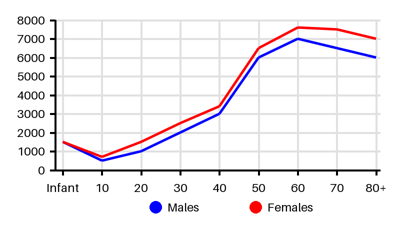
Prevalence per 100.000 [fs8][97r][ueh][wo3][vqk]
Symptoms & findings
Symptoms
Agitation, Anorexia, Apathy, Arrhythmia, Coma, Delirium, Depression, Fasciculations, Headache, Hyperreflexia, Lethargy, Muscle cramps, Nausea, Nystagmus, Psychosis, Seizure, Tetany, Tremor, Trousseau's sign, Vomiting, Weakness
Clinical findings
Atrial fibrillation, Chvostek's sign, Flat T wave, Hypercalcemia, Hyperglycemia, Hypocalcemia, Hypokalemia, Peaked T wave, Prolonged PR interval, Prolonged QRS complex
Anamneses
None listed.
Approach
Blood test: Mg, Ca, phosphate, glucose, creatinine
Urine: 24-hour Mg
Fractional excretion of magnesium: (uMg x pCr) / (0.7 x pMg x uCr) [fs8]
ECG
Treatment
Assessment of the severity of symptoms and determination of the etiology: [gsw]
Life-threatening symptoms (seizures and ventricular arrhythmias) [fs8]
Rapid stabilization: Magnesium sulfate 1-2g over 15 minutes IV
Eclampsia: 4-6g administered over 20-30 minutes
Nonemergency situations:
Discontinue drugs casing hypomagnesemia
Severe hypomagnesemia in a stable patient: Magnesium sulfate 1gram/hour IV
Oral magnesium 300mg per day: lack of empiric evidence regarding the oral bioavailability. Because of its poor absorption, magnesium is an effective osmotic laxative, and the severity of diarrhea increases linearly with the magnesium content of stool.
Subcutaneous delivery of magnesium sulfate has been used in intractable hypomagnesemia.
Differential diagnoses
Clostridium tetani, Diabetes mellitus, Hyperkalemia, Hyperphosphatemia, Hyperventilation, Hypocalcemia, Hypocapnia, Hypokalemia, Hypoparathyroidism, Milk-alkali syndrome
References
[1] Gragossian A, Bashir K, Bhutta BS, et al. Hypomagnesemia. https://www.ncbi.nlm.nih.gov/books/NBK500003/
[2] Khanum M, Arshad U, Ullah I, Shakir HA. Frequency of Hypomagnesemia and Its Relationship With Severity Among Patients of Acute Ischemic Stroke Presenting to a Tertiary Care Hospital. Cureus. 2024 Apr 14;16(4):e58244.
[3] Ghayyur A, Hussain SS, Butt A, Shahid S, Asif HH, Nisar S. Risk factors of Hypomagnesemia in Patients with Acute Ischemic Stroke: a cross sectional study of a tertiary care hospital, Lahore Pakistan during 2015. FUUAST J. BIOL., 7(1): 23-32. 2017.
[4] Gautam S, Khapunj A. Prevalence of Hypomagnesemia among Elderly Patients attending a Tertiary Care Center: A Descriptive Cross-sectional Study. JNMA J Nepal Med Assoc. 2021 Jan 31;59(233):35-38.
[5] http://emedicine.medscape.com/article/2038394 (2014-01-02); [Medscape]
[6] Adomako E, Yu ASL. Magnesium Disorders: Core Curriculum 2024. CORE CURRICULUM IN NEPHROLOGY. Volume 83, Issue 6, P803-815, June 2024.
[7] [http://www.merckmanuals.com]