Diagnosis
Hyperkalemia
Mild: Potassium >5.5 mmol/l
Moderate: 6.0–6.4 mmol/l
Severe: 6.5–6.9 mmol/l
Very severe: ≥ 7.0 mmol/l
Etiology
Cause [wm1][4ku]
Increased K intake
Iatrogenic: intravenous or oral potassium supplementation, blood transfusion
Decreased potassium excretion
Renal failure (oliguria)
Primary adrenal insufficiency: Addison disease, adrenal hyperplasia, hypoaldosteronism
Drug side effects: NSAIDs, diuretics, spironolactone, Cyclosporin A, ACE inhibitors/AT-blockers (RAAS), trimethoprim, tacrolimus, pentamidine, Beta blockers, Digoxin toxicity, amiloride, Fluoride toxicity, Methotrexate, Propofol infusion syndrome, Succinylcholine, Heparins, Penicillin G
Transcellular potassium shifts
Acidosis: hydrogen ion enters a cell --> decreased K+ uptake by the cell in order to maintain electrical neutrality
Diabetes type 1 (insulin deficiency)
Dehydration
Acute tubular necrosis
Cell destruction:
Pseudohyperkalemia due to hemolysis in the laboratory, leukocytosis, or thrombocytosis
Burns
Tumor lysis syndrome
Rhabdomyolysis
Strenuous or prolonged exercise
Malignant hyperthermia
Pathophysiology [4ku]
The sodium-potassium pump
Intracellular potassium concentration: 140 mEq/L
Extracellular potassium concentration: 4 to 5 mEq/L
95-98% of the total body potassium is found in the intracellular space
Under normal conditions, approximately 90% of potassium excretion occurs in the urine, with less than 10% of potassium excreted through sweat or stool
Elevated renal potassium excretion:
Aldosterone
Diuretics
WNK1 and WNK4
High levels of serum potassium
A high flow of urine (osmotic diuresis)
Presence of negative ions in the distal tubule (bicarbonate)
Complications [4ku]
Cardiac arrest
Weakness
Arrhythmias
Paralysis
Epidemiology
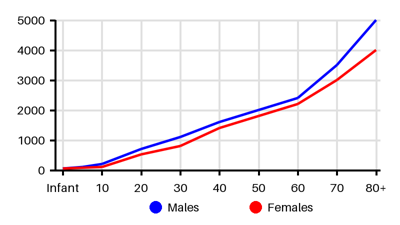
Incidence per 100.000 [h6u][swm][wm1][3hv][y7o]
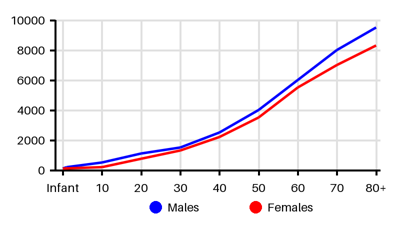
Prevalence per 100.000 [h6u][swm][wm1][3hv][y7o]
Symptoms & findings
Symptoms
Anuria, Areflexia, Arrhythmia, Bradycardia, Burns, Cardiac arrest, Diarrhea, Fatigue, Hematuria, Hyporeflexia, Ileus, Nausea, Oliguria, Palpitations, Paralysis, Paresthesia, Respiratory failure, Tachycardia, Vomiting, Weakness
Clinical findings
Acidosis, Elevated Creatinine, Elevated Lactate, Elevated Lactic Dehydrogenase, Hyperglycemia, Hypokalemia, Loss of P wave, Metabolic acidosis, Peaked T wave, Prolonged PR interval, Prolonged QRS complex, Proteinuria, Shortened QT interval, ST depression, ST elevation, Ventricular fibrillation
Anamneses
None listed.
Localized findings
Approach
Blood test: Complete blood cell count, serum electrolytes, glucose, creatinine, blood urea nitrogen, osmolality, digoxin level test, uric acid/phosphorous (for tumor lysis syndrome)
Blood gas (acid-base disorders)
Urine: stix, urine electrolyte, osmolality
Ultrasound abdomen (renal circulation, post-renal obstruction)
ECG
Digitoxin level
Treatment
Avoid high-potassium foods: [y9d]
Salt substitutes
Yogurt and milk
Molasses
Seaweed
Chocolate
Cereal, wheat, granola
Vegetables (acorn squash, artichoke, bamboo shoots, beets, broccoli, brussel sprouts, chinese cabbage, carrots, greens (except kale), kohlrabi, mushrooms (canned), parsnips, potatoes, pumpkin, rutabagas, spinach, tomatoes, vegetable juices)
Dried fruit (apricot, dates, figs, raisins, prunes)
Nuts and seeds
Dried peas and beans (lima beans, black beans, refried beans, lentils, legumes)
Fruit and juice (apricot, avocado, banana, cantaloupe, grapefruit, honeydew, kiwi fruit, mango, nectarine, orange, papaya, pomegranate, prune)
Medical treatment: [cue][nsi][o2e]
If K > 5.0 mmol/l:
Patiromer (Veltassa): 8.4 g orally per day, can titrate up to 25.2 g per day
Sodium polystyrene sulfonate: 15 g orally once per day; can repeat up to 4 times per day
Sodium zirconium cyclosilicate (Lokelma): 10 g orally 3 times per day
If K > 6.0 mmol/l:
Intravenous calcium if ECG-changes for immediate effect:
Calcium gluconate 1-2 g or 10 to 20 mL of 10 percent solution IV over 2-3 minutes
Calcium chloride 500-1,000 mg
Diuretics: give with saline if volume depletion
Furosemide: 20 to 40 mg iv/po
Bumetanide: 0.5 to 1 mg iv/po
Insulin with glucose: 10 units IV with 50 mL of 50 percent glucose
Albuterol (Ventolin): 10 to 20 mg by nebulizer over 10 minutes
If increasing K:
Hemodialysis
Differential diagnoses
Acidosis, Adrenal insufficiency, Blood transfusion, Burn wound, Congenital adrenal hyperplasia, Drug side effects, Electrical injury, Hemolysis, Hypoaldosteronism, Hypocalcemia, Hypoinsulinemia, Lab error, Metabolic acidosis, Renal failure, Rhabdomyolysis, Tumor lysis syndrome
References
[1] https://emedicine.medscape.com/article/907543
[2] Simon LV, Hashmi MF, Farrell MW. Hyperkalemia. [Updated 2023 Sep 4]. In: StatPearls [Internet]. Treasure Island (FL): StatPearls Publishing; 2025 Jan-. Available from: https://www.ncbi.nlm.nih.gov/books/NBK470284/
[3] Humphrey T, Davids MR, Chothia MY, Pecoits-Filho R, Pollock C, James G. How common is hyperkalaemia? A systematic review and meta-analysis of the prevalence and incidence of hyperkalaemia reported in observational studies. Clin Kidney J. 2021 Dec 2;15(4):727-737.
[4] Nilsson E, Gasparini A, Ärnlöv J, Xu H, Henriksson KM, Coresh J, Grams ME, Carrero JJ. Incidence and determinants of hyperkalemia and hypokalemia in a large healthcare system. Int J Cardiol. 2017 Oct 15;245:277-284.
[5] Belmar Vega L, Galabia ER, Bada da Silva J, Bentanachs González M, Fernández Fresnedo G, Piñera Haces C, Palomar Fontanet R, Ruiz San Millán JC, de Francisco ÁLM. Epidemiology of hyperkalemia in chronic kidney disease. Nefrologia (Engl Ed). 2019 May-Jun;39(3):277-286. English, Spanish.
[6] Einhorn LM, Zhan M, Hsu VD, Walker LD, Moen MF, Seliger SL, Weir MR, Fink JC. The frequency of hyperkalemia and its significance in chronic kidney disease. Arch Intern Med. 2009 Jun 22;169(12):1156-62.
[7] Raymond CB, Sood AR, Wazny LD. Treatment of hyperkalemia in patients with chronic kidney disease--a focus on medications. CANNT J. 2010 Jul-Sep;20(3):49-53; quiz 54-5. PMID: 21038829.
[8] Hollander-Rodriguez JC, Calvert JF Jr. Hyperkalemia. Am Fam Physician. 2006 Jan 15;73(2):283-90. PMID: 16445274.
[9] Kim MJ, Valerio C, Knobloch GK. Potassium Disorders: Hypokalemia and Hyperkalemia. Am Fam Physician. 2023 Jan;107(1):59-70. PMID: 36689973.
[10] Alfonzo, A., Harrison, A., Baines, R., Chu, A., Mann, S. and MacRury, M. (2020) Renal Association Clinical Practice Guidelines—Treatment of Acute Hyperkalaemia in Adults