Diagnosis
Mononucleosis
An acute and self-limited infection of the lymphatic system characterized by sore throat (pharyngitis), cervical lymphadenopathy, fatigue and fever.
Also known as: EBV, Epstein–Barr virus, Glandular fever
Etiology
Cause [crs][b87][esg][qqd]
Epstein-Barr virus (>90%)
Other causes: Cytomegalovirus, Adenovirus, Toxoplasma gondii, adenovirus, Hepatitis A virus, HIV, rubella virus, herpes virus, group A beta-hemolytic streptococci
Pathophysiology
Virus is transmitted via intimate contact with body (oropharyngeal) secretions
Incubation period is long: 3-6 weeks
EBV infects the B cells in the oropharyngeal epithelium. Circulating B cells spread the infection to liver, spleen, and peripheral lymph nodes
This results in a humoral and cellular response to the virus
T-lymphocyte response is essential in the control of EBV infection; natural killer (NK) cells and predominantly CD8 cytotoxic T cells control proliferating B lymphocytes infected with EBV
EBV is a lifelong infection with periodic reactivation
The majority of patients recover without sequelae and develop lifelong immunity to controlling the dormant virus
Ineffective T-cell response (immunosuppresion) may result in excessive and uncontrolled B-cell proliferation, resulting in B-cell lymphomas
Complications [n8g][qqd]
Spontaneous splenic rupture
Airways obstruction due to oropharyngitis or massive lymphadenopathy
Meningoencephalitis
Autoimmune hemolytic anemia
Pancytopenia: Thrombocytopenia, neutropenia
Cardiac complications: Myocarditis, pericarditis
Ocular complications: Episcleritis, uveitis, conjunctivitis
Erythema multiforme
Pancreatitis
Parotitis
Pnemonitis
B-cell lymphoma
Nasopharyngeal carcinoma
Gastric carcinoma
Posttransplant lymphoproliferative disorder (PTLD)
Hemophagocytic lymphohistiocytosis (HLH)
Epidemiology
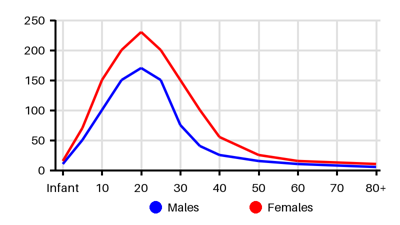
Incidence per 100.000 [bc8][ddo][esg][bsy][hp7][du5][3az][n8g][zvp][1ps][qqd]
Symptoms & findings
Symptoms
Anorexia, Arthralgia, Confusion, Fatigue, Fever, Headache, Hepatomegaly, Lymphadenopathy, Malaise, Myalgia, Nausea, Odynophagia, Petechia, Sore throat, Splenomegaly
Clinical findings
Atypical lymphocytes, Elevated ALAT, Elevated ASAT, Elevated Bilirubin, Jaundice, Leukocytosis, Monospot, Thrombocytopenia
Anamneses
None listed.
Localized findings
Approach
Blood test: WBC, thrombocyte, liver function test
Heterophile antibody (monospot): [n8g]
+ Negative 3–12 months postinfection
- Nonspecific: false positives due to acute infections and autoimmune diseases
VCA IgM antibody:
+ Specific
+ Negative 3–12 months postinfection
VCA IgG antibody:
Best test for diagnosis of past EBV infection
EBNA-1 IgG antibody:
Best test to distinguish acute from convalescent EBV infection
EA antibody:
+ A marker of acute infection
- Absent in 20–40% of acute illnesses
Immunoblot antibodies:
+ Used to stage infection (acute, convalescent, past)
- Relatively expensive
Blood viral load: best test to monitor severity of the infection
Oral viral load:
Confirms past infection
Cannot be used to diagnose acute infection
Peripheral blood smear: atypical lymphocytes
Bone marrow smear
Biopsy
CT
Treatment
There is no specific treatment for infectious mononucleosis [qqd]
Supportive care:
Hydration
Rest
Nutritional intake
NSAIDs, paracetamol, throat sprays to treat fever, sore throat, and fatigue
No clinical evidence regarding acyclovir, valacyclovir, ganciclovir, or corticosteroids
Antibiotics can result in a generalized maculopapular rash
Hospitalization if complications: splenic rupture, airway compromise, dehydration, thrombocytopenia, hemolytic anemia, and neurologic complications.
Differential diagnoses
Adenovirus, Bacterial tonsillitis, Cytomegalovirus, Depression, Diphtheria, Drug eruptions, Encephalitis, Erythema multiforme, Fibromyalgia, Gianotti-Crosti syndrome, Guillain-Barre syndrome, Hemophagocytic lymphohistiocytosis, Herpes simplex, HIV, Influenza, Leukemia, Lyme disease, Meningitis, Mumps, Peritonsillar abscess, Pharyngitis, Posttransplant lymphoproliferative disorder, Rickettsia, Rubella, Scarlet fever, Splenic injury, Toxoplasmosis, Viral hepatitis
References
[1] Mohseni M, Boniface MP, Graham C. Mononucleosis. [Updated 2023 Aug 8]. In: StatPearls [Internet]. Treasure Island (FL): StatPearls Publishing; 2025 Jan-. Available from: https://www.ncbi.nlm.nih.gov/books/NBK470387/
[2] https://emedicine.medscape.com/article/784513
[3] Morris MC, Edmunds WJ. The changing epidemiology of infectious mononucleosis? J Infect. 2002 Aug;45(2):107-9.
[4] https://emedicine.medscape.com/article/963894
[5] Dunmire SK, Hogquist KA, Balfour HH. Infectious Mononucleosis. Curr Top Microbiol Immunol. 2015;390(Pt 1):211-40.
[6] Kuri, A., Jacobs, B.M., Vickaryous, N. et al. Epidemiology of Epstein-Barr virus infection and infectious mononucleosis in the United Kingdom. BMC Public Health 20, 912 (2020).
[7] Hubble MP, Lai PK, Mackay-Scollay M, Alpers MP. Epidemiology of infectious mononucleosis in Western Australia: A retrospective hospital survey, 1966-1972. Med J Aust. 1974 Dec 14;2(24):863-6.
[8] Stahlman S, Williams VF, Ying S. Infectious mononucleosis, active component, U.S. Armed Forces, 2002-2018. MSMR. 2019 Jul;26(7):28-33.
[9] Hunt G, Brady MT. Chapter 311. Epstein-Barr Virus Mononucleosis. In: Rudolph CD, Rudolph AM, Lister GE, First LR, Gershon AA. eds. Rudolph's Pediatrics, 22e. The McGraw-Hill Companies; 2011. Accessed December 19, 2024.
[10] Williams-Harmon YJ, Jason LA, Katz BZ. Incidence of Infectious Mononucleosis in Universities and U.S. Military Settings. J Diagn Tech Biomed Anal. 2016 Jun;5(1):10.4172/2469-5653.1000113.
[11] Leung AKC, Lam JM, Barankin B. Infectious Mononucleosis: An Updated Review. Curr Pediatr Rev. 2024;20(3):305-322.
[12] Takeuchi K, Tanaka-Taya K, Kazuyama Y, Ito YM, Hashimoto S, Fukayama M, Mori S. Prevalence of Epstein-Barr virus in Japan: trends and future prediction. Pathol Int. 2006 Mar;56(3):112-6.
[13] Balfour HH Jr, Sifakis F, Sliman JA, Knight JA, Schmeling DO, Thomas W. Age-specific prevalence of Epstein-Barr virus infection among individuals aged 6-19 years in the United States and factors affecting its acquisition. J Infect Dis. 2013 Oct 15;208(8):1286-93.