Diagnosis
Spontaneous bacterial peritonitis
Acute infection of ascites (an abnormal accumulation of fluid in the abdomen) without an identifiable source of infection.
Etiology
Cause [ega][y2f][b8m]
Enteric aerobic gram-negative Escherichia coli (90%)
Klebsiella pneumonia
Gram-positive organisms (Streptococcus, Staphylococcus, and Enterococcus)
Listeria monocytogenes
Candida albicans
Pathophysiology [b8m][vw9]
Bacterial displacement from the GI tract into ascites
Transmural migration?
Hematogenous transmission?
Liver disease:
Cirrhosis --> ascites + delayed intestinal transit --> intestinal bacterial overgrowth
Compromised host defense: Impaired phagocytes, low complement levels, malfunctioning reticuloendothelial system --> prolonged bacteremia
Migration into ascites --> peritonitis
Risk factors [vw9][6az]
Peritoneal dialysis
Child-Pugh stage C
Elevated MELD score
Portal hypertension
H2 antagonists and proton-pump inhibitors
Ascites: Heart failure, Budd-Chiari syndrome
Nephrotic syndrome
Systemic lupus erythematosus
Decreased albumin
Complications [b8m]
Renal failure
Liver failure
Sepsis
Multi organ failure
Bleeding after paracentesis
Bowel perforation after paracentesis
Spontaneous fungal peritonitis
Epidemiology
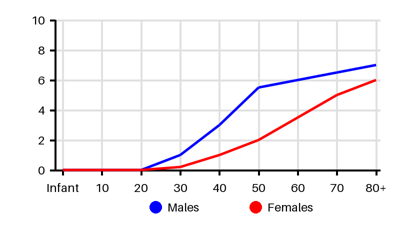
Incidence per 100.000 [zwa][cbs][y2f][ega][btp][ytz][314]
Symptoms & findings
Symptoms
Chills, Confusion, Decreased consciousness, Delirium, Diarrhea, Fever, Icterus, Ileus, Malaise, Nausea, Spider nevus, Tachycardia, Tachypnea, Thirst, Vomiting
Clinical findings
Ascites, Elevated ASAT, Elevated Bilirubin, Elevated Creatinine, Elevated CRP, Elevated Lactic Dehydrogenase, Elevated PT-INR, Jaundice, Leukocytosis
Anamneses
None listed.
Localized findings
Approach
Blood test: Bilirubin, albumin, INR, cretinine, platelets, ASAT, ALAT, CRP [ytz]
Blood gas
Blood culture
Urine culture
Diagnostic paracentesis: cell count, differential, culture, cytology, lactate, pH
Abdominal x-ray
Ultrasound abdomen
CT abdomen
MRI
Diagnostic criteria [y2f][b8m]
Elevated ascitic fluid absolute polymorphonuclear count (> 250 cells/uL)
No intra-abdominal surgically treatable source of infection
Treatment
Prophylaxis in high-risk patients: Ciprofloxacin or trimethoprim-sulfa [y2f][b8m]
Antibiotic therapy: Cefotaxime 8 g/24 for 5 days (or Ciprofloxacin) [y2f]
Alternative: Piperacillin-tazobactam or carbapenem
Substitution of albumin to prevent occurrence of hepatorenal syndrome in patients with total bilirubin > 4 mg/dL or creatinine > 1 mg/dL or urea nitrogen > 30 mg/dL
Differential diagnoses
Abdominal abscess, Acute mesenteric ischemia, Acute pancreatitis, Aortic dissection, Appendicitis, Diverticulitis, Gastrointestinal perforation, Perforated ulcer, Peritonitis, Pyelonephritis, Ruptured aortic aneurysm, Urinary tract infection
References
[1] Cardoso C, Cremers I, Oliveira AP. Spontaneous bacterial peritonitis caused by Listeria monocytogenes: a case report and literature review. Ann Hepatol. 2012 Nov-Dec;11(6):955-7.
[2] Lutz P, Nischalke HD, Strassburg CP, Spengler U. Spontaneous bacterial peritonitis: The clinical challenge of a leaky gut and a cirrhotic liver. World J Hepatol. 2015 Mar 27;7(3):304-14.
[3] Ameer MA, Foris LA, Mandiga P, et al. Spontaneous Bacterial Peritonitis(Archived) [Updated 2023 Aug 8]. In: StatPearls [Internet]. Treasure Island (FL): StatPearls Publishing; 2025 Jan-. Available from: https://www.ncbi.nlm.nih.gov/books/NBK448208/
[4] http://emedicine.medscape.com/article/789105 (2014-01-02); [Medscape]
[5] Schwabl P, Bucsics T, Soucek K, Mandorfer M, Bota S, Blacky A, Hirschl AM, Ferlitsch A, Trauner M, Peck-Radosavljevic M, Reiberger T. Risk factors for development of spontaneous bacterial peritonitis and subsequent mortality in cirrhotic patients with ascites. Liver Int. 2015 Sep;35(9):2121-8.
[6] Chang SS, Lai CC, Lee MG, Lee YC, Tsai YW, Hsu WT, Lee CC. Risk of spontaneous bacterial peritonitis associated with gastric Acid suppression. Medicine (Baltimore). 2015 Jun;94(22):e944.
[7] Rattanamongkolgul S, Wongjitrat C, Puapankitcharoen P. Prevalence of cirrhosis registered in Nakhon Nayok, Thailand. J Med Assoc Thai. 2010 Feb;93 Suppl 2:S87-91.
[8] Tay PWL, Xiao J, Tan DJH, Ng C, Lye YN, Lim WH, Teo VXY, Heng RRY, Yeow MWX, Lum LHW, Tan EXX, Kew GS, Lee GH, Muthiah MD. An Epidemiological Meta-Analysis on the Worldwide Prevalence, Resistance, and Outcomes of Spontaneous Bacterial Peritonitis in Cirrhosis. Front Med (Lausanne). 2021 Aug 5;8:693652.
[9] Metwally K, Fouad T, Assem M, Abdelsameea E, Yousery M. Predictors of Spontaneous Bacterial Peritonitis in Patients with Cirrhotic Ascites. J Clin Transl Hepatol. 2018 Dec 28;6(4):372-376.
[10] Kaymakoglu S, Eraksoy H, Okten A, Demir K, Calangu S, Cakaloglu Y, Boztas G, Besisik F. Spontaneous ascitic infection in different cirrhotic groups: prevalence, risk factors and the efficacy of cefotaxime therapy. Eur J Gastroenterol Hepatol. 1997 Jan;9(1):71-6.