Diagnosis
Perforated ulcer
Perforation of an peptic ulcer resulting in a communication between the gastric lumen and the peritoneal cavity.
Etiology
Cause [soq][iis]
H.pylori with Peptic Ulcer Disease
Gastric cancer (30% of gastric perforations are associated with malignancy)
Drug side effects (NSAIDs, SSRIs, corticosteroids, anticoagulants)
Smoking, alcohol, diet high in salt
Zollinger-Ellison syndrome
Trauma
Iatrogenic (endoscopy, cardiopulmonary resuscitation)
Foreign bodies (chicken bones or fish bones)
Spontaneous perforation of the stomach in the neonatal period
Pathophysiology [iis]
Acute perforation --> Leakage of acidic gastric juice into the peritoneal cavity
Profound chemical peritonitis
Contamination from the gastric contents --> Subsequent bacterial peritonitis
Perforations occurring over a prolonged period may be contained locally by the inflammatory reaction
Complications [iis]
Adhesions and bowel obstruction
Delirium
Wound infection
Bacterial peritonitis
Intraabdominal abscess
Sepsis
Multiorgan failure
Epidemiology
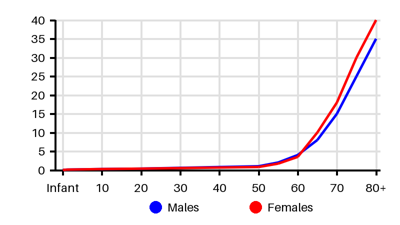
Incidence per 100.000 [soq][s88][r7h][so3][ye8][uqk][srz]
Symptoms & findings
Symptoms
Chills, Fever, Hematemesis, Hematochezia, Hiccup, Hypotension, Melena, Nausea, Oliguria, Syncope, Tachycardia, Tachypnea, Vomiting
Clinical findings
Elevated Amylase, Elevated CRP, Elevated Lactate, Hemoperitoneum, Leukocytosis, Metabolic acidosis, Peritonitis, Pneumomediastinum, Pneumoperitoneum
Anamneses
None listed.
Localized findings
Approach
Blood test
Hemofec
Abdominal x-ray [fp7]
Contrast x-ray [fp7]
CT abdomen [fp7]
Endoscopy with biopsy
Treatment
Rapid resuscitation: [fp7]
Mean arterial pressure ≥ 65 mmHg
Urine output ≥ 0.5 ml/kg/h
Lactate normalization
Non-operative management: selected cases where small perforation has sealed as confirmed on water-soluble contrast study [fp7]
Nil by mouth
Intravenous hydration
Decompression via nasogastric tube
Anti-secretory and PPI therapy
Antibiotics:
Cefotaxime 2 g 8-hourly + Metronidazole 500 mg 6-hourly
Piperacillin/tazobactam 4.5 g 6-hourly + Metronidazole 500 mg 6-hourly
Antifungal therapy if critically ill, immunocompromised, hospital-acquired infection: Fluconazole, Echinocandin, Amphotericin B
Follow-up endoscopy at 4–6 weeks
Surgery: pneumoperitoneum, extraluminal contrast leakage or peritonitis [s88][iis]
Stable patients --> laparoscopic approach
Laparoscopic suture repair
Laparoscopic fibrin glue repair
Unstable patients --> open surgery
Primary closure (with omentopexy)
Gastric wedge resection + primary closure (with omentopexy)
Billroth I: Gastroduodenostomy
Billroth II: Gastrojejunostomy
Roux-en-Y gastrojejunostomy
Endoscopic treatment: if severe co-morbidity [fp7]
Iatrogenic perforations --> endoscopic clips
Clips may be ineffective if fibrosis with loss of compliance
Covered self-expandable metal stents + laparoscopic drain placement
Differential diagnoses
Acute mesenteric ischemia, Acute pancreatitis, Aortic dissection, Appendicitis, Ascariasis, Cholecystitis, Choledocholithiasis, Cholelithiasis, Colorectal cancer, Constipation, Crohn disease, Diverticulitis, Drug side effects, Endometriosis, Esophageal perforation, Gastric cancer, Gastritis, Gastroenteritis, Gastrointestinal perforation, Ingestion of corrosives, Ischemic colitis, Meckels diverticulum, Ovarian torsion, Pelvic inflammatory disease, Ruptured aortic aneurysm, Small bowel cancer, Splenic injury, Superior mesenteric artery syndrome, Trauma, Typhoid fever, Ulcerative colitis, Ulcer disease
References
[1] Thorsen K, Søreide JA, Kvaløy JT, Glomsaker T, Søreide K. Epidemiology of perforated peptic ulcer: age- and gender-adjusted analysis of incidence and mortality. World J Gastroenterol. 2013 Jan 21;19(3):347-54.
[2] Sigmon DF, Tuma F, Kamel BG, et al. Gastric Perforation. [Updated 2023 Jun 26]. In: StatPearls [Internet]. Treasure Island (FL): StatPearls Publishing; 2025 Jan-. Available from: https://www.ncbi.nlm.nih.gov/books/NBK519554/
[3] Dadfar A, Edna TH. Epidemiology of perforating peptic ulcer: A population-based retrospective study over 40 years. World J Gastroenterol. 2020 Sep 21;26(35):5302-5313.
[4] Canoy DS, Hart AR, Todd CJ. Epidemiology of duodenal ulcer perforation: a study on hospital admissions in Norfolk, United Kingdom. Dig Liver Dis. 2002 May;34(5):322-7.
[5] Hermansson M, Ekedahl A, Ranstam J, Zilling T. Decreasing incidence of peptic ulcer complications after the introduction of the proton pump inhibitors, a study of the Swedish population from 1974-2002. BMC Gastroenterol. 2009 Apr 20;9:25.
[6] Svanes C. Trends in perforated peptic ulcer: incidence, etiology, treatment, and prognosis. World J Surg. 2000 Mar;24(3):277-83.
[7] Svanes C, Lie RT, Kvåle G, Svanes K, Søreide O. Incidence of perforated ulcer in western Norway, 1935-1990: cohort- or period-dependent time trends? Am J Epidemiol. 1995 May 1;141(9):836-44.
[8] Munoz Abraham AS, Osei H, Martino A, Kazmi S, Saxena S, Fitzpatrick CM, Villalona GA. Incidence and Outcomes of Perforated Peptic Ulcers in Children: Analysis of the Kid's Inpatient Database and Report of Two Cases Treated by Laparoscopic Omental Patch Repair. J Laparoendosc Adv Surg Tech A. 2019 Feb;29(2):248-255.
[9] Tarasconi A, Coccolini F, Biffl WL, Tomasoni M, Ansaloni L, Picetti E, Molfino S, Shelat V, Cimbanassi S, Weber DG, Abu-Zidan FM, Campanile FC, Di Saverio S, Baiocchi GL, Casella C, Kelly MD, Kirkpatrick AW, Leppaniemi A, Moore EE, Peitzman A, Fraga GP, Ceresoli M, Maier RV, Wani I, Pattonieri V, Perrone G, Velmahos G, Sugrue M, Sartelli M, Kluger Y, Catena F. Perforated and bleeding peptic ulcer: WSES guidelines. World J Emerg Surg. 2020 Jan 7;15:3.
[10] http://emedicine.medscape.com/article/195537 (2014-01-02); [Medscape]
[11] http://emedicine.medscape.com/article/181753 (2014-01-02); [Medscape]