Diagnosis
Ruptured aortic aneurysm
A life-threatening emergency where a weakened aneurysmal aortic wall tears, causing massive internal bleeding and disrupting blood flow.
Aneurism: An irreversible dilatation to at least 1.5 times its normal caliber
True aneurysm: Involves all layers of the wall
False aneurysm (pseudoaneurysm): Involves only a portion of the wall
Etiology
Cause
Degenerative: atherosclerosis
Mycotic/infected
Connective tissue disease: Marfans syndrome, Ehlers-Danlos, medial necrosis
Pseudoaneurysm: iatrogenic (catheter, anastomosis), trauma, dissection
Poststenotic: thoracic outlet syndrome, aortic/pulmonary valvular stenosis, coarctation of aorta
Pathophysiology [8mb]
Law of Laplace: wall stress = (Pressure x Radius) / (2 x wall thickness)
Risk of rupture is decided by:
The size (radius)
Rate of expansion
Hypertension (pressure)
Aneurysm shape: fusiform = low risk, saccular = average, eccentric = high risk
Position and geometry
Presence of intraluminal thrombus
Presence of wall calcification
Aortic wall thickness
Degree of wall inflammation
Rupture: Force per unit area within the vessel exceeds the tensile wall strength
Posterolateral wall rupture --> contained bleeding within the retroperitoneal space --> patient may survive for treatment
Clinical manifestation:
Hyperacute abdominal/back pain
Hypotension and tachycardia
Pulsatile abdominal mass
Grey-Turner's sign: Ecchymosis involving the flanks
Risk factors [xgv]
Age
Gender: female = higher risk of rupture
Smoking
Family history
Hypertension
Diameter: Risk of rupture related to aortic wall tension (Laplace law)
30-55mm: 1.6% annual rupture risk [pbz]
50-59mm: 3.5% annual rupture risk [iso]
60-70mm: 10-20% annual rupture risk [2va]
70-80mm: 30-40% annual rupture risk [2va]
>80mm: 30-50% annual rupture risk [2va]
Complications [xgv]
Death (30% for rAAA)
Pneumonia (5%)
Myocardial infarction (2-5%)
Groin infection (<5%)
Graft infection (<1%)
Colon ischemia (<15-20%)
Renal failure
Incisional hernia (10-20%)
Amputation
Impotence in males
Lymphocele in groin (~2%)
Late graft-enteric fistula
Endograft infection
Limb occlusion leading to acute limb ischemia
Endoleak after endovascular repair
Type I: Blood flow into the aneurysm sac due to incomplete seal
Type Ia for proximal fixation problems
Type Ib for distal fixation problems
Type II: Backflow from collateral vessels (lumbar or inferior mesenteric artery)
Type III: Blood flow into the aneurysm sac due to inadequate overlapping graft joints or rupture of the graft fabric
Type IV: Blood flow into the aneurysm sac due to the porosity of the graft fabric
Epidemiology
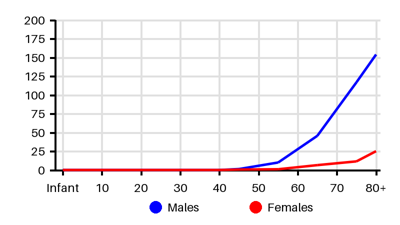
Incidence per 100.000 [qti][vzd][46c][svc][akr][vpp][vqu][fys][k1a]
Symptoms & findings
Symptoms
Coma, Cullen's sign, Cyanosis, Decreased consciousness, Diastolic murmur, Dysphagia, Dyspnea, Fox's sign, Grey Turner's sign, Heart murmur, Hematemesis, Hemiplegia, Hemoptysis, Hoarseness, Hypotension, Nausea, Pallor, Paralysis, Paresthesia, Pulselessness, Seizure, Stridor, Syncope, Systolic murmur, Tachycardia, Tachypnea, Thrill, Unconsciousness, Vascular murmur
Clinical findings
Anemia, Elevated CRP, Elevated Lactate, Hemoperitoneum, Hemothorax, Mediastinal widening, Shock
Anamneses
None listed.
Localized findings
Approach
Blood test
Blood gas
Ultrasound abdomen
CT abdomen
Angiography
MRI abdomen
Chest X-ray
CT thorax
Echocardiography
Treatment
Initial treatment: [xgv]
Airways
Breathing: O2
Circulation (sBP: 100-120 mmHg): Fluid resuscitation, blood transfusion
Pain management: IV morphine
Endovascular aortic repair (EVAR): the preferred treatment for rAAAs if it is anatomically feasible
Mortality: 20-35% (30 day), 30-41% (1-year) [zbw][ftg][8ng][g3r][r2y]
Open surgical repair:
Mortality: 24-31% (30 day), 35-44% (1-year) [zbw][ftg][8ng][g3r][r2y]
Differential diagnoses
Acute pancreatitis, Appendicitis, Cholelithiasis, Diverticulitis, Gastritis, Gastrointestinal obstruction, Inguinal hernia, Myocardial infarction, Perforated ulcer, Pneumothorax, Spinal disc herniation, Urinary tract infection, Urolithiasis
References
[1] Jeanmonod D, Yelamanchili VS, Jeanmonod R. Abdominal Aortic Aneurysm Rupture(Archived) [Updated 2023 Aug 8]. In: StatPearls [Internet]. Treasure Island (FL): StatPearls Publishing; 2025 Jan-. Available from: https://www.ncbi.nlm.nih.gov/books/NBK459176/
[2] http://emedicine.medscape.com/article/756735 (2014-01-02); [Medscape]
[3] Powell JT, Gotensparre SM, Sweeting MJ, Brown LC, Fowkes FG, Thompson SG. Rupture rates of small abdominal aortic aneurysms: a systematic review of the literature. Eur J Vasc Endovasc Surg 2011; 41(1):2-10.
[4] Parkinson F, Ferguson S, Lewis P, Williams IM, Twine CP, South East Wales Vascular N. Rupture rates of untreated large abdominal aortic aneurysms in patients unfit for elective repair. J Vasc Surg 2015; 61(6):1606-12.
[5] Lederle FA, Johnson GR, Wilson SE, Ballard DJ, Jordan WD, Jr., Blebea J, Littooy FN, Freischlag JA, Bandyk D, Rapp JH, Salam AA. Rupture rate of large abdominal aortic aneurysms in patients refusing or unfit for elective repair. Jama 2002; 287(22):2968-72.
[6] Acosta S, Ogren M, Bengtsson H, Bergqvist D, Lindblad B, Zdanowski Z. Increasing incidence of ruptured abdominal aortic aneurysm: a population-based study. J Vasc Surg. 2006 Aug;44(2):237-43.
[7] Choksy SA, Wilmink AB, Quick CR. Ruptured abdominal aortic aneurysm in the Huntingdon district: a 10-year experience. Ann R Coll Surg Engl. 1999 Jan;81(1):27-31.
[8] Schermerhorn ML, Bensley RP, Giles KA, Hurks R, Oʼmalley AJ, Cotterill P, Chaikof E, Landon BE. Changes in abdominal aortic aneurysm rupture and short-term mortality, 1995-2008: a retrospective observational study. Ann Surg. 2012 Oct;256(4):651-8.
[9] Schmitz-Rixen T, Keese M, Hakimi M, Peters A, Böckler D, Nelson K, Grundmann RT. Ruptured abdominal aortic aneurysm-epidemiology, predisposing factors, and biology. Langenbecks Arch Surg. 2016 May;401(3):275-88.
[10] Laine MT, Laukontaus SJ, Sund R, Aho PS, Kantonen I, Alback A, Venermo M. A Population-Based Study of Abdominal Aortic Aneurysm Treatment in Finland 2000 to 2014. Circulation 2017; 136(18):1726-1734.
[11] Wilmink AB, Quick CR. Epidemiology and potential for prevention of abdominal aortic aneurysm. Br J Surg 1998; 85(2):155-62.
[12] Mureebe L, Egorova N, Giacovelli JK, Gelijns A, Kent KC, McKinsey JF. National trends in the repair of ruptured abdominal aortic aneurysms. J Vasc Surg 2008.
[13] Otterhag SN, Gottsäter A, Lindblad B, Acosta S. Decreasing incidence of ruptured abdominal aortic aneurysm already before start of screening. BMC Cardiovasc Disord 2016; 16:44.
[14] Lilja F, Mani K, Wanhainen A. Editor's Choice - Trend-break in Abdominal Aortic Aneurysm Repair With Decreasing Surgical Workload. Eur J Vasc Endovasc Surg 2017; 53(6):811-819.
[15] Gunnarsson K, Wanhainen A, Djavani Gidlund K, Björck M, Mani K. Endovascular Versus Open Repair as Primary Strategy for Ruptured Abdominal Aortic Aneurysm: A National Population-based Study. Eur J Vasc Endovasc Surg 2016; 51(1):22-8.
[16] IMPROVE. Powell JT, Sweeting MJ, Thompson MM, Ashleigh R, Bell R, Gomes M, Greenhalgh RM, Grieve R, Heatley F, Hinchliffe RJ, Thompson SG, Ulug P. Endovascular or open repair strategy for ruptured abdominal aortic aneurysm: 30 day outcomes from IMPROVE randomised trial. BMJ 2014; 348:f7661.
[17] Reimerink JJ, Hoornweg LL, Vahl AC, Wisselink W, van den Broek TA, Legemate DA, Reekers JA, Balm R, Amsterdam Acute Aneurysm Trial C. Endovascular repair versus open repair of ruptured abdominal aortic aneurysms: a multicenter randomized controlled trial. Ann Surg 2013; 258(2):248-56.
[18] IMPROVE. Endovascular strategy or open repair for ruptured abdominal aortic aneurysm: one-year outcomes from the IMPROVE randomized trial. Eur Heart J 2015; 36(31):2061-2069.
[19] Desgranges P, Kobeiter H, Katsahian S, Bouffi M, Gouny P, Favre JP, Alsac JM, Sobocinski J, Julia P, Alimi Y, Steinmetz E, Haulon S, Alric P, Canaud L, Castier Y, Jean-Baptiste E, Hassen-Khodja R, Lermusiaux P, Feugier P, Destrieux-Garnier L, Charles-Nelson A, Marzelle J, Majewski M, Bourmaud A, Becquemin JP, Investigators E. Editor's Choice - ECAR (Endovasculaire ou Chirurgie dans les Anevrysmes aorto-iliaques Rompus): A French Randomized Controlled Trial of Endovascular Versus Open Surgical Repair of Ruptured Aorto-iliac Aneurysms. Eur J Vasc Endovasc Surg 2015; 50(3):303-10.