Diagnosis
Viral hepatitis
Acute or chronic infection of the liver due to a viral infection:
Short-term (acute) illness characterized by fever, nausea, abdominal pain, malaise, and jaundice. In some cases, these acute infections are mild or do not cause any symptoms.
Chronic infections with or without symptoms that may lead to life-threatening complications.
Etiology
Cause [gvy][4sg]
Hepatitis A virus:
Fecal-oral contamination from objects, food, or drinks (poor sanitation)
Incubation period: 4 weeks
Acute hepatitis: malaise, anorexia, nausea, vomiting, and jaundice
Usually self-limiting without treatment or severe liver failure with mortality (1%)
Hepatitis A infections do not become long-term (chronic)
Hepatitis B virus:
Blood-borne pathogen spreading through blood (IV drugs, MSM) or body fluids (semen, vaginal mucus, saliva, tears and smaller amount in stool, urine, or sweat)
Incubation period: 12 weeks
Clinical presentation: usually mild self-limiting, rarely fulminant hepatic failure (1%)
The risk for chronic infection becomes lower with age:
90% among infants infected at birth
25-50% of children infected at age 1-5
5% of persons infected as adults will become chronically infected
Complications: cirrhosis, liver cancer, liver failure, and death
Hepatitis C virus:
Blood-borne pathogen spreading through blood, birth (rare) or body fluids (rare)
Incubation period: 8 weeks
Approximately 55-85% develop chronic infections with or without symptoms
Complications: cirrhosis, liver cancer, liver failure, and death
Hepatitis D virus:
Incubation period: 13 weeks
Requires hepatitis B virus for replication (uses HBsAg as envelope protein)
May result in a sudden worsening of hepatitis B and fulminant hepatic failure
Hepatitis E virus:
Fecal-oral transmission (contaminated water or maternal-neonatal transmission)
Incubation period: 2-10 weeks
Chronic infection described in organ transplant recipients
Pregnant women infected during the third trimester have a greater than 25% risk of mortality with a risk of fulminant hepatic failure
Hepatitis G virus (Human Pegivirus)
Transmission by blood, sexual contact and vertical transmission
Incubation period: 2-3 weeks
Presents as a coinfection in patients with chronic hepatitis B or C infections
Other virus infections that rarely cause hepatitis in the immunocompetent state:
Cytomegalovirus (CMV)
Epstein-Barr virus (EBV)
Herpes simplex virus (HSV)
Varicella-zoster virus (VZV)
Other causes of hepatitis:
Infectious: bacteria, protozoa, parasite, fungus
Autoimmune
Drugs: paracetamol, antibiotics
Ischemic
Metabolic: Hemochromatosis, Wilson disease, Alpha 1-antitrypsin deficiency
Toxin: alcohol, mushroom
Pregnancy: HELLP, Preeclampsia
Pathophysiology [4sg]
Incubation/Viral Replication Phase:
Asymptomatic
Positive for markers of hepatitis
Prodromal Phase:
Symptoms: anorexia, nausea, vomiting, malaise, pruritus, arthralgia, and fatigue
Mimicking gastroenteritis or any systemic viral infection
Icteric Phase:
Dark-colored urine
Pale-colored stool
Jaundice
Right upper quadrant pain
Hepatomegaly
Elevated liver enzymes
End-phase:
Convalescent Phase:
Resolution of symptoms
Liver enzymes returning to normal levels
Acute fulminant hepatic failure:
Chronic hepatitis
Complications [4sg]
Acute fulminant liver failure
Hepatic encephalopathy
Portal hypertension
Ascites
Spontaneous bacterial peritonitis
Variceal bleeding
Hepatorenal syndrome
Chronic infection --> Chronic liver failure
Cirrhosis
Hepatocellular carcinoma
Epidemiology
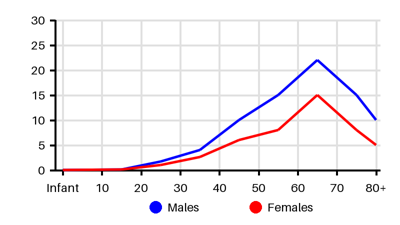
Incidence per 100.000 [gvy][ake][wp4][ngf][6yk]
Symptoms & findings
Symptoms
Acholia, Acne, Anorexia, Coma, Confusion, Dark urine, Decreased consciousness, Diarrhea, Edema, Fatigue, Fever, Headache, Hematemesis, Hematochezia, Hepatomegaly, Hypotension, Icterus, Lymphadenopathy, Malaise, Myalgia, Nausea, Pruritus, Spider nevus, Splenomegaly, Tachycardia, Unconsciousness, Vomiting
Clinical findings
ANA, ANCA, Anemia, Anti-SMA, Ascites, Bilirubinuria, Cholestasis, Decreased Albumin, Elevated ALAT, Elevated ALP, Elevated ASAT, Elevated Bilirubin, Elevated GGT, Elevated PT-INR, Hypergammaglobulinemia, Jaundice, Thrombocytopenia
Anamneses
None listed.
Localized findings
Approach
Blood test: ASAT, ALAT, PT-INR, Bilirubin, Albumin, GGT, ALP
Ultrasound
CT abdomen
ERCP/MRCP
Liver biopsy
Serelogy/PCR-algorythm:
Hepatitis A virus:
anti-HAV IgM pos --> acute infection
anti-HAV IgG pos --> immune (natural infection)
HAV-PCR --> detection of Hepatitis A Virus in stool, blood, liver tissue
Hepatitis B virus:
HbsAg neg / anti-HBc neg / anti-HBs neg --> susceptible
HbsAg neg / anti-HBc pos / anti-HBs pos--> immune (natural infection)
HbsAg neg / anti-HBc neg / anti-HBs pos --> immune (vaccination)
HbsAg pos / anti-HBc pos / anti-HBc IgM pos / anti-HBs neg --> acute infection
HbsAg pos / anti-HBc pos / anti-HBc IgM neg / anti-HBs neg --> chronic infection
HbsAg neg / anti-HBc pos / anti-HBs neg --> unclear interpretation: resolved infection, false positive, low level chronic infection
Hepatitis C virus:
anti-HCV neg --> no infection
anti-HCV pos --> HCV-PCR pos --> active HCV-infection with viremia
anti-HCV pos --> HCV-PCR neg --> no active HCV infection (interpretation: historic infection, false positive, follow-up HCV-PCR testing required)
Hepatitis D/E virus:
anti-HDV/anti-HEV: IgM and IgG
PCR to detect virus in serum/stool
Hepatitis G virus (Pegivirus):
PCR to detect virus
Treatment
Hepatitis A virus: [4sg]
Prophylactic vaccination, sanitation, and strict personal hygiene
No antiviral therapy is available
Supportive treatment due to risk of dehydration and acute liver failure
Hepatitis B virus:
Prophylactic vaccination
Acute hepatitis:
Supportive treatment
If acute liver failure (INR >1.5, bilirubin >10 mg/dL), protracted course >4 weeks or immunocompromised: nucleoside or nucleotide analogs
Chronic hepatitis:
Pegylated interferon α for 48 weeks and lifelong nucleoside/nucleotide analog
Liver failure/cancer: Liver transplantation + Hepatitis B immune globulin (HBIG)
Hepatitis C virus:
Antiviral therapy can cure >95%:
Glecaprevir 300 mg / pibrentasvir 120 mg for 8 weeks
Sofosbuvir 400 mg / velpatasvir 100 mg for 12 weeks
Chronic hepatitis:
Eradication therapy with the same regimen as in acute HCV
Decompensated cirrhosis/cancer --> Liver transplantation
Hepatitis D/E/G virus:
HBV/HDV coinfection: pegylated interferon (PEG-IFN)
HEV: Supportive
HGV: No recommendation
Complications:
Hepatic encephalopathy: oral lactulose, rifaximin
Gastrointestinal bleeding: Endoscopy with sclerotherapy or band ligation, PPI, somatostatin/octreotide, antibiotics, transjugular intrahepatic portosystemic shunt (TIPS)
Ascites: restriction of dietary sodium intake of 2000 mg daily, oral diuretic agents (spironolactone and furosemide), paracentesis if severely symptomatic
Spontaneous bacterial peritonitis: intravenous antibiotics
Hepatocellular carcinoma: radiofrequency ablation, transarterial chemoembolization, systemic chemotherapy, surgical resection, liver transplantation
Differential diagnoses
Acute pancreatitis, Alcoholic liver disease, Aortic dissection, Autoimmune hepatitis, Budd-Chiari syndrome, Celiac disease, Cholangitis, Cholecystitis, Cholelithiasis, Drug-induced liver injury, Gastroenteritis, Gastrointestinal obstruction, Hepatocellular carcinoma, Internal hemorrhage, Intussusception, Liver abscess, Pancreatic cancer, Primary biliary cirrhosis, Primary sclerosing cholangitis, Ruptured aortic aneurysm, Systemic lupus erythematosus, Ulcerative colitis, Ulcer disease
References
[1] New York State Department of Health: Hepatitis B and C Annual Report 2020 https://www.health.ny.gov/statistics/diseases/communicable/docs/2020_hepatitis_b_c_annual_report.pdf
[2] Grant LM, Purres M. Viral Hepatitis. [Updated 2024 Mar 10]. In: StatPearls [Internet]. Treasure Island (FL): StatPearls Publishing; 2025 Jan-. Available from: https://www.ncbi.nlm.nih.gov/books/NBK554549/
[3] https://www.cdc.gov/hepatitis/statistics/2021surveillance/hepatitis-c/figure-3.4.htm
[4] Zhao Q, Jiang S, Li M, Yao L, Ma X, Li M, Wang C, Pan Y, Zhao H, Li B. Incidence trend and age-period-cohort analysis of reported hepatitis C among residents aged 30 to 79 in northeastern China, 2008 to 2017. Medicine (Baltimore). 2020 Sep 4;99(36):e22005.
[5] New York State Department of Health: Hepatitis B and C Annual Report 2020: https://www.cdc.gov/hepatitis/statistics/2020surveillance/hepatitis-b/figure-2.4.htm
[6] Miao N, Zheng H, Sun X, Wang F, Zhang G, Yin Z. Acute Hepatitis B - China, 2005-2019. China CDC Wkly. 2020 Jul 24;2(30):559-563.
[7] http://emedicine.medscape.com/article/170539 (2014-01-02); [Medscape]
[8] http://emedicine.medscape.com/article/172356 (2014-01-02); [Medscape]
[9] http://emedicine.medscape.com/article/775507 (2014-01-02); [Medscape]