Diagnosis
Renal cell carcinoma
Carcinoma originating from the renal parenchyma.
Also known as: Kidney cancer
Etiology
Cause [oag]
Sporadic/nonhereditary (96%): associated with structural alterations of chromosome 3
Hereditary (4%): Genetic defect with translocation between chromosomes 3 and 8
Von Hippel-Lindau Syndrome, Hereditary Leiomyomatosis, Aggressive Papillary Carcinoma Syndrome, Hereditary Papillary Carcinoma, Birt-Hogg-Dubé syndrome, Tuberous Sclerosis Syndrome
Type of kidney cancers [oag]
Renal cell carcinoma (>90% of all renal malignancies)
Clear cell RCC (70-80% of all RCC)
Multilocular cystic renal neoplasm of low malignant potential
Papillary RCC
Hereditary leiomyomatosis RCC
Chromophobe RCC
Collecting duct carcinoma
Renal medullary carcinoma
MiT Family translocation carcinomas
Succinate dehydrogenase (SDH) deficient RCC
Mucinous tubular and spindle cell carcinoma
Tubulocystic RCC
Acquired cystic disease-associated RCC
Clear cell papillary RCC
Transitional cell carcinoma of the renal pelvis (behave like bladder cancer)
Renal sarcoma (rare)
Pathophysiology [oag]
Genetic mutation in the proximal renal tubular epithelium
RCC usually remain asymptomatic until late in the disease
Clinical presentation:
Most are detected incidentally
Flank pain/fullness
Hematuria
Varicocele due to tumor invasion into the renal vein
Hypercalcemia (bony metastasis or a paraneoplastic phenomenon)
Other symptoms: fatigue, weight loss, fever, night sweats, malaise, hypertension, and anemia
Metastatic pattern: [j15]
Lung (75%)
Soft tissues (36%)
Bone (20%)
Liver (18%)
Cutaneous sites (8%)
Central nervous system (8%)
Risk factors [oag]
Male
Old age
Smoking
Obesity
Hypertension
Chronic renal failure
Alcohol
Diabetes
Physical activity
Exposure to cadmium, asbestos and solvents (trichloroethylene)
Complications [oag]
Metastasis
Paraneoplastic phenomenon: erythrocytosis, hypercalcemia, non-metastatic liver involvement (Stauffer syndrome), thrombocytosis, prolonged prothrombin time, and hepatosplenomegaly
Adverse effects from targeted systemic therapy or surgery: renal failure, hypertension, proteinuria, impaired wound healing, gastrointestinal perforation, hemorrhage, thrombosis, reversible leukoencephalopathy, heart failure, hypothyroidism.
Epidemiology
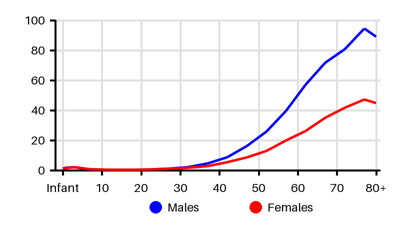
Incidence per 100.000 [ybe][kbz][svf][84k][zoh][fbk]
Symptoms & findings
Symptoms
Cachexia, Fatigue, Fever, Hematuria, Hypertension, Malaise, Night sweats, Weight loss
Clinical findings
Anemia, Elevated ALP, Elevated Bilirubin, Elevated GGT, Elevated Hematocrit, Elevated Hemoglobin, Elevated Sedimentation Rate, Hypercalcemia, Polycythemia, Varicocele
Anamneses
None listed.
Localized findings
Approach
Blood test: Complete blood cell, electrolytes, kidney function tests, liver function tests, calcium, biomarkers
Urinanalysis
Ultrasound abdomen
CT abdomen
CT thorax for staging
PET-CT
MRI
Staging [oag]
T1: Tumor ≤7 cm, limited to the kidney
T1a: Tumor ≤4 cm, limited to the kidney
T1b: Tumor 4-7 cm, limited to the kidney
T2: Tumor >7 cm, limited to the kidney
T2a: Tumor >7 cm but ≤10 cm, limited to the kidney
T2b: Tumor >10 cm, limited to the kidney
T3: Tumor extends into major veins but not into the adrenal gland or beyond Gerota
T3a: Tumor extends into the renal vein or invades the pelvicalyceal system, or invades perirenal and/or renal sinus fat but not beyond Gerota fascia
T3b: Tumor extends into IVC below the diaphragm
T3c: Tumor extends into IVC above the diaphragm or invades the IVC wall
T4: Tumor invades beyond Gerota fascia (into the ipsilateral adrenal gland)
Regional Lymph Nodes (N):
NX: Regional lymph nodes cannot be assessed
N0: No regional lymph node metastasis
N1: Metastases in regional lymph node(s).
Distant Metastasis (M):
M0: No distant metastasis
M1: Distant metastasis.
Treatment
Surgery: Only known curative treatment for localized RCC [j15]
Stage 1a: Partial Nephrectomy
Stage 1b, 2, 3: Radical nephrectomy (open/laparoscopic)
Palliative nephrectomy (alleviation of symptoms such as pain, hemorrhage, malaise, hypercalcemia, erythrocytosis, or hypertension)
Thermal Ablation: small lesions and patients who are not candidates for surgery
Molecular-targeted therapy: Stage 4 patients with metastatic disease
Sunitinib, Bevacizumab, Pazopanib, Temsirolimus, Everolimus, Lenvatinib, Nivolumab, Avelumab, Cabozantinib, Sorafenib, Axitinib, Avelumab, Pembrolizumab
Chemotherapy (Stage 4)
Floxuridine, 5-fluorouracil (5-FU), Vinblastine, Paclitaxel, Carboplatin, Ifosfamide, Gemcitabine, Doxorubicin
Immunotherapy: Interleukin-2 and Interferon
Radiation therapy
Renal artery embolization: palliative treatment in patients who are not candidates for surgery
Active surveillance
Differential diagnoses
Benign prostatic hyperplasia, Bladder cancer, Cancer origo incerta, Lymphoma, Prostate cancer, Prostatitis, Pyelonephritis, Pyonephrosis, Renal cyst, Renal hemorrhage, Renal infarction, Sarcoma, Urinary tract infection, Urolithiasis, Wilms Tumor
References
[1] Pandey J, Syed W. Renal Cancer. [Updated 2024 Oct 4]. In: StatPearls [Internet]. Treasure Island (FL): StatPearls Publishing; 2025 Jan-. Available from: https://www.ncbi.nlm.nih.gov/books/NBK558975/
[2] http://emedicine.medscape.com/article/281340 (2014-01-02); [Medscape]
[3] Palumbo C, Pecoraro A, Rosiello G, Luzzago S, Deuker M, Stolzenbach F, Tian Z, Shariat SF, Simeone C, Briganti A, Saad F, Berruti A, Antonelli A, Karakiewicz PI. Renal cell carcinoma incidence rates and trends in young adults aged 20-39 years. Cancer Epidemiol. 2020 Aug;67:101762.
[4] Rossi SH, Klatte T, Usher-Smith J, Stewart GD. Epidemiology and screening for renal cancer. World J Urol. 2018 Sep;36(9):1341-1353.
[5] Huang J, Leung DK, Chan EO, Lok V, Leung S, Wong I, Lao XQ, Zheng ZJ, Chiu PK, Ng CF, Wong JH, Volpe A, Merseburger AS, Powles T, Teoh JY, Wong MCS. A Global Trend Analysis of Kidney Cancer Incidence and Mortality and Their Associations with Smoking, Alcohol Consumption, and Metabolic Syndrome. Eur Urol Focus. 2022 Jan;8(1):200-209.
[6] Tyson MD, Humphreys MR, Parker AS, Thiel DD, Joseph RW, Andrews PE, Castle EP. Age-period-cohort analysis of renal cell carcinoma in United States adults. Urology. 2013 Jul;82(1):43-7.
[7] Horner, MJ.; Ries, LAG.; Krapcho, M.; Neyman, N.; Aminou, R.; Howlader, N.; Altekruse, SF.; Feuer, EJ.; Huang, L.; Mariotto, A.; Miller, BA.; Lewis, DR.; Eisner, MP.; Stinchcomb, DG.; Edwards, BK., editors. SEER Cancer Statistics Review, 1975–2006. Bethesda, MD: National Cancer Institute; 2009.
[8] https://www.cancerresearchuk.org/health-professional/cancer-statistics/statistics-by-cancer-type/kidney-cancer/incidence#heading-One