Diagnosis
Prostate cancer
Carcinoma originating from the prostate.
Etiology
Cause [3fp]
Sporadic mutations in oncogenes
Genetic factors (BRCA1 or BRCA2)
Family history (prostate cancer, Lynch syndrome)
Inflammation
Infections: chlamydia, gonorrhea, or syphilis
Environmental exposure:
Iionizing radiation
Chemicals
Pathophysiology [3fp]
The prostate is roughly 3 cm long and weighs approximately 20 g
The prostate produce one-third of the total seminal fluid and nourishes the sperm
The prostate gland requires androgen (testosterone) to function optimally
Prostate cancer typically begins with a mutation in normal prostate glandular cells
Usually low-grade with relatively low risk and limited aggressiveness
The cancer cells grow and multiply forming a tumor nodule
Prostate cancer commonly metastasizes to the bones and lymph nodes.
Type:
Adenocarcinoma (95%)
Squamous
Transitional cell
Sarcoma
Metastasis
Risk factors [v9n][3fp]
Age
Ethnicity
Diet (saturated fat and red meat, lower intake of fruits/vegetables/vitamins/coffee)
Obesity
Physical inactivity
Hyperglycemia
Epidemiology
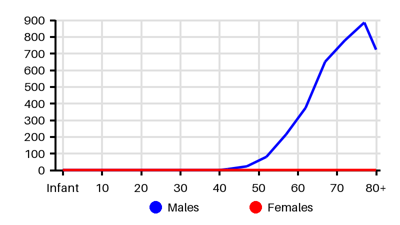
Incidence per 100.000 [3fp][q4r][ryq][5dv]
Symptoms & findings
Symptoms
Cachexia, Fatigue, Hematospermia, Hematuria, Impotence, Incomplete voiding, Lymphadenopathy, Nocturia, Paralysis, Paresis, Polyuria, Postvoid dribbling, Urinary incontinence, Urinary urgency, Weak urine stream, Weight loss
Clinical findings
Anemia, Elevated Creatinine, Elevated PSA, Urinary retention
Anamneses
None listed.
Localized findings
Approach
Digital Rectal Examination
Blood test: PSA
Urine stix
Bladder scan
Uroflow
Transrectal ultrasound
MR pelvis
PET-CT
Transrectal biopsy
The Gleason Scoring System [3fp]
Based on the microscopic arrangement, architecture, or pattern of the prostate gland
Patterns are graded from 1 (normal) to 5 (presence of only abnormal cancer cells)
Low-grade tumors: Gleason score ≤ 6
Intermediate-grade = 7
High-grade ≥7
Treatment
Management strategy consider the following: Cancer severity (TNM, Gleason score), patient preferences, life expectancy, pretreatment general functional, genitourinary symptoms, expected post-treatment functional status [v2i][3fp]
Watchful waiting: Localized prostate cancer in advanced age
Active surveillance: PSA monitoring, repeat prostate biopsies, repeat MRI
the goal is to delay curative intervention without missing the window for a cure
Radical prostatectomy: If localized and potentially curable disease
Laparoscopic, robotically-assisted, classic retropubic and perineal prostatectomy
Radiation therapy: Results comparable to surgery
Conventional radiation therapy
Three-dimensional (3-D) conformal radiation therapy
Intensity-modulated radiation therapy
Temporary and permanent brachytherapy
Proton-beam radiation
Stereotactically guided radiation
Hormone therapy: Androgen deprivation therapy
Surgical castration: Orchiectomy
Medical castration: Luteinizing hormone analogues or antagonists, antiandrogens
Recurrence:
Watchful waiting
Brachytherapy
Prostatectomy
Cystoprostatectomy
Cryotherapy
Hormone ablation
Metastatic prostate cancer (incurable):
Bisphosphonates
Rank ligand inhibitors
Hormonal treatment
Chemotherapy
Radiopharmaceuticals
Immunotherapy
Focused radiation
Metastatic hormone-sensitive prostate cancer (incurable): Androgen deprivation
Combined androgen blockade
Intermittent androgen suppression
Androgen suppression plus abiraterone acetate with prednisone
Androgen suppression plus enzalutamide
Androgen suppression plus docetaxel
Relugolix
Metastatic hormone-resistant prostate cancers: the last stage of metastatic disease
Radiation therapy
Non-chemotherapy palliative options:
Megestrol, Nonsteroidal antiandrogens, Corticosteroids, Ketoconazole, Radiation therapy, Bisphosphonates, Suramin, Estrogen
Other therapies:
Sipuleucel-T (Provenge)
Abiraterone acetate (Zytiga, Yonsa)
Enzalutamide (Xtandi)
Cabazitaxel (Jevtana)
Mitoxantrone
Apalutamide (Erleada)
Rucaparib (Rubraca)
Olaparib (Lynparza)
Niraparib/abiraterone (Akeega)
Differential diagnoses
Benign prostatic hyperplasia, Bladder cancer, Deep venous thrombosis, Medullary compression, Prostatic abscess, Prostatitis, Pulmonary embolism, Renal cell carcinoma, Tuberculosis, Urinary tract infection, Urolithiasis
References
[1] Leslie SW, Soon-Sutton TL, Skelton WP. Prostate Cancer. [Updated 2024 Oct 4]. In: StatPearls [Internet]. Treasure Island (FL): StatPearls Publishing; 2025 Jan-. Available from: https://www.ncbi.nlm.nih.gov/books/NBK470550/
[2] Rawla P. Epidemiology of Prostate Cancer. World J Oncol. 2019 Apr;10(2):63-89.
[3] Giona S. Chapter 1 - The Epidemiology of Prostate Cancer; 2021 May 27. https://www.ncbi.nlm.nih.gov/books/NBK571326/
[4] https://www.cdc.gov/united-states-cancer-statistics/publications/prostate-cancer.html
[5] https://www.cancerresearchuk.org/health-professional/cancer-statistics/statistics-by-cancer-type/prostate-cancer/incidence
[6] http://emedicine.medscape.com/article/1967731 (2014-01-02); [Medscape]