Diagnosis
Short bowel syndrome
Presence of < 200 cm of small intestine in adult patients causing a life-altering and life-threatening inability to maintain nutritional homeostasis of protein, fluid, electrolyte or micronutrient without parenteral or enteral supplementation.
Also known as: Intestinal failure
Etiology
Cause [cqd][hvp]
Adults: Acute mesenteric ischemia, Crohn disease, radiation enteritis, volvulus, trauma
Pediatric patients: Congenital malformation, intestinal atresia, necrotizing enterocolitis
Pathophysiology [cqd][hye][hvp]
Approximately 9 liters of fluid passes through the small bowel daily in the form of oral fluids, saliva, gastric, biliary, and pancreatic secretions
7 liters absorbed in the small bowel
2 liters in the large bowel
Most nutrients are absorbed in the first 100 centimeters of the jejunum
B12, bile salts, and Mg are absorbed in the last 100 centimeters of the ileum
Loss of function: Disease-associated loss of absorption
Loss of length: Small intestine resection --> loss of intestinal absorptive surface
Resection of 50–70% of the small bowel: transient malabsorption
Residual length of <200 cm may result in short bowel syndrome (normal length 275 to 850 cm)
Clinical manifestation:
Acute phase: Metabolic derangement, significant intestinal loss --> dehydration, acute kidney failure, acid-base abnormalities, and electrolyte deficiencies
Adaption phase (1-2 years): Adaptive increase in the bowel area for absorption, slower intestinal transit time to optimize absorption, and adaptive hyperphagia
Maintenance phase: Special diets, oral or intramuscular supplementation of nutrients, and pharmacological treatments
Complications [cqd]
Dehydration
Renal failure
Nephrolithiasis due to hyperoxaluria
Cholelithiasis
Bacterial translocation, bacteremia, sepsis
Interruption of enterohepatic circulation of bile acids
Liver fibrosis/steatosis, Intestinal Failure-Associated Liver Disease
Catheter infections
Lactic acidosis
Epidemiology
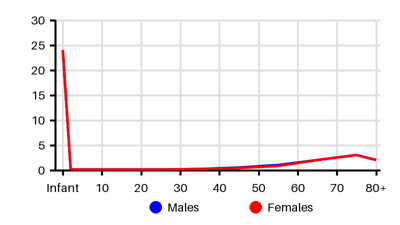
Incidence per 100.000 [cqd][h5o][1om][fa2][hye]
Symptoms & findings
Symptoms
Bloating, Dehydration, Diarrhea, Dry mucous membranes, Flat neck veins, Malnutrition, Meteorism, Poor skin turgor, Steatorrhea, Weight loss
Clinical findings
Anemia, Elevated MCV, Macrocytic anemia, Macrocytosis
Anamneses
None listed.
Approach
Blood test
Abdominal x-ray
Barium enema
Treatment
Dietary therapy: [hye][hvp]
Acute phase: Treat dehydration, acid-base/electrolyte deficiencies, renal failure
Adaption phase: Oral/enteral nutrition with gradually increasing loads. If intestinal failure is irreversible --> lifelong parenteral nutrition or intestinal transplantation
Maintenance phase: Many smaller meals, high fat diet, vitamins and minerals
Nutritional Therapies: Supply of nutrients, water, electrolyte, vitamins, acid/base-balance [hye]
Enteral nutrition [cqd]
Micronutrient (vitamin and mineral) supplementation
Parenteral nutrition
Other: Dehydration, hyponatremia, renal failure, kidney stones, gallstones, hypomagnesemia, hypocalcemia (osteoporosis), D-lactic acidosis
Medical management: [hye][1om]
Antimotility Agents: loperamide 4-16mg/day, opioid receptor agonist
Bile Acid Binding Resins: Cholestyramine 4-16g/day
Proton Pump Inhibitors/H2-antagonist
Octreotide
Pancreatin 25,000-40,000U/meal
Antibiotics: Metronidazole 800-1200mg/day
Hormonal Pharmacologic Agents: growth hormone, insulin, and GLP-2
Ursodeoxycholic acid
Probiotics
Surgery: [koh][1om]
Reversed intestinal segments (slow intestinal transit)
Intestinal valves
Colonic transposition in the small intestinal remnant (slow intestinal transit)
Longitudinal intestinal lengthening and tailoring
Serial transverse enteroplasty
Spiral intestinal lengthening and tailoring
Small intestine transplantation
Differential diagnoses
Celiac disease, Crohn disease, Gastric outlet obstruction, Gastrinoma, Gastritis, Renal failure, Ulcerative colitis
References
[1] Caporilli C, Giannì G, Grassi F, Esposito S. An Overview of Short-Bowel Syndrome in Pediatric Patients: Focus on Clinical Management and Prevention of Complications. Nutrients. 2023 May 17;15(10):2341.
[2] Guillen B, Atherton NS. Short Bowel Syndrome. Updated 2023 Jul 17: https://www.ncbi.nlm.nih.gov/books/NBK536935/
[3] Keller J, Panter H, Layer P. Management of the short bowel syndrome after extensive small bowel resection. Best Pract Res Clin Gastroenterol. 2004 Oct;18(5):977-92.
[4] Puttonen M, Tuominen S, Ukkola-Vuoti L, Lassenius MI, Virtanen H, Merras-Salmio L, Pakarinen MP. Pediatric Short Bowel Syndrome: Real-World Evidence on Incidence and Hospital Resource Use From a Finnish Data Lake. J Pediatr Gastroenterol Nutr. 2023 Oct 1;77(4):479-485.
[5] Seetharam P, Rodrigues G. Short bowel syndrome: a review of management options. Saudi J Gastroenterol. 2011 Jul-Aug;17(4):229-35.
[6] ESPEN-Home Artificial Nutrition Working Group; Van Gossum A, Bakker H, De Francesco A, Ladefoged K, Leon-Sanz M, Messing B, Pironi L, Pertkiewicz M, Shaffer J, Thul P, Wood S. Home parenteral nutrition in adults: a multicentre survey in Europe in 1993. Clin Nutr. 1996 Apr;15(2):53-9.
[7] Muto M, Kaji T, Onishi S, Yano K, Yamada W, Ieiri S. An overview of the current management of short-bowel syndrome in pediatric patients. Surg Today. 2022 Jan;52(1):12-21.
[8] Ko JS. Current Status of Intestinal Failure and Intestinal Transplantation. Pediatric Gastroenterology, Hepatology & Nutrition 2012 September 15(3):127-137.