Diagnosis
Amyloidosis
Amyloidosis is a progressive, incurable, metabolic disease characterized by abnormal deposits of protein in one or more organs or body systems.
Also known as: AA amyloidosis, AL amyloidosis, Senile systemic amyloidosis
Etiology
Cause [skh]
Primary amyloidosis -> AL amyloidosis (immunoglobulin light chain amyloidosis):
A plasma-cell dyscrasia characterized by an autonomous proliferation of plasma cells with an overproduction of a monoclonal insoluble Ig protein. It usually affects the heart, kidneys, liver and nerves.
Secondary amyloidosis (AA amyloidosis):
Result of chronic infection or inflammatory disease: Rheumatoid arthritis, Juvenile chronic arthritis, Ankylosing spondylitis, Psoriasis, Still disease, Behcet syndrome, Familial Mediterranean fever, Crohn disease, Leprosy, Osteomyelitis, Tuberculosis, Chronic bronchiectasis, Castleman disease, Hodgkin disease, Renal cell carcinoma, Colorectal cancer, Lung cancer, Bladder cancer, Cryopyrin-associated periodic syndromes. It most commonly affects the kidneys, liver and spleen.
Hereditary amyloidosis (familial amyloidosis):
Autosomal dominant disease. It most commonly happens when a protein (transthyretin) made by the liver is abnormal. Often affects the nerves, heart and kidneys.
Wild-type amyloidosis (senile systemic amyloidosis):
It occurs when the transthyretin protein made by the liver is normal but produces amyloid for unknown reasons. Wild-type amyloidosis tends to affect men over age 70 and often targets the heart. It can also cause carpal tunnel syndrome.
Localized amyloidosis:
This type of amyloidosis often has a better prognosis than the varieties that affect multiple organ systems. Typical sites for localized amyloidosis include the bladder, skin, throat or lungs. Correct diagnosis is important so that treatments that affect the entire body can be avoided.
Pathophysiology [v7f]
Insoluble amyloid protein production -> accumulation -> organ failure. Common site of deposition and organ failure: heart, kidneys, gastrointestinal system, nervous system, joints, liver, spleen, pancreas, respiratory system, and skin.
Epidemiology
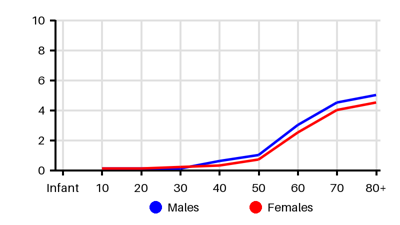
Incidence per 100.000 [v7f][8t9][sss]
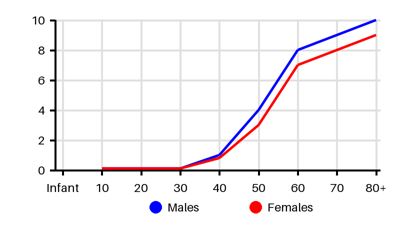
Prevalence per 100.000 [v7f][8t9][sss]
Symptoms & findings
Symptoms
Anorexia, Arrhythmia, Claudication, Constipation, Diarrhea, Dizziness, Dyspnea, Edema, Fatigue, Heart murmur, Hematemesis, Hematochezia, Hemoptysis, Hepatomegaly, Hoarseness, Hypotension, Impotence, Onychodystrophy, Palpitations, Paralysis, Paresis, Paresthesia, Ptosis, Splenomegaly, Weakness, Weight loss, Xerostomia
Clinical findings
Decreased Albumin, Elevated BNP, Elevated Creatinine, Macroglossia, Proteinuria
Anamneses
None listed.
Localized findings
Approach
Blood test
Urine test
ECG
Ultrasound cor
Bone marrow biopsy
Tissue biopsy
Treatment
Primary AL amyloidosis: daratumumab (a monoclonal antibody (mAb) that binds to CD38 on the surface of plasma cells, causing apoptosis), hyaluronidase, cyclophosphamide, bortezomib, and dexamethasone. Autologous stem cell transplantation (ASCT) is performed in those with an incomplete response to drug therapy.
Secondary amyloidosis (AA amyloidosis): treatment of the underlying disease, Colchine, Dimethylsulfoxide, Anticytokine therapy, cytotoxic immunosuppressive agents, clearance of amyloid deposits, stabilisators/binders
Hereditary amyloidosis/Wild-type amyloidosis: reducing transthyretin synthesis, stabilization of transthyretin protein, or elimination of the main source with liver transplantation.
Differential diagnoses
Alopecia, Angina pectoris, Carpal tunnel syndrome, Cutis verticis gyrata, Heart failure, Mastocytosis, Multiple myeloma, Myocardial infarction, Nephrotic syndrome, Peripheral neuropathy, Pseudoxanthoma elasticum, Renal failure, Scleredema, Sebaceous hyperplasia, Xanthomas
References
[1] https://www.mayoclinic.org/diseases-conditions/amyloidosis/symptoms-causes/syc-20353178
[2] Bustamante JG, Zaidi SRH. Amyloidosis. [Updated 2023 Jul 31]. Treasure Island (FL): StatPearls Publishing; 2024 Jan-. Available from: https://www.ncbi.nlm.nih.gov/books/NBK470285/
[3] Quock et al. Epidemiology of AL amyloidosis: a real-world study using US claims data. Blood Adv. 2018 May 22;2(10):1046-1053.
[4] Hou et al. A population-based cohort study of the epidemiology of light-chain amyloidosis in Taiwan. Sci Rep 12, 15736 (2022).
[5] http://emedicine.medscape.com/article/208839 (2014-01-24); [Medscape]
[6] http://emedicine.medscape.com/article/1093258 (2014-01-24); [Medscape]