Diagnosis
Diarrhea
Passage of > 3 loose stools/day. Secretoric, Osmotic or Steatorrhea.
Also known as: Dysentery
Etiology
Cause/Pathophysiology [wqy]
Watery diarrhea: Lactose intolerance
Fatty diarrhea: Celiac disease, chronic pancreatitis
Secretory diarrhea: increased active secretion or reduced absorption
Cholera toxin
Exudative diarrhea: blood and pus in the stool
Crohns disease, ulcerative colitis, and severe E. coli infection
Inflammatory diarrhea: inflammatory damage to the mucosa --> loss of protein-rich fluids
Bacterial: E.coli, Campylobacter, Salmonellae, Shigellae, Clostridium difficile
Viral: rotavirus, norovirus, adenovirus, astrovirus
Parasitic: Giardia, Entamoeba histolytica, cryptosporidium, tuberculosis
Colon cancer
Inflammatory bowel disease
Dysentery: inflammatory disorder of the intestine with severe diarrhea containing blood and mucus combined with fever
Shigella, Entamoeba histolytica, and Salmonella.
Motility-related diarrhea: rapid movement of food through the intestines --> not enough time for absorbtion
Hyperthyroidism
Short bowel syndrome
Drug side effects: antibiotics, cholinergica, SSRIs, chemotherapy, misoprostol, orlistat
Complications [wqy]
Dehydration and severe hypovolemia
Renal failure
Intussusception
Hemolytic-uremic syndrome
Hemorrhagic colitis
Sepsis
GI perforation
Toxic megacolon
Epidemiology
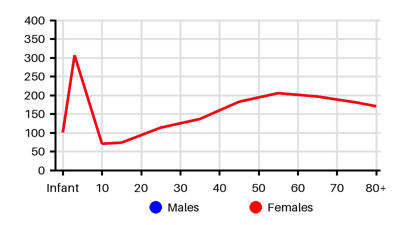
Incidence per 100.000 [4ad][vf1][i1e][ick][g8f][hmw][ihw]
Symptoms & findings
Symptoms
Diarrhea, Fever, Hypotension, Tachycardia, Tachypnea
Clinical findings
Anamneses
Localized findings
Approach
Blood test
Osmolality
Calprotectin
Gastroscopy
Colonoscopy
Treatment
Prevention: [vf1]
Vaccines
Handwash and hygiene
Breastfeeding & Nutrition
Oral Rehydration Solutions & Zinc
Treatment: Oral rehydration therapy is the cornerstone of treatment [vf1]
Mild dehydration:
<10 kg body weight --> 60-120 mL oral rehydration for each diarrhea/vomiting episode
>10 kg body weight --> 120-140 mL oral rehydration for each diarrhea/vomiting episode
Moderate dehydration:
Oral rehydration solution (50-100 mL/kg over 3-4 hours)
Oral rehydration for each diarrhea/vomiting depending on body weight
Severe dehydration:
Intravenous lactated Ringer solution or normal saline: 20 mL/kg
Followed by 100 mL/kg oral rehydration solution over 4 hours
Oral rehydration for each diarrhea/vomiting depending on body weight
Treatment depending on etiology: [vf1]
Antimotility agents
Antimicrobial therapy:
Aeromonas species: Cefixime, 3rd/4th gen cephalosporins
Campylobacter species: Erythromycin
C difficile: Discontinue causative antibiotics, use oral metronidazole or vancomycin
Cryptosporidium parvum: Paromomycin, Nitazoxanide (antihelmintic)
Entamoeba histolytica: Metronidazole followed by iodoquinol or paromomycin
E coli: Trimethoprim-sulfamethoxazole, 2nd/3rd generation cephalosporin
G lamblia: Metronidazole or nitazoxanide
Plesiomonas species: Trimethoprim-sulfamethoxazole or cephalosporin
Salmonella species: Treatment is not indicated for nontyphoid-uncomplicated diarrhea. Treat infants and high-risk patients (immunocompromised, sickle cell disease). TMP-SMX, ceftriaxone and cefotaxime
Shigella species: TMP-SMX, cefixime, ceftriaxone, and cefotaxime
V cholerae: Doxycycline, and erythromycin
Yersinia species: TMP-SMX, cefixime, ceftriaxone, and cefotaxime
Differential diagnoses
Acute pancreatitis, Appendicitis, Bacterial overgrowth syndrome, Bile acid malabsorption, Carcinoid tumor, Celiac disease, Cholecystitis, Chronic pancreatitis, Clostridium difficile, Colorectal cancer, Crohn disease, Drug side effects, Gastric bypass, Gastroenteritis, Giardiasis, Hyperthyroidism, Infectious colitis, Intussusception, Irritable bowel syndrome, Ischemic colitis, Lactose intolerance, Malabsorption, Meckels diverticulum, Shigellosis, Short bowel syndrome, Ulcerative colitis, Viral hepatitis
References
[1] Nemeth V, Pfleghaar N. Diarrhea. [Updated 2022 Nov 21]. In: StatPearls [Internet]. Treasure Island (FL): StatPearls Publishing; 2025 Jan-. Available from: https://www.ncbi.nlm.nih.gov/books/NBK448082/
[2] Birhan TA, Bitew BD, Dagne H, Amare DE, Azanaw J, Genet M, Engdaw GT, Tesfaye AH, Yirdaw G, Maru T. Prevalence of diarrheal disease and associated factors among under-five children in flood-prone settlements of Northwest Ethiopia: A cross-sectional community-based study. Front Pediatr. 2023 Jan 23;11:1056129.
[3] http://emedicine.medscape.com/article/928598 (2014-01-02); [Medscape]
[4] Abuzerr S, Nasseri S, Yunesian M, Hadi M, Mahvi AH, Nabizadeh R, Mustafa AA. Prevalence of diarrheal illness and healthcare-seeking behavior by age-group and sex among the population of Gaza strip: a community-based cross-sectional study. BMC Public Health. 2019 Jun 7;19(1):704.
[5] Arena, C., Amoros, J.P., Vaillant, V. et al. Acute diarrhea in adults consulting a general practitioner in France during winter: incidence, clinical characteristics, management and risk factors. BMC Infect Dis 14, 574 (2014).
[6] Saravana Kumar, V., Devika, S., George, S. and Jeyaseelan, L. (2017). Spatial mapping of acute diarrheal disease using GIS and estimation of relative risk using empirical Bayes approach. Clinical Epidemiology and Global Health, 5(2), pp.87–96.
[7] Mashoto KO, Omolo JJ, Kazyoba PE. One Week Prevalence and Incidence of Diarrhea: Baseline Status of Cluster Randomised Controlled Trial of Nano Maji Filter System in Geita, Tanzania. East Afr Health Res J. 2022;6(1):98-105.
[8] Chen L, Jiao J, Liu S, Liu L, Liu P. Mapping the global, regional, and national burden of diarrheal diseases attributable to unsafe water. Front Public Health. 2023 Dec 6;11:1302748.
[9] Robert Steffen, Epidemiology of Traveler's Diarrhea, Clinical Infectious Diseases, Volume 41, Issue Supplement_8, December 2005, Pages S536–S540.