Diagnosis
Dysmenorrhea
Painful cramps of the uterus during menstruation.
Also known as: Menstrual pain
Etiology
Cause [zsn]
Primary (absence of pelvic pathology and caused by the menstrual cycle)
Secondary (identifiable organic diseases such as endometriosis)
Endometriosis, interstitial cystitis, pelvic inflammatory disease, Ruptured ovarian cyst, Cervical stenosis, Adenomyosis, Fibroids, Uterine polyps, Intrauterine adhesions, cesarean scar, Congenital malformations, Intrauterine contraceptive device, Transverse vaginal septum, Allen-Masters syndrome, ovarian abscess, Ovarian torsion.
Pathophysiology [zsn]
Prostaglandin (a potent myometrial stimulant and vasoconstrictor)
prolonged uterine contractions
decreased blood flow to the myometrium
Infarction of the endometrium --> endometrial shedding --> menstruation --> pain
Risk factors [zsn]
Age up to 30 years
Smoking
Attempts to lose weight
High or low body mass index
Depression/anxiety
Longer menstrual cycles
Younger age at menarche
Nulliparity
History of sexual assault
Previous cesarean section with incomplete uterine scar healing
Longer and heavier menstrual flow
Family history of dysmenorrhea
Disruption of social networks
Complications to secondary dysmenorrhea [zsn]
Infertility
Pelvic organ prolapse
Heavy bleeding
Anemia
Epidemiology
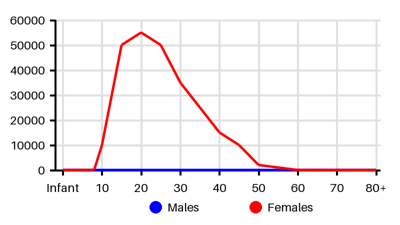
Incidence per 100.000 [dvm][1c6][kp2][gor]
Symptoms & findings
Symptoms
Anxiety, Constipation, Diarrhea, Dizziness, Dyspareunia, Fatigue, Headache, Infertility, Malaise, Menorrhagia, Metrorrhagia, Nausea, Vaginal bleeding, Vaginal discharge, Vomiting
Clinical findings
None listed.
Anamneses
Localized findings
Approach
Blood test
Chlamydial culture
Serelogy
HCG
Urine stix
CA 125
Transvaginal ultrasound
Hysterosalpingography
CT abdomen
MRI
Laparoscopy
Treatment
Treat underlying condition in secondary dysmenorrhea [zsn]
Supportive treatment:
Heat applied to the lower abdomen
NSAIDs (direct inhibition of PG production) [oec]
Acetaminophen
Psychologic and behavioral therapy
Combined oral contraceptives with estrogen and progesterone
Intra Uterine Device (IUD)
Gonadotropin-releasing hormone agonists and antagonists
Aromatase inhibitor
Calcium channel blockers
Vasopressin
Magnesium
Surgery:
Laparoscopy
Endometrial ablation
Hysterectomy
Differential diagnoses
Abortion, Adenomyosis, Adrenal insufficiency, Appendicitis, Crohn disease, Endometrial cancer, Endometriosis, Interstitial cystitis, Irritable bowel syndrome, Myoma uteri, Ovarian cancer, Ovarian torsion, Pelvic inflammatory disease, Pregnancy, Ruptured ectopic pregnancy, Ruptured ovarian cyst, Ulcerative colitis, Urinary tract infection, Uterine leiomyoma
References
[1] Nagy H, Carlson K, Khan MAB. Dysmenorrhea. [Updated 2023 Nov 12]. In: StatPearls [Internet]. Treasure Island (FL): StatPearls Publishing; 2025 Jan-. Available from: https://www.ncbi.nlm.nih.gov/books/NBK560834/
[2] Latthe P, Latthe M, Say L, Gülmezoglu M, Khan KS. WHO systematic review of prevalence of chronic pelvic pain: a neglected reproductive health morbidity. BMC Public Health. 2006 Jul 6;6:177.
[3] Lin SY, Yang YC, Lin CC, Chang CY, Hsu WH, Wang IK, Lin CD, Hsu CY, Kao CH. Increased Incidence of Dysmenorrhea in Women Exposed to Higher Concentrations of NO, NO2, NOx, CO, and PM2.5: A Nationwide Population-Based Study. Front Public Health. 2021 Jun 17;9:682341.
[4] Dawood MY. Dysmenorrhea and prostaglandins. In: Gold JJ, Josimovich JB (eds). Gynecologic Endocrinology. New York: Plenum Publishing Corporation, 1987, 405–421.
[5] Harlow SD, Park M. A longitudinal study of risk factors for the occurrence, duration and severity of menstrual cramps in a cohort of college women. Br J Obstet Gynaecol. 1996 Nov;103(11):1134-42.
[6] Davis AR, Westhoff CL. Primary dysmenorrhea in adolescent girls and treatment with oral contraceptives. J Pediatr Adolesc Gynecol. 2001 Feb;14(1):3-8.
[7] http://emedicine.medscape.com/article/253812 (2014-01-02); [Medscape]