Diagnosis
Ruptured ovarian cyst
Sudden rupture in the ovary, commonly at the site of a cyst, accompanied by hemorrhage in the ovarian tissue and/or intraperitoneal bleeding.
Etiology
Cause [afp]
Follicular cyst and corpus luteum cyst from a normal growing monthly follicle
Theca lutein cyst (overstimulation by hCG in pregnancy)
Polycystic ovary syndrome
Dermoid cyst (embryonal stem cells)
Cystadenomas (ovarian tissue)
Endometriomas (result of endometriosis)
Neoplastic cysts: Serous/mucinous adenoma, stromal/germ cell tumors, malignancy (serous carcinoma, mucinous carcinoma, endometrioid carcinoma, clear cell carcinoma, and malignant Brenner tumors, immature teratoma, endodermal sinus tumors, embryonal carcinoma, and polyembryoma)
Pathophysiology [afp]
Ovarian cysts are fluid-filled structures that may be simple or complex
A mature ovarian follicle ruptures every month and releasing an ovum
After ovulation, follicular remnants form a corpus luteum (produces progesterone)
Ovarian cysts can cause complications:
Rupture
Hemorrhage
Torsion
Clinical presentation of a ruptured ovarian cyst:
Asymptomatic
Acute unilateral lower abdominal pain
Epidemiology
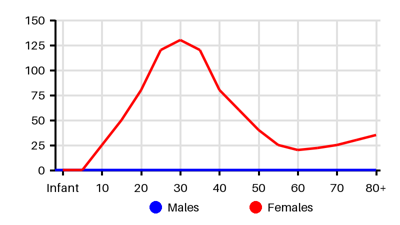
Incidence per 100.000 [moh][7a4]
Symptoms & findings
Symptoms
Amenorrhea, Chills, Dyschezia, Dyspareunia, Dysuria, Fever, Hypotension, Infertility, Menorrhagia, Metrorrhagia, Nausea, Polyuria, Syncope, Tachycardia, Tachypnea, Vaginal bleeding, Vomiting, Weakness
Clinical findings
Anemia, Decreased hematocrit, Hemoperitoneum
Anamneses
None listed.
Localized findings
Approach
Pelvic exam
Blood test: hemoglobin, hematocrit, hCG, Ca-125, LH, FSH, estradiol, testosterone
Urine stix: hCG, rule out urinary tract infection and urolithiasis
Transvaginal ultrasonography
Abdominal ultrasonography
Endocervical swabs to assess for pelvic inflammatory disease
CT abdomen
MRI abdomen
Laparoscopy
Treatment
Most cysts resolve spontaneously without intervention --> Symptomatic support: [xy7]
Oral analgesics: acetaminophen, NSAIDs, IV morphine
Observation with serial:
Abdominal examinations
Laboratory testing
Transvaginal ultrasound
Surgery: Laparoscopy or laparotomy [afp]
Hemodynamic unstable
Suspected ovarian torsion
Acute abdominal pain
Persistent adnexal mass
Suspicious of malignancy: Cyst size greater than 10 cm, complex multilocular mass, papillary excrescences or solid components, irregularity, thick septations, evidence of ascites, and increased vascularity on color doppler
Prophylaxis: multiple episodes of ruptured physiologic cysts
Consider suppression of ovulation with oral hormonal contraception
Differential diagnoses
Aortic dissection, Appendicitis, Colorectal cancer, Diverticulitis, Endometriosis, Internal hemorrhage, Liver injury, Myoma uteri, Ovarian abscess, Ovarian cancer, Ovarian torsion, Pelvic inflammatory disease, Perforated ulcer, Rectus sheath hematoma, Retroperitoneal hemorrhage, Ruptured aortic aneurysm, Ruptured ectopic pregnancy, Splenic injury, Teratoma, Urinary tract infection, Urolithiasis
References
[1] Mobeen S, Apostol R. Ovarian Cyst. [Updated 2023 Jun 5]. In: StatPearls [Internet]. Treasure Island (FL): StatPearls Publishing; 2025 Jan-. Available from: https://www.ncbi.nlm.nih.gov/books/NBK560541/
[2] Westhoff C, Clark CJ. Benign ovarian cysts in England and Wales and in the United States. Br J Obstet Gynaecol. 1992 Apr;99(4):329-32.
[3] Aziz WM, Fawzi HA. Acute Appendicitis Versus Ruptured Ovarian Cyst in Female Patients Presented as Acute Abdomen Pain. Indian Journal of Public Health Research & Development, 2019, Vol 10, Issue 1, p364.
[4] http://emedicine.medscape.com/article/253620 (2014-01-02); [Medscape]