Diagnosis
Systemic sclerosis
A rare chronic autoimmune disease characterized by excessive fibrosis of the skin, muscles, and internal organs.
Also known as: Scleroderma, Systemic scleroderma
Etiology
Cause [o5z]
Autoimmune disease of unknown etiology
Genetic factors: family history, HLA (DRB1, DQA1, and DQB1)
Environmental triggers:
Infections: CMV, EBV, Parvovirus B19
Silica exposure
Solvent exposure
Radiation exposure or radiotherapy
Drugs (bleomycin, carbidopa, pentazocine, cocaine, penicillamine, vitamin K)
Classification [o5z]
Localized scleroderma: primarily affects the skin and subcutaneous tissue
Morphea (dermal fibrosis with patches of thickened skin)
Linear scleroderma
Scleroderma en coup de sabre
Systemic sclerosis: systemic manifestations and internal organ involvement
Limited systemic sclerosis (CREST syndrome)
Diffuse systemic sclerosis
Pathophysiology [fse][o5z]
Triggers --> endothelial cell injury --> aberrant autoimmune response
Activated macrophages, monocytes, and dendritic cells
T- and B cells produce pro-fibrotic/pro-inflammatory cytokines and autoantibodies
Fibroblast activation --> pro-thrombotic cascade
Occlusion of the microvasculature --> widespread microangiopathy --> tissue hypoxia
Vascular smooth muscle cell proliferation
Tissue fibrosis --> loss of tissue architecture
Organ damage: Skin, GI-tract, lungs, heart, kidney, CNS
Clinical manifestation:
Raynaud phenomenon: cold --> vasospasms (early and common manifestation)
Skin: Perivascular inflammation --> dermal edema --> dermal fibrosis
Lungs: inflammation of the alveolar walls --> interstitial pneumonitis --> fibrosis --> --> vasculopathy (loss of pulmonary microvasculature) --> pulmonary arterial hypertension, pleuritis, pulmonary hemorrhage
Kidney: ischemic changes, glomerulonephritis, renal crisis
Musculoskeletal: Arthralgia, arthritis, myalgia, myositis, muscle fibrosis
Heart: constrictive pericarditis, pericardial fibrosis/effusion, myocardial fibrosis --> dilated cardiomyopathy, arrhythmia
Gastrointestinal: perioral skin tightening, reduced oral aperture, periodontitis, gingivitis, esophageal dysmotility (dysphagia, heartburn, esophagitis, stricture, Barrett's esophagus), gastroparesis, salivary gland fibrosis --> Sjögren syndrome, bloating, nausea, vomiting, anorexia, GI bleeding, diarrhea, constipation, pseudo-obstruction
General fibrosis: GI-tract, thyroid gland (hypothyroidism), salivary glands, penis
Complications [o5z]
Fibrosis --> end-organ damage
Digital ischemia --> gangrene --> amputation
Gastrointestinal complications
Pulmonary involvement --> pulmonary fibrosis
Renal crisis
Epidemiology
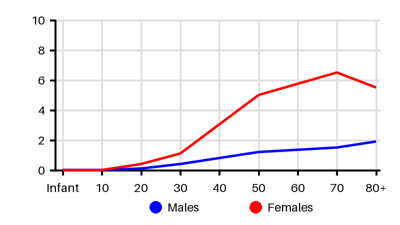
Incidence per 100.000 [fse][usc][isd][zsw][hs5][8wy][stb]
Symptoms & findings
Symptoms
Arrhythmia, Arthralgia, Arthritis, Bloating, Constipation, Cough, Diarrhea, Dyspareunia, Dyspepsia, Dysphagia, Dyspnea, Fatigue, Heartburn, Hoarseness, Hypertension, Impotence, Joint contracture, Microstomia, Muscle atrophy, Muscle weakness, Myalgia, Pruritus, Raynaud phenomenon, Syncope, Weight loss, Xerophthalmia, Xerostomia
Clinical findings
ANA, Carpal Tunnel Syndrome, Elevated Aldolase, Elevated Creatine Kinase, Elevated Creatinine, Gastroesophageal Reflux Disease, Heart failure, Pericardial effusion, Pericarditis, Primary biliary cirrhosis, Proteinuria, Pulmonary fibrosis, Pulmonary hypertension, Renal failure, Trigeminal neuralgia
Anamneses
None listed.
Localized findings
Approach
Blood test: Antinuclear antibodies, Anti-centromere, anti-Scl-70, anti-RNA polymerase
Biopsy
ECG
Echocardiography
CT
Endoscopy
Diagnosic Criteria:
American College of Rheumatology 1980 [8mb]
Major Criterion: sufficient for diagnosis
Proximal scleroderma: Symmetrical thickening/tightening of the skin affecting limbs, face, neck, or trunk.
Minor Criteria: two required for diagnosis
Sclerodactyly: Skin thickening limited to the fingers.
Digital pitting scars or loss of fingertip substance: Due to ischemia.
Bilateral basilar pulmonary fibrosis: Radiographic evidence
LeRoy and Medsger Criteria for Early Systemic Sclerosis [te8]
Core Requirement: Raynaud’s phenomenon
Additional Criteria (at least one required):
Abnormal nailfold capillaries:
Dilated capillaries, hemorrhages, or avascular areas on nailfold capillaroscopy
SSc-specific autoantibodies:
Anticentromere, anti-topoisomerase I (anti-Scl70), or anti-RNA polymerase III antibodies.
American College of Rheumatology 2013: score ≤9 indicates systemic sclerosis [o5z]
Bilateral skin thickening proximal to metacarpophalangeal joints: 9
Skin thickening of fingers (counting only higher score)
Between distal and proximal interphalangeal joints: 4
Puffy fingers: 2
Fingertip lesions (counting only the higher score)
Fingertip pitting scars: 3
Digital tip ulcers: 2
Telangiectasia: 2
Abnormal nailfold capillaries: 2
Raynaud phenomenon: 3
Lung disease (maximum score of 2)
ILD: 2
PAH: 2
Positive systemic sclerosis-specific antibodies (anti-centromere, anti–Scl–70, and anti–RNA polymerase III): 3
Treatment
There are no curative treatment [o5z]
Non-medical treatment:
Patient education
Regular exercise
Healthy diet and lifestyle
Emotional support
Raynaud phenomenon: keep extremities warm, avoid smoking and stress, and eliminate β-blockers
Vasodilator therapy: nifedipine (30-120 mg/d), amlodipine (5-20 mg/d), pentoxifylline, nitroglycerin, and phosphodiesterase inhibitors
Skin disease: Methotrexate (15-25 mg/week), IV methylprednisolone (30 mg/kg/d for 3 days), Prednisone (1 mg/kg/d), Hydroxychloroquine, mycophenolate mofetil, cyclophosphamide, antihistamines and topical moisturizing agents
Musculoskeletal involvement: arthralgias, arthritis, mypsitis
NSAIDs, Low-dose prednisone (<10 mg/d), HCQ (200-400 mg daily), MTX, Antitumor necrosis factor agents
Physiotherapy to prevent contractures
Pulmonary involvement: interstitial lung disease --> leading cause of mortality
Supplemental oxygen, diuretics, and anticoagulation
Cyclophosphamide has shown benefit for up to 18 months
Mycophenolate mofetil (1.5-3 g/day)
Lung transplantation
Vasodilator therapy: phosphodiesterase-5 inhibitors (tadalafil 40 mg daily and sildenafil 20 mg orally 3 times daily), endothelin receptor antagonists (such as bosentan at 62.5-125 mg twice daily, prostacyclin analogs (epoprostenol, treprostinil, beraprost, and iloprost at 2.5-5 μg inhaled 6-9 times daily
Cardiac involvement: Arrhythmias --> antiarrhythmic agents and pacemaker
Gastrointestinal involvement: microstomia --> exercise, xerostomia --> good dental hygiene, secretagogues, hearthburn --> dietary adjustments (avoid late/large/spicy meals, elevated head), proton pump inhibitors, gastroparesis --> Motility agents (metoclopramide)
Scleroderma renal crisis: ACE inhibitors
Differential diagnoses
Acute intermittent porphyria, Amyloidosis, Cutaneous T-cell lymphoma, Eosinophilia, Eosinophilia-myalgia syndrome, Eosinophilic Fasciitis, Graft-versus-host disease, Lichen sclerosus, Lyme disease, Morphea, Nephrogenic systemic fibrosis, Phenylketonuria, Primary biliary cirrhosis, Progeria, Pulmonary hypertension, Reflex sympathetic dystrophy, Scleroderma, Sjogren syndrome, Werners syndrome
References
[1] Adigun R, Goyal A, Hariz A. Systemic Sclerosis (Scleroderma) [Updated 2024 Apr 5]. In: StatPearls [Internet]. Treasure Island (FL): StatPearls Publishing; 2025 Jan-. Available from: https://www.ncbi.nlm.nih.gov/books/NBK430875/
[2] Bergamasco A, Hartmann N, Wallace L, Verpillat P. Epidemiology of systemic sclerosis and systemic sclerosis-associated interstitial lung disease. Clin Epidemiol. 2019 Apr 18;11:257-273.
[3] Arias-Nuñez MC, Llorca J, Vazquez-Rodriguez TR, Gomez-Acebo I, Miranda-Filloy JA, Martin J, Gonzalez-Juanatey C, Gonzalez-Gay MA. Systemic sclerosis in northwestern Spain: a 19-year epidemiologic study. Medicine (Baltimore). 2008 Sep;87(5):272-280.
[4] Westerlind H, Bairkdar M, Gunnarsson K, Moshtaghi-Svensson J, Sysojev AÖ, Hesselstrand R, Holmqvist M. Incidence and prevalence of systemic sclerosis in Sweden, 2004-2015, a register-based study. Semin Arthritis Rheum. 2022 Apr;53:151978.
[5] Kanecki K, Goryński P, Tarka P, Wierzba W, Tyszko P. Incidence and prevalence of Systemic Sclerosis (SSc) in Poland - differences between rural and urban regions. Ann Agric Environ Med. 2017 May 11;24(2):240-244.
[6] Bairkdar M, Rossides M, Westerlind H, Hesselstrand R, Arkema EV, Holmqvist M. Incidence and prevalence of systemic sclerosis globally: a comprehensive systematic review and meta-analysis. Rheumatology (Oxford). 2021 Jul 1;60(7):3121-3133.
[7] Muntyanu A, Aw K, Kaouache M, Rahme E, Osman M, Baron M, Ghazal S, Netchiporouk E. Epidemiology of systemic sclerosis in Quebec, Canada: a population-based study. Lancet Reg Health Am. 2024 Jun 8;35:100790.
[8] Hoffmann-Vold AM, Midtvedt Ø, Molberg Ø, Garen T, Gran JT. Prevalence of systemic sclerosis in south-east Norway. Rheumatology (Oxford). 2012 Sep;51(9):1600-5.
[9] Subcommittee for Scleroderma Criteria of the American Rheumatism Association Diagnostic and Therapeutic Criteria Committee. Preliminary criteria for the classification of systemic sclerosis (scleroderma). Arthritis Rheum. 1980;23:581-590.
[10] LeRoy EC, Medsger TA Jr. Criteria for the classification of early systemic sclerosis. J Rheumatol. 2001;28:1573-1576.
[11] http://emedicine.medscape.com/article/331864; [Medscape]
[12] [Clinical Dermatology 4.th Edition by Weller, Hunter, Savin and Dahl]