Diagnosis
Nasal polyps
Benign, inflammatory and hyperplastic outgrowths of the sinonasal mucosa that can lead to chronic nasal obstruction and congestion.
Etiology
Cause [6vk]
Inflammatory/reactive polyps:
Chronic rhinosinusitis
Allergic rhinitis
Allergic fungal rhinosinusitis
Bacterial rhinosinusitis
Vasculitis (eosinophilic granulomatosis with polyangiitis)
Occupational dust
Nasal papilloma associated with human papillomavirus
Cystic fibrosis
Pathophysiology [6vk]
Allergy:
Environmental or seasonal allergic triggers
Eosinophilia and IgE inflammation --> elevated IL-5
Polyposis represents an end-stage manifestation of poorly controlled allergies
Infection:
Anatomical and functional changes
Impaired mucociliary clearance
Atrophy of the sinonasal mucosa --> diminished mucus secretion
Stasis of thick mucus --> impair the clearance of irritants and biological offenders
Risk of infection: viruses, bacteria, and fungi
Chronic inflammation --> localized increases in cell and tissue size (edema)
Increased susceptibility to polyp formation
Clinical presentation:
Asymptomatic
Nasal obstruction
Facial congestion
Anosmia
Ageusia
Rhinorrhea
Complications [6vk]
Mucoceles --> orbital compression --> exophthalmos, diplopia
Irreversible anosmia
Obstructive sleep apnea
Epidemiology
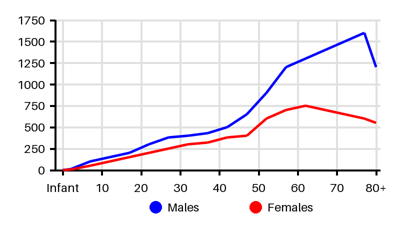
Prevalence per 100.000 [hru][d3t][uva][2ip][csw][yy7]
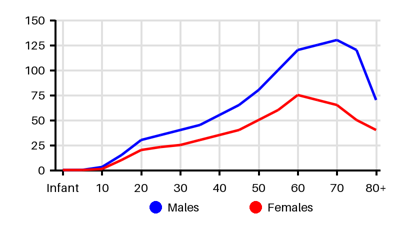
Incidence per 100.000 [hru][d3t][uva][2ip][csw][yy7]
Symptoms & findings
Symptoms
Anosmia, Cough, Epistaxis, Headache, Hyponosmia, Nasal congestion, Rhinorrhea, Snoring
Clinical findings
None listed.
Anamneses
None listed.
Localized findings
Approach
Anterior rhinoscopy
Nasal endoscopy
CT caput
Biopsy
Treatment
Local and systemic therapies targeting the underlying allergic etiology: [wes][6vk]
Continuing nasal saline irrigation
Corticosteroids (spray or oral)
Antibiotics
Antihistamines
Monoclonal antibodies
Surgery: endoscopic removal
Polypectomy
Balloon sinuplasty
Functional endoscopic sinus surgery
Biodegradable steroid-eluting stents
Differential diagnoses
Acute invasive fungal sinusitis, Acute sinusitis, Allergic rhinosinusitis, Chronic sinusitis, Encephalocele, Human papillomavirus, Lymphoma, Malignant melanoma, Obstructive sleep apnea, Rhinitis, Squamous cell carcinoma, Wegener's granulomatosis
References
[1] del Toro E, Hardin FML, Portela J. Nasal Polyps. [Updated 2025 May 5]. In: StatPearls [Internet]. Treasure Island (FL): StatPearls Publishing; 2025 Jan-. Available from: https://www.ncbi.nlm.nih.gov/books/NBK560746/
[2] Raciborski F, Arcimowicz M, Samoliñski B, Pinkas W, Samel-Kowalik P, Śliwczyñski A. Recorded prevalence of nasal polyps increases with age. Postepy Dermatol Alergol. 2021 Aug;38(4):682-688
[3] Klossek JM, Neukirch F, Pribil C, Jankowski R, Serrano E, Chanal I, El Hasnaoui A. Prevalence of nasal polyposis in France: a cross-sectional, case-control study. Allergy. 2005 Feb;60(2):233-7
[4] Hedman J, Kaprio J, Poussa T, Nieminen MM. Prevalence of asthma, aspirin intolerance, nasal polyposis and chronic obstructive pulmonary disease in a population-based study. Int J Epidemiol. 1999 Aug;28(4):717-22
[5] Campion NJ, Kohler R, Ristl R, Villazala-Merino S, Eckl-Dorna J, Niederberger-Leppin V. Prevalence and Symptom Burden of Nasal Polyps in a Large Austrian Population. J Allergy Clin Immunol Pract. 2021 Nov;9(11):4117-4129.e2
[6] D’Netto, Michael, et al. “Nasal Polyposis: Incidence and Survival in Olmsted County, Minnesota.” Journal of Allergy and Clinical Immunology, vol. 153, no. 2, 2024, pp. AB363.
[7] Chen, S., Zhou, A., Emmanuel, B., Thomas, K., & Guiang, H. (2020). Systematic literature review of the epidemiology and clinical burden of chronic rhinosinusitis with nasal polyposis. Current Medical Research and Opinion, 36(11), 1897–1911
[8] https://emedicine.medscape.com/article/861456