Diagnosis
Metabolic acidosis
Acidosis (pH < 7.35) due to a reduction in serum bicarbonate (HCO₃⁻ <22 mmol/L) and a compensatory decrease in arterial pCO2 (due to hypeventilation).
Etiology
Cause [csa]
Anion gap = (Na + K) - (Cl + HCO3). Normal AG = 12-16
Anion gap acidosis --> increased production or decreased excretion of acids:
CAT MUDPILES [csa]
Cyanide and carbon monoxide poisoning
Arsenic
Toluene
Methanol, Metformin, Metabolism inborn errors
Uremia/renal failure
Diabetic ketoacidosis (other ketoacidosis: alcoholism, starvation)
Paraldehyde, phenformin
Iron/Isoniazid
Lactic acidosis >4 mmol/L:
Type A: impaired tissue oxygenation: hypoxia, carbon monoxide poisoning, anemia, cardiogenic/hemorrhagic/septic shock
Type B: liver failure, malignancy, and drugs or toxins (alcohols, salicylates, isoniazid, metformin, propofol, linezolid, albuterol, intravenous epinephrine, nucleoside reverse transcriptase inhibitors for HIV-treatment, iron, paraldehyde, sulfur, toluene, ammonium chloride, hyperalimentation fluids/TPN)
Ethylene glycol
Salicylates/Strychnine
Non-anion gap (hyperchloraemic) acidosis --> increased loss of alkali (HCO3) from:
the GI tract or kidneys or reduced elimination of acids due to renal failure
Urine anion gap = Urine Na + Urine K – Urine Cl, if urine pH is <6.5 [iou]
Urine anion gap = Urine Na + Urine K - (Urine Cl + Urine HCO3), if urine pH is >6.5
USEDCARP [csa]
Ureteral diversion (ureterosigmoidostomy)
Fistula (pancreatic, biliary, intestinal)
Extra chloride, saline infusion, hyperalimentation (TPN)
Diarrhea
Carbonic anhydrase inhibitors (acetazolamide), Cholestyramine
Adrenal insufficiency (Hypoaldosteronism, Addison disease)
Renal tubular acidosis (reduced acid secretion)
Spironolactone
Pathophysiology [iou]
Anion gap: the number of cations must equal the number of anions
The anion gap measures the amount of unmeasured anions (normally albumin)
High anion gap --> excess acids:
Lactate
Ketones
Toxic metabolites
Compensation:
Lungs --> respiratory alkalosis: Tachypnea and hyperpnea reduces the PaCO2 in an attempt to increase the pH back toward normal
Kidneys: Responsible for reabdorption of filtered bicarbonate (HCO3-) and elimination of acid generated from nitrogen (protein) metabolism. Metabolic compensation with increased acid elimination.
Hypoalbuminemia: The albumin level must also be taken into account because albumin is a negatively charged protein:
[anion gap](corrected) = [anion gap](measured) + 2.5 × (4.0 - [albumin])
Complications of severe metabolic acidosis:
Myocardial depression
Seizure
Shock
Multiorgan failure
Epidemiology
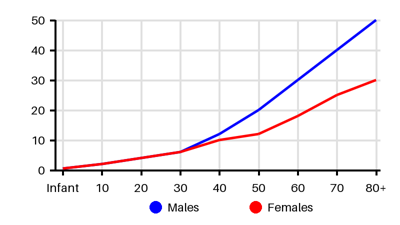
Incidence per 100.000 [t9s][afd][47s][tvs][4zg][a2s][nma][zds][gqm]
Symptoms & findings
Symptoms
Blurred vision, Confusion, Diarrhea, Dyspnea, Headache, Hematuria, Hyperventilation, Lethargy, Nausea, Oliguria, Photophobia, Polydipsia, Polyuria, Respiratory failure, Scotoma, Seizure, Tachycardia, Tachypnea, Tinnitus, Vertigo, Vomiting
Clinical findings
Acidosis, Decreased Cortisol, Elevated Creatinine, Elevated Lactate, Elevated Methanol, Elevated PTH, Hyperglycemia, Papilledema, Proteinuria
Anamneses
None listed.
Approach
Blood test: glucose, anion gap, ketone levels, lactate, salicylate, iron, ethanol, methanol, ethylene glycol, isopropyl, hCG
Blood gas: pH, HCO3, pO2, pCO2, CO
Urine stix
Urine microscopy
Urinalysis: pH > 5.5 + acidemia --> type I renal tubular acidosis
ECG
What is the pH? Acidemia or alkalemia? [csa]
Is the primary disturbance metabolic or respiratory?
Acute respiratory acidosis: elevated pCO2 >40-45 indicating decreased ventilation
Chronic respiratory acidosis: elevated pCO2 and elevated bicarbonate indicating renal compensation with increased hydrogen elimination and bicarbonate retention
Metabolic acidosis: decreased pCO2 <40 due to compensatory respiratory alkalosis
Is there an AG or non-AG metabolic acidosis?
Is there an appropriate respiratory compensation?
Winter formula: Expected pCO2 = 1.5 x (HCO3) + 8 ± 2
Are there additional metabolic disturbances?
Delta/delta concept: For every increase in the AG of 1 mmol/L above normal (12 mmol), serum HCO3- will drop by an equal amount (ΔAG / ΔHCO3-)
Ratio <1: additional metabolic acidosis is present
Ratio >1: additional metabolic alkalosis is present
Treatment
Inadequate respiratory compensation --> Address respiratory failure:
Airways
Breathing
General therapy: [a2s]
Sodium bicarbonate IV (NaHCO3) [etv]
Tris(hydroxymethyl)aminomethane (THAM)
Carbicarb IV
Dialysis
Treat the underlying conditions: [iou]
Ketoacidosis: insulin and fluids
Alcohol toxicity: fomepizole and/or dialysis
Adrenal insufficiency: mineralocorticoid
Lactic acidosis: Thiamine, IV fluid and respiratory support
Metformin-induced lactic acidosis: hemodialysis
Sepsis: antibiotics
Salicylate toxicity: GI decontamination with charcoal, IV bicarbonate, hemodialysis
Differential diagnoses
Acidosis, Acute renal failure, Adrenal insufficiency, Alcoholic ketoacidosis, Alcohol intoxication, Anemia, Colovesical fistula, Diabetes mellitus, Diabetic ketoacidosis, Drug side effects, Hemolysis, Hyperkalemia, Hyperparathyroidism, Iron toxicity, Lactic acidosis, Methanol toxicity, Necrotizing enterocolitis, Renal failure, Respiratory alkalosis, Salicylate intoxication, Sepsis
References
[1] https://emedicine.medscape.com/article/768268
[2] Kharsa A, Vashisht R, Rout P, et al. Anion Gap and Non-Anion Gap Metabolic Acidosis. [Updated 2025 Aug 6]. In: StatPearls [Internet]. Treasure Island (FL): StatPearls Publishing; 2025 Jan-. Available from: https://www.ncbi.nlm.nih.gov/books/NBK448090/
[3] Bowling CB, Inker LA, Gutierrez OM, et al. Age-specific associations of reduced estimated glomerular filtration rate with concurrent chronic kidney disease complications. Clin J Am Soc Nephrol. 2011;6(12):2822-2828.
[4] Drawz PE, Babineau DC, Rahman M. Metabolic complications in elderly adults with chronic kidney disease. J Am Geriatr Soc. 2012;60(2):310-315.
[5] Cook EE, Davis J, Israni R, Mu F, Betts KA, Anzalone D, Yin L, Szerlip H, Uwaifo GI, Fonseca V, Wu EQ. Prevalence of Metabolic Acidosis Among Patients with Chronic Kidney Disease and Hyperkalemia. Adv Ther. 2021 Oct;38(10):5238-5252.
[6] Kuczera P, Ciaston-Mogilska D, Oslizlo B, Hycki A, Wiecek A, Adamczak M. The Prevalence of Metabolic Acidosis in Patients with Different Stages of Chronic Kidney Disease: Single-Centre Study. Kidney Blood Press Res. 2020;45(6):863-872.
[7] Fujii, T., Udy, A.A., Nichol, A. et al. Incidence and management of metabolic acidosis with sodium bicarbonate in the ICU: An international observational study. Crit Care 25, 45 (2021).
[8] Kraut JA, Madias NE. Treatment of acute metabolic acidosis: a pathophysiologic approach. Nat Rev Nephrol. 2012 Oct;8(10):589-601.
[9] Guy C, Holmes NE, Kishore K, Marhoon N, Serpa-Neto A. Decompensated metabolic acidosis in the emergency department: Epidemiology, sodium bicarbonate therapy, and clinical outcomes. Crit Care Resusc. 2023 Jun 24;25(2):71-77.
[10] Feest TG, Round A, Hamad S. Incidence of severe acute renal failure in adults: results of a community based study. BMJ. 1993 Feb 20;306(6876):481-3.
[11] Akrawi DS, Li X, Sundquist J, Sundquist K, Zöller B. Familial risks of kidney failure in Sweden: a nationwide family study. PLoS One. 2014 Nov 25;9(11):e113353.
[12] https://emedicine.medscape.com/article/242975