Diagnosis
Polymyalgia rheumatica
An inflammatory condition affecting people over 50 years that causes acute onset of stiffness and pain in the shoulder and pelvic musculature.
Etiology
Cause [eub][6tm][mhw][abq]
Unknown
Genetic predisposition --> Familial aggregation, common in Scandinavia, HLA-DR4
Environmental triggers (cyclical pattern, seasonal variation): mycoplasma pneumonia, parvovirus B19, EBV, vaccine adjuvants
Pathophysiology [abq]
Autoimmune activation --> elevated inflammatory markers and cytokines
Inflammation of the glenohumeral and hip joints
Pain and stiffness in and around the shoulders, neck, and hip girdle
Worst in the morning or after rest/inactivity
Carpal tunnel syndrome
Distal tenosynovitis
Closely related to giant cell arteritis (GCA): headache, claudication
of the muscles of the jaw, and visual loss
PMR is 2–3 times more common than giant cell arteritis
15% of patients with PMR develop giant cell arteritis GCA
40-50% of patients with GCA have associated PMR
Complications [abq]
Premature atherosclerosis resulting from chronic inflammation
Premature CAD
Lymphoplasmacytic lymphoma
Waldenstrom macroglobulinemia
Inflammatory arthritis
Epidemiology
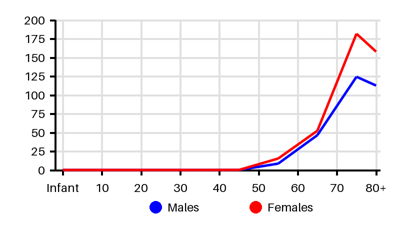
Incidence per 100.000 [eub][6tm]
Symptoms & findings
Symptoms
Fever, Malaise, Stiffness, Weight loss
Clinical findings
Elevated CRP, Elevated Sedimentation Rate
Anamneses
None listed.
Localized findings
Approach
Blood tests: Hb, WBC, TRC, ESR, CRP, anti-CCP, ANA, ANCA, tuberculosis tests, creatinine, liver function test, Calcium, ALP, TSH, fT4, creatine kinase, vitamin D [6tm][rsa]
Protein electrophoresis
Ultrasound of hips and shoulders: subacromial–subdeltoid bursitis, biceps tenosynovitis, glenohumeral joint inflammation and hip synovitis/trochanteritis
MRI: to rule out differential diagnosis
PET-CT: systemic inflammatory connective tissue disease
Diagnostic criteria [6tm]
2012 Provisional Classification Criteria for Polymyalgia Rheumatica: A European League Against Rheumatism/American College of Rheumatology Collaborative Initiative
Mandatory criteria:
Age ≥50 years
Bilateral shoulder aching
Abnormal CRP and/or erythrocyte sedimentation rate >40mm/h
Requires ≥4 points without ultrasound or ≥5points with ultrasound
Morning stiffness duration >45 min: 2 points
Hip pain or limited range of motion: 1 points
Absence of RF and/or ACPA: 2 points
Absence of other joint involvement: 1 points
At least one shoulder with subdeltoid bursitis and/or bicep tenosynovitis and/or glenohumeral synovitis (either posterior or axillary) and at least one hip with synovitis and/or trochanteric bursitis with/without ultrasound: 0/1 points
Both shoulders with subdeltoid bursitis, biceps tenosynovitis or glenohumeral synovitis with/without ultrasound: 0/1 points
Treatment
Glucocorticoids: Prednisolone 12.5–25 mg per day and gradually tapered by 2.5 mg per month down to 10 mg per day for a minimum of 12 months [6tm][mhw][abq]
Dose based on inflammatory activity, risk of relapse and risk of GC toxicity (diabetes, cardiovascular disease, osteoporosis, infections, cataract and glaucoma)
Vitamin D and calcium supplementation
Methotrexate 7.5–10 mg/week (if GC toxicity)
Azathioprine: 100–150 mg/day (limited evidence)
Disease‐modifying antirheumatic drugs (DMARDs): Tocilizumab, Sarilumab, TNF-α inhibitor
Differential diagnoses
Adhesive capsulitis, Amyloidosis, Ankylosing spondylitis, Cancer origo incerta, Depression, Dermatomyositis, Diabetes mellitus, Endocarditis, Fibromyalgia, HIV, Hyperparathyroidism, Hyperthyroidism, Hypoparathyroidism, Hypothyroidism, Leukemia, Lymphoma, Mononucleosis, Multiple myeloma, Obstructive sleep apnea, Osteoarthritis, Osteomalacia, Osteomyelitis, Parkinson's disease, Parvovirus B19, Polymyositis, Prostate cancer, Pseudogout, Psoriatic arthritis, Rheumatoid arthritis, Scleroderma, Septic arthritis, Sjogren syndrome, Spondylosis, Systemic lupus erythematosus, Temporal arteritis, Tuberculosis, Viral hepatitis
References
[1] Raheel S, Shbeeb I, Crowson CS, Matteson EL. Epidemiology of Polymyalgia Rheumatica 2000-2014 and Examination of Incidence and Survival Trends Over 45 Years: A Population-Based Study. Arthritis Care Res (Hoboken). 2017 Aug;69(8):1282-1285.
[2] Lundberg IE, Sharma A, Turesson C, Mohammad AJ. An update on polymyalgia rheumatica. J Intern Med. 2022 Nov;292(5):717-732.
[3] https://emedicine.medscape.com/article/330815
[4] Acharya S, Musa R. Polymyalgia Rheumatica. [Updated 2025 Aug 16]. In: StatPearls [Internet]. Treasure Island (FL): StatPearls Publishing; 2025 Jan-. Available from: https://www.ncbi.nlm.nih.gov/books/NBK537274/
[5] Samara, D. (2011). Prognosis and management of polymyalgia rheumatica. Universa Medicina, 30(1), 63–70.