Diagnosis
Endocarditis
Infection of the inner lining of the heart, which may include the heart valves, the mural endocardium, or a septal defect.
Also known as: Infective endocarditis
Etiology
Cause [3y8]
Native valve endocarditis (56.6%)
Prosthetic valve endocarditis (30.1%)
Device-related endocarditis (9.9%)
Microbe: [91h][nq3]
Acute endocarditis: Staphylococcus aureus (25-30%), group A/B/C/D/G streptococci, Streptococcus viridans
Subacute endocarditis: alpha-hemolytic streptococci, enterococci, HACEK (Haemophilus aphrophilus, Actinobacillus actinomycetemcomitans, Cardiobacterium hominis, Eikenella corrodens, Kingella kingae), Candida albicans
Pathophysiology [zq9][nq3]
Prodromal endocardial injury (catheter/electrode/surgery/IV drugs) --> Turbulence or trauma to the endothelial surface (fibrin-platelet vegetation)
Medical procedure (oral surgery, endoscopy) --> Bacteremia delivers the organisms
Adherence of the organisms
Eventual invasion of the valvular leaflets --> vegetations:
Septic emboli
Circulating immune complexes (glomerulonephritis and vasculitis)
Risk factors [zq9][nq3]
Previous endocarditis
Congenital heart disease (15% of cases, VSD, PDA, Fallot)
Intravenous drug use
Prosthetic valve
Degenerative heart disease (bicuspid aortic valve)
Rheumatic heart disease
Mitral valve prolapse
Intravascular device
Complications [zq9][nq3]
Valvular insufficiency --> heart failure (valve perforation, rupture of chordae tendineae and papillary muscles)
Myocardial infarction
Pericarditis
Cardiac arrhythmia
Myocardial abscesses
Sinus of Valsalva aneurysm
Arterial emboli
Mycotic aneurysms
Arthritis
Myositis
Glomerulonephritis
Acute renal failure
Stroke
Mesenteric abscess/infarction
Splenic abscess/infarction
Epidemiology
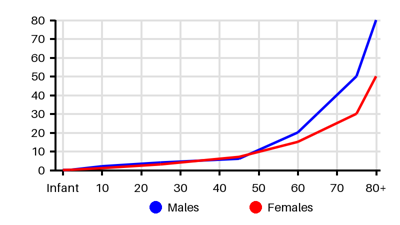
Incidence per 100.000 [tow][91h][3y8][qn7][w4d][s31]
Symptoms & findings
Symptoms
Anorexia, Aphasia, Arrhythmia, Arthralgia, Arthritis, Ataxia, Blindness, Chills, Coma, Confusion, Cough, Delirium, Dysphagia, Dyspnea, Fatigue, Fever, Headache, Heart murmur, Hematuria, Malaise, Myalgia, Nail clubbing, Neck stiffness, Night sweats, Pallor, Paralysis, Paresis, Paresthesia, Splenomegaly, Vomiting
Clinical findings
Anamneses
Localized findings
Approach
Blood test [zq9]
Blood culture
Echocardiography:
identify vegetations
characterize the hemodynamic severity
assess ventricular function and pulmonary pressures
detect complications
Transesophageal echocardiography
Cardiac CT
PET CT scan
Dukes clinical criteria for diagnosis
2 major criteria; or
1 major criterion and 3 minor criteria; or
5 minor criteria
Major Criteria
Blood culture positive for typical microorganisms consistent with endocarditis from 2 separate blood cultures: Viridans streptococci, Streptococcus bovis, HACEK group (Haemophilus spp., Actinobacillus actinomycetemcomitans, Cardiobacterium hominis, Eikenella spp., and Kingella kingae), Staphylococcus aureus; or community-acquired enterococci
Transesophageal echocardiogram:
Oscillating intracardiac mass on valve
Abscess
New partial dehiscence of prosthetic valve
New valvular regurgitation (worsening of pre-existing murmur not sufficient)
Minor Criteria
Predisposing heart condition, or injection drug use
Fever, temperature >38° C
Vascular phenomena: major arterial emboli, septic pulmonary infarcts, mycotic aneurysm, intracranial hemorrhage, conjunctival hemorrhages, and Janeway lesions
Immunologic phenomena: glomerulonephritis, Osler’s nodes, Roth’s spots, and rheumatoid factor
Microbiological evidence: positive blood culture but does not meet a major criterion as noted above or serological evidence of active infection with organism consistent with endocarditis
Treatment
American College of Cardiology - Practice Guidelines: [zgu]
Antibiotic therapy with guidance from blood culture sensitivity [nq3]
Native valve: Ceftriaxone 2 g/day + Gentamicin 3 mg/kg/day for 2-4 weeks
Prosthetic: Penicillin G 24 million IU/day or Ceftriaxone +/- Gentamicin for 6 weeks
MRSA: Vancomycin 15mg/kg/12hr or Daptomycin 8 mg/kg/day for 6-weeks
If embolism --> consider to temporarily discontinue anticoagulation
If pacer/ICD present --> remove hardware
Surgery if:
Valve dysfunction causing heart failure
Resistant organism (S.aureus, fungi)
Heart block or abscess
Persistent infection (>7 days after onset of antibiotics)
Relapsing prosthetic valve endocarditis
Persistent vegetations despite appropriate antibiotic therapy
Mobile vegetations greater than 10 mm in length
Differential diagnoses
Abdominal abscess, Antiphospholipid syndrome, Aortic dissection, Discitis, Heart failure, Intracerebral hemorrhage, Lyme disease, Meningitis, Myocardial infarction, Myocarditis, Myxoma, Pericarditis, Pleural empyema, Pneumonia, Polymyalgia rheumatica, Pulmonary embolism, Reactive arthritis, Rheumatoid arthritis, Stroke, Systemic lupus erythematosus, Temporal arteritis, Tricuspid regurgitation, Vasculitis
References
[1] Hammond-Haley M, Hartley A, Al-Khayatt BM, Delago AJ, Ghajar A, Ojha U, Marshall DC, Salciccioli JD, Prendergast BD, Shalhoub J. Trends in the incidence and mortality of infective endocarditis in high-income countries between 1990 and 2019. Int J Cardiol. 2023 Jan 15;371:441-451.
[2] Cresti A, Chiavarelli M, Scalese M, Nencioni C, Valentini S, Guerrini F, D'Aiello I, Picchi A, De Sensi F, Habib G. Epidemiological and mortality trends in infective endocarditis, a 17-year population-based prospective study. Cardiovasc Diagn Ther. 2017 Feb;7(1):27-35.
[3] Yallowitz AW, Decker LC. Infectious Endocarditis. [Updated 2023 Apr 24]. In: StatPearls [Internet]. Treasure Island (FL): StatPearls Publishing; 2025 Jan-. Available from: https://www.ncbi.nlm.nih.gov/books/NBK557641/
[4] http://emedicine.medscape.com/article/216650 (2014-01-18); [Medscape]
[5] Chen H, Zhan Y, Zhang K, Gao Y, Chen L, Zhan J, Chen Z, Zeng Z. The Global, Regional, and National Burden and Trends of Infective Endocarditis From 1990 to 2019: Results From the Global Burden of Disease Study 2019. Front Med (Lausanne). 2022 Mar 9;9:774224.
[6] Anuforo A, Aneni E, Akintoye E, Anikpezie N, Patel SD, Soipe A, Olojakpoke E, Burke D, Latorre JG, Khandelwal P, Chaturvedi S, Ovbiagele B, Otite FO. Trends in Age, Sex, and Racial Differences in the Incidence of Infective Endocarditis in Florida and New York. Circulation. 2024 Apr 23;149(17):1391-1393.
[7] Ahtela E, Oksi J, Porela P, Ekström T, Rautava P, Kytö V. Trends in occurrence and 30-day mortality of infective endocarditis in adults: population-based registry study in Finland. BMJ Open. 2019 Apr 20;9(4):e026811.
[8] Sousa, C., Nogueira, P. & Pinto, F.J. Insight into the epidemiology of infective endocarditis in Portugal: a contemporary nationwide study from 2010 to 2018. BMC Cardiovasc Disord 21, 138 (2021).
[9] Nishimura RA, Otto CM, Bonow RO, Carabello BA, Erwin JP 3rd, Guyton RA, O'Gara PT, Ruiz CE, Skubas NJ, Sorajja P, Sundt TM 3rd, Thomas JD; ACC/AHA Task Force Members. 2014 AHA/ACC Guideline for the Management of Patients With Valvular Heart Disease: executive summary: a report of the American College of Cardiology/American Heart Association Task Force on Practice Guidelines. Circulation. 2014 Jun 10;129(23):2440-92.