Diagnosis
Toxic epidermal necrolysis
A potentially life-threatening dermatologic disorder characterized by widespread erythema, necrosis, and bullous detachment of the epidermis and mucous membranes:
SJS: <10% skin detachment area
SJS/TEN-overlap: 10-30% skin detachment area
TEN: >30% skin detachment area
Also known as: Stevens-Johnson syndrome
Etiology
Cause [rmr][die][fmw]
Antibiotics: TMS, penicillin, glycopeptide, cephalosporin, aminoglycoside, quinolone, carbapenem, tetracycline, macrolide, chloramphenicol
Antiepileptic drugs: Carbamazepine, Lamotrigine, Phenytoin, Barbiturate, Valproate
NSAIDs
Allopurinol
Corticosteroid
Nevirapine
Abacavir
Infection: Mycoplasma, herpes simplex
Malignancy
Vaccination
Idiopathic
Pathophysiology [fmw]
Immune-related cytotoxic reaction characterized by:
Destruction of keratinocytes that express a foreign antigen --> epidermal necrosis
Epidermolysis --> blistering and bullous epidermal detachment
Severity of immune reaction:
Erythema multiforme (usually benign) may lead to -->
Stevens-Johnson syndrome (erythema multiforme major) may lead to -->
Toxic epidermal necrolysis
Mucous membrane involvement:
Gastrointestinal hemorrhage
Respiratory failure: pulmonary embolism, ARDS, and pneumonia
Ocular: corneal ulcer, xerophthalmia, meibomian gland dysfunction, panophthamitis, blindness
Genitourinary affection: stenosis, stricture, dyspareunia, phimosis
Complications [fmw]
Dehydration
Sepsis
Multiorgan failure
Death
Epidemiology
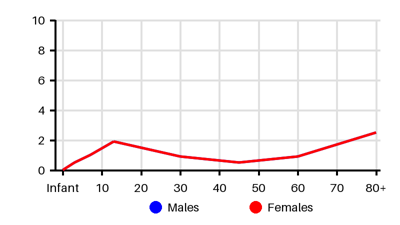
Incidence per 100.000 [6qm][7dv][vou][gsk][fmw]
Symptoms & findings
Symptoms
Anorexia, Arthralgia, Conjunctivitis, Cough, Diarrhea, Dyspnea, Fever, Headache, Hypotension, Malaise, Myalgia, Nausea, Pruritus, Sore throat, Tachycardia, Vomiting
Clinical findings
Anamneses
None listed.
Localized findings
Approach
Blood test: Hb, LPK, Trc, ASAT, ALAT
Urin: proteinuria
Skin biopsy
Erythema Multiforme [6qm]
Target lesions <3cm in diameter
No or only 1 mucous membrane involvement
<20% body are involved
Biopsy compatible with Erythema Multiforme (PCR --> Herpes Simpex DNA?)
Stevens-Johnson syndrome [6qm]
Target lesions <3cm in diameter
2 or more mucous membrane involvement
Fever
10-20% body are involved
Biopsy compatible with Erythema Multiforme
Toxic Epidermal Necrolysis [6qm]
Bullae and/or erosions >3cm in diameter with erythema and desquamation as seen in exfoliative erythroderma
Frequent mucous membrane involvement
Fever
>20% body are involved
Biopsy compatible with drug-induced toxic epidermal necrolysis
Treatment
Treat underlying disease and discontinue triggering medication [die][fmw]
Supportive care:
fluid replacement
nutritional support
pain relief
oxygen supplementation
skin care
antibiotics if superinfection
Therapeutic options:
Systemic corticosteroids
IV immunoglobulin
Plasmapheresis
Cyclosporine
TNF-α antagonists (infliximab, etanercept)
Differential diagnoses
Bullous pemphigoid, Drug eruptions, Erythema multiforme, Erythroderma, Paraneoplastic pemphigus, Pemphigus vulgaris, Photosensitivity, Staphylococcal scalded skin syndrome, Systemic lupus erythematosus, Toxic shock syndrome
References
[1] Fukasawa T, Urushihara H, Takahashi H, Okura T, Kawakami K. Risk of Stevens-Johnson Syndrome and Toxic Epidermal Necrolysis Associated With Antibiotic Use: A Case-Crossover Study. J Allergy Clin Immunol Pract. 2023 Nov;11(11):3463-3472.
[2] Hasegawa A, Abe R. Recent advances in managing and understanding Stevens-Johnson syndrome and toxic epidermal necrolysis. F1000Res. 2020 Jun 16;9:F1000 Faculty Rev-612.
[3] Labib A, Milroy C. Toxic Epidermal Necrolysis. Updated 2023 May 8: https://www.ncbi.nlm.nih.gov/books/NBK574530/
[4] Chan HL, Stern RS, Arndt KA, Langlois J, Jick SS, Jick H, Walker AM. The incidence of erythema multiforme, Stevens-Johnson syndrome, and toxic epidermal necrolysis. A population-based study with particular reference to reactions caused by drugs among outpatients. Arch Dermatol. 1990 Jan;126(1):43-7.
[5] Gillis NK, Hicks JK, Bell GC, Daly AJ, Kanetsky PA, McLeod HL. Incidence and Triggers of Stevens-Johnson Syndrome and Toxic Epidermal Necrolysis in a Large Cancer Patient Cohort. J Invest Dermatol. 2017 Sep;137(9):2021-2023.
[6] Antoon JW, Goldman JL, Lee B, Schwartz A. Incidence, outcomes, and resource use in children with Stevens-Johnson syndrome and toxic epidermal necrolysis. Pediatr Dermatol. 2018 Mar;35(2):182-187.
[7] Yang MS, Lee JY, Kim J, Kim GW, Kim BK, Kim JY, Park HW, Cho SH, Min KU, Kang HR. Incidence of Stevens-Johnson Syndrome and Toxic Epidermal Necrolysis: A Nationwide Population-Based Study Using National Health Insurance Database in Korea. PLoS One. 2016 Nov 11;11(11):e0165933.
[8] http://emedicine.medscape.com/article/229698; [Medscape]
[9] [Clinical Dermatology 4.th Edition by Weller, Hunter, Savin and Dahl]