Diagnosis
Respiratory acidosis
Respiratory muscle pump failure causing alveolar hypoventilation:
Hypercapnia (PaCO₂ >6.0 kPa)
Reduced HCO₃⁻/PaCO₂ ratio (normal range 0.5-0.7)
Acidosis (pH <7.35)
Also known as: Respiratory failure
Etiology
Causes: [oan][wiy]
Brain damage: Encephalitis, stroke, tumor, and spinal cord injury
CNS depressants: Opiate, alcohol, benzodiazepines
Pulmonary conditions (Dead space ventilation): Acute respiratory distress syndrome (ARDS), bronchitis, bronchiectasis, emphysema, COPD, pulmonary embolism, Interstitial lung disease, atelectasis, pneumonia, congestive heart failure, pulmonary edema
Chest wall and pleural disorders: Flail chest, kyphoscoliosis, hyperinflation, large pleural effusions, obesity-hypoventilation syndrome (Pick-wick syndrome), and thoracoplasty
Foreign body
Neuromuscular transmission: Amyotrophic lateral sclerosis, botulism, Guillain-Barre syndrome, myasthenia graves, organophosphate poisoning, poliomyelitis, spinal cord injury, tetanus, and transverse myelitis
Muscle abnormalities: Diaphragmatic paralysis, diffuse atrophy, muscular dystrophy, and ruptured diaphragm
Pathophysiology [oan][wiy]
The respiratory centers in the pons and medulla control alveolar ventilation
PCO2, PO2, and pH regulate the ventilation
The respiratory system provides O2 and removes CO2 in this equilibrium:
CO2 + H2O <--> H2CO3- <--> HCO3- + H+
Type 1 respiratory failure: Inadequate supply of oxygen --> hypoxemia
Alveolar hypoventilation, low atmospheric pressure/fraction of inspired oxygen, diffusion defect, ventilation/perfusion mismatch, and right-to-left shunt
Type 2 respiratory failure: inadequate removal of carbon dioxide --> hypercapnia
Respiratory pump failure (reduced respiratory frequency and intensity) and increased carbon dioxide production --> accumulation of CO2 --> decreased bicarbonate (HCO3-) --> lowering of pH (acidosis)
Metabolic compensation: kidneys excrete more acid (hydrogen and ammonium) and reabsorb bicarbonate
Epidemiology
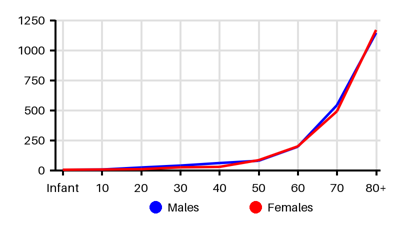
Incidence per 100.000 [oan][nym][fzy]
Symptoms & findings
Symptoms
Bradypnea, Cyanosis, Decreased consciousness, Dyspnea, Hypoventilation, Nail clubbing, Respiratory failure, Wheezing
Clinical findings
Acidosis, Elevated Intracranial Pressure, Hypercapnia, Hyperkalemia, Papilledema, Polycythemia, Pulmonary edema
Anamneses
None listed.
Approach
Blood test
Blood gas: elevated PCO2, elevated HCO3- (if chronic condition), and decreased pH
Capnometry
Pulse oximetry
Chest x-ray
Lung ultrasound
Urine stix
CT thorax
CT caput
Treatment
Airway
Breathing: Arterial oxygen tension (PaO2) > 60 mmHg or SaO2 > 90% [oan]
O2 supplementation if hypoxemia: Avoid O2 toxicity -> CO2 narcosis
Ventilatory support if hypercapnia (respiratory acidosis)
Indications for Mechanical Ventilation:
Apnea with respiratory arrest
Respiratory rate >30 breaths per minute
Disturbed conscious level or coma
Respiratory muscle fatigue
Hemodynamic instability
Failure of supplemental oxygen to increase PaO2 to 55-60 mmHg
Hypercapnia with arterial pH < 7.25
Circulation
Treat the underlying cause: Bronchodilators, naloxone
Differential diagnoses
Acute respiratory distress syndrome, Asthma, Atelectasis, Botulism, Brain stem injury, Bronchitis, Central sleep apnea, COPD, Cor pulmonale, Diaphragmatic paralysis, Drug side effects, Emphysema, Fat embolism syndrome, Myocardial infarction, Neuromuscular disease, Obesity-hypoventilation syndrome, Obstructive sleep apnea, Pleural effusion, Pneumoconiosis, Pneumonia, Pneumonitis, Pneumothorax, Pulmonary edema, Pulmonary embolism, Pulmonary fibrosis, Pulmonary hypertension, Respiratory failure, Scoliosis, Shock, Spinal cord injury
References
[1] Mirabile VS, Shebl E, Sankari A, et al. Respiratory Failure in Adults. Updated 2023 Jun 11: https://www.ncbi.nlm.nih.gov/books/NBK526127/
[2] Patel S, Sharma S. Respiratory Acidosis. [Updated 2023 Jun 12]. In: StatPearls [Internet]. Treasure Island (FL): StatPearls Publishing; 2025 Jan-. Available from: https://www.ncbi.nlm.nih.gov/books/NBK482430/
[3] Suh ES, Hart N. Respiratory failure. Medicine, Volume 40, Issue 6, 293 - 297.
[4] Chung Y, Garden FL, Marks GB, Vedam H. Population Prevalence of Hypercapnic Respiratory Failure from Any Cause. Am J Respir Crit Care Med. 2022 Apr 15;205(8):966-967.